
Against the Current - Rock Digging
Mr. Ly Pha Da next to a 30-year-old rock peach tree. Ancient, moss-covered peach branches, worth millions of dong, are a major attraction for peach tree collectors and an opportunity for many to make money during Tet (Lunar New Year). It is precisely the valuable material and spiritual value that the hobby of collecting rock peach trees brings that has led to the indiscriminate cutting down of these trees in the Mekong Delta...
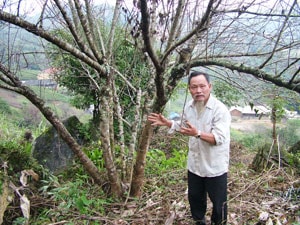 |
| Mr. Ly Pha Da next to a 30-year-old rock peach tree. |
Going to Nam Can to dig for stones.
Breaking through the thick fog that enveloped the mountains and forests in the near-freezing cold of nearly 0°C, we arrived at the Nam Can International Border Gate. In previous years, after crossing the Noong De pass following the full moon of the twelfth lunar month, the National Highway 7 was covered in the vibrant colors of peach blossoms. This year, however, there were only a few scattered peach blossom branches, occasionally brought back by a few households from the Mong villages of Truong Son and Tien Tieu. The Nam Can International Border Gate was bustling with people and vehicles entering and exiting the country on the last day of the year. After waiting for almost two hours, we finally saw three trucks carrying peach blossom branches approaching from the Ban border gate. Posing as a peach blossom trader, I immediately approached the truck owners and learned that these were Mr. Hoang Van Giau (Yen Thanh) and Mr. Nguyen Minh Duc (Vinh City), owners of a carpentry and construction cooperative from Pol Xavan town (Xieng Khouang - Laos), who were returning home for Tet (Lunar New Year) and bringing back a few branches as gifts, not for sale. Mr. Duc said: "Last year, we brought back about the same amount, but when we went down to Muong Xen, we saw that peach blossoms were fetching a good price, and there were plenty available in Noong Het, so we had the trucks return and make several trips, earning a decent amount. This year, however, peach blossoms are very rare in Laos, and there aren't many beautiful branches. We had to order these branches quite a while in advance from people in remote mountainous areas."
Still posing as a peach blossom vendor, I went down to the Mong Tien Tieu village in Nam Can commune to approach some local peach blossom sellers. Ho Dua Chay's house, located right next to the main road, had a few freshly cut peach blossom branches with a layer of yellow sap still clinging to the underside. Seeing a customer, Dua Chay was overjoyed and rushed out, speaking broken Vietnamese: "You want to buy peach blossoms? These are freshly cut branches from the fields! Each branch is 30,000 dong. I only have 4 branches now; if you want more, you'll have to wait 2 days and pay a deposit of half the price in advance..." According to Dua Chay, peach blossoms near the road are no longer available; you have to go up to the high fields, a 3-hour walk to get there. Beautiful peach blossoms can only be found in Pha Vien and Long Quang villages (Noong Het - Laos), not in Ky Son. Last year, Dua Chay sold about 20 branches, while Ho Lenh Chu sold the most in the village, with 40 branches. A few years ago, in Tien Tieu village, out of more than 70 households, nearly half would go to the fields to cut peach blossoms to sell during Tet. This year, the peach blossoms haven't bloomed yet, and seeing customers asking for them, they feel regretful and just stand at their doors looking up at the hill.
"Mr. Da quarrying stones"
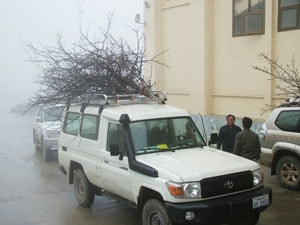 | 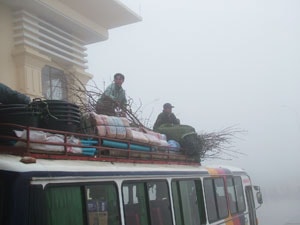 |
| Excavated rocks are transported across the Nam Can border gate. |
While the traditional "stone peach" (Lao or Hmong peach) is being indiscriminately cut down for commercial sale during Tet (Lunar New Year), a garden of "stone peach" trees in full bloom remains intact in Truong Son village (Nam Can). On an area of 2 hectares, Mr. Ly Pha Da has planted 700 trees arranged in contour rows from the edge of National Highway 7 upwards. Following Mr. Da's directions, I went up to visit the garden. I had known about "stone peach" trees for a long time, but this was my first time seeing an entire garden with many varieties in full bloom. The moss-covered, gnarled branches of the peach trees twisted and turned in bizarre ways, thanks to Mr. Da's meticulous care and shaping. The old, gnarled branches carefully held round buds in a water-like pattern, waiting to burst open when spring arrived. Mr. Da said that he obtained the peach tree saplings from Noong Het and began planting them in 1975 after he moved from Puc San village to live here. After more than 30 years, his peach orchard has three main types of grafted peaches from Laos: the bullhorn peach, the flexible peach, and the bird-flower peach, with the bullhorn peach being the most beautiful. Mr. Da said that he used to grow peaches for their fruit, but due to the demand from customers who wanted to admire them, he pruned some branches to sell the flowers. Last Tet (Lunar New Year), he sold 100 branches, earning 4 million VND. With the extra funds, he grafted and planted another 450 new trees. According to him, to prevent the peach trees from being affected in subsequent seasons, pruning must be done carefully, avoiding haphazard cuts, and after pruning, the branches must be shaped and trained to create the desired form for the new branches. He is very worried that with the current rate of deforestation, the Mong ethnic group's stone peaches will soon disappear.
There will only be stories left.
After the Japanese peach blossoms of all shapes and sizes faded from the traditional Tet holiday, the ancient and mysterious stone peach blossoms took the top spot. Their unique beauty and commercial value have made stone peach blossoms a sought-after commodity for traders and locals alike. In Ky Son district, stone peach blossoms are transported downstream not only via Nam Can but also from Tay Son, Muong Long, Huoi Tu, and from Na Ngoi and Nam Can along the Kien stream... And the journey of these branches is carried on all kinds of vehicles, from trucks, buses, tankers... to motorbikes, cars... even smuggled goods vehicles? It's impossible to count how many vehicles carry peach blossoms and how many branches are transported each Tet holiday, but it's known that stone peach blossoms are becoming increasingly scarce. According to some residents of Muong Xen town, it's very difficult to buy beautiful stone peach blossom branches for Tet this year. The stone peach tree is facing a serious threat of destruction, directly affecting the survival of a natural tree species within the system of protective forest trees. The stone peach tree will remain a valuable asset if more people of the Hmong ethnic group, like Mr. Ly Pha Da, understand its spiritual and cultural value and preserve and protect it.
Report by: Huu Nghia



;)