
People of Bai Ngang
(Baonghean) - Coastal residents of Nghe An province call the beach "Bai Ngang" (horizontal beach). Bai Ngang in Nghe An stretches from the northernmost point of Dong Hoi to the middle of Deo Ngang Pass, a place where, in the time of the Dung and Doang couple who created the mountains, rivers, fields, and many valuable mineral resources and a pristine living environment, it was a place of great importance...
(Baonghean) - Coastal residents of Nghe An province call the beach "Bai Ngang" (horizontal beach). Bai Ngang in Nghe An stretches from the northernmost point of Dong Hoi to the middle of Deo Ngang Pass, a place where, in the time of the Dung and Doang couple who created the mountains, rivers, fields, and many valuable mineral resources and a pristine living environment, it was a place of great importance...
Coastal dwellers call the East Sea "sea fields" (water surface fields), creating unique means of seafaring, and they also coined the phrase "building rafts and making boats" commonly used in communication. From birth, people in coastal areas breathe in the cool sea breeze, immersing themselves in the echoes of waves and the murmur of casuarina forests. Growing up amidst the waves and winds, their youth is marked by maturity; the boys of the coastal region, their voices breaking, learn to speak with strength and decisiveness. They spend one part of the day at school and the other following their fathers and brothers to sea, developing a natural aptitude for understanding the annual fish migration patterns, with two breeding seasons near the shore, allowing them to plan for catching the southern and southern fish.
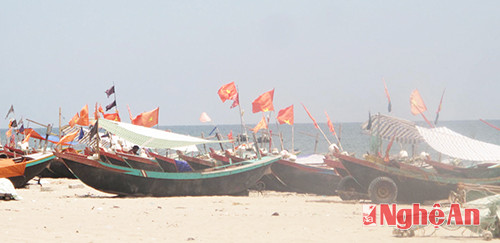 |
| The boat returned to the shore. |
Understanding the sea allows them to be connected to it for life. These veteran fishermen grasp the positions of warm and cold ocean currents, the shallow and deep points of the shore, and the tide cycles. They observe the sunset, gaze at the moon and stars to understand the wind direction, the living space, and the behavior patterns of various marine species underwater.
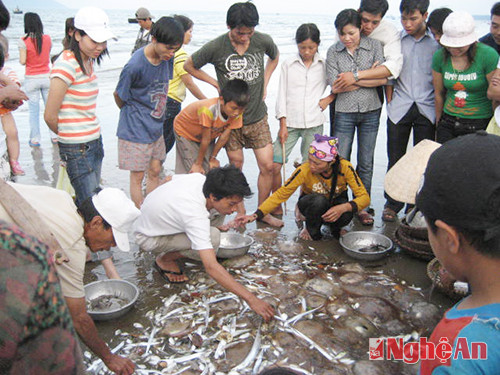 |
| The joy of "the fish coming home". |
Estuaries, with their vast open spaces, are where the characteristics of the sea and river intersect, providing an ideal environment for people and species to thrive and multiply. The people of the coastal areas are as open and expansive as the estuaries themselves:
"It's a door, but it has no lock."
It never truly closes.
A vast expanse of water
"Unfolding a multitude of expectations."
(Poem by Quang Huy)
The salty essence of the sea flows naturally in their blood, permeating their tanned, uncorroded skin. They travel by boat, passing through the same unlocked gateway, but the coastal people are precise in their terminology, referring to "going to the sea" and "entering the river." They use the same concept of "gate," but differentiate their names according to the sea route: When traveling from offshore towards the shore, it's called a "river gate," while when traveling from inland towards the sea, it's called a "sea gate." That is, calling it a "sea gate" or "river gate" must be linked to the destination they are heading towards. "Going to the sea" and "entering the river" are the standard ways of thinking for coastal people.
Natural conditions are also one of the reasons why the inhabitants of the coastal areas have established taboos, prohibitions, and spiritual beliefs, enriching their spiritual lives. These age-old beliefs have contributed to the unique cultural identity of the region, cherished and preserved by generations and reflected in unique festivals such as the Fishing Festival, the Rain-Praying Festival for abundant harvests, the custom of considering the Whale God as a "mermaid" and burying and worshipping "mermaids" as if they were their parents, and the boat racing festival, a kind of river sports festival. Generations of residents in the coastal areas of Nghe An province have also established and enhanced a dense network of cultural and historical architectural works in the villages and communes of the region.
Fishermen in the Dan Nhai - Cua Hoi and Cua Lo areas, who work at sea year-round, often visit the Corn Temple to pray and are always blessed with peace and safety by the sacred and powerful deity Ngoc. Similarly, fishermen from Hoi Thong village (now Xuan Hoi commune, Nghi Xuan district, Ha Tinh province) also frequently visit the Corn Temple to offer incense and sincerely pray, and are granted permission by the Four Holy Mothers to bring the deity's spirit to be worshipped in their village. Like the Corn Temple in Quynh Phuong, the Dai Can Temple (also known as the Ca Temple) in Hoi Thong village, which worships the Great National Deity of the South Sea and the Four Holy Mothers, has received eight royal decrees from the Le Dynasty to the six Nguyen Dynasty emperors, making it the oldest temple in Ha Tinh province.
Through vivid visual representations of cultural and historical architectural works in their homeland, the coastal residents educate their children and grandchildren to remember their ancestral roots, rekindling the nation's tradition of self-reliance, thereby affirming the truth: For generations, the coastal people have possessed a resilient spirit and a steadfast stance, standing firm amidst the waves and winds on their own two feet…
Text and photos:Diocese


