
People in Nghe An province are getting rich from providing logistics services for the fishing industry.
(Baonghean) - With over 82 km of coastline and an annual catch exceeding 100,000 tons, Nghe An's fisheries industry has driven the strong development of other onshore industries, contributing to improving the lives of people in coastal areas.
Rich on the shore
With 319 boats and over 2,000 workers engaged in fishing at sea, Tien Thuy commune currently has 14 fuel kiosks and 28 ice production facilities serving the fishing fleet. Mr. Nam Giang, manager of the Lach Quen fuel station, said: "Our facility has two fuel outlets at Lach Quen port, selling an average of over 35,000 liters of fuel per month to about 15 boats, not only from Tien Thuy but also from Quynh Long. Revenue from fuel sales is approximately 300-350 million VND per month, and after deducting all expenses, we earn over 30 million VND."
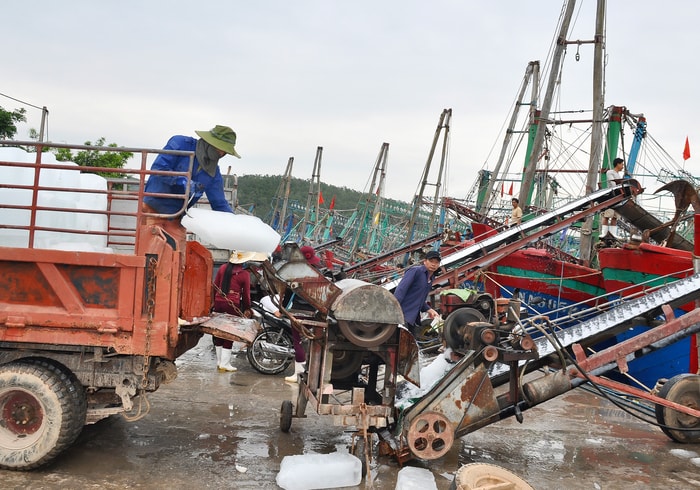 |
| Fishermen prepare ice to preserve seafood before heading out to sea at Lach Quen port. Photo: TH |
Also in the Lach Quen area, Mr. Ho Dinh Ngoc's ice production facility has to operate continuously to meet the needs of the fishermen. Mr. Ngoc said that each month, his facility sells nearly 20,000 ice blocks to over 30 boats and ships, bringing in revenue of over 240 million VND, with a profit of nearly 50 million VND per month after deducting expenses.
Mr. Nguyen Do Tuong, residing in Duc Long village, Quynh Thuan commune, has only lived at Lach Quen fishing port for four years, but his family has already become wealthy from providing logistical services for the fishing industry. His business supplies fishermen with everything from nets and fishing gear to ice and fuel, averaging around 100 million VND per trip. After deducting expenses, his family earns 40-50 million VND per month.
The entire Quynh Luu district currently has over 1,280 fishing vessels with a total engine capacity of 250,020 horsepower. To supply raw materials for these vessels operating offshore, nearly 40 fuel stations and almost 50 ice production facilities are operating regularly in the coastal areas and estuaries. Each month, these facilities supply over 7 million liters of fuel and 25,000 tons of ice to meet the needs of the district's fishing fleet.
According to statistics, Nghe An currently has over 70,000 workers in the fisheries sector, including over 18,000 in fishing, approximately 5,000 in processing, and over 10,000 in fisheries logistics services and shipbuilding and repair. |
Exporting Nghe An's seafood products.
Currently, in 11 coastal communes of Quynh Luu district, there are more than 400 households involved in purchasing and processing seafood, with a wide variety of products such as fish sauce, shrimp paste, dried fish, and peeled shrimp... In addition to domestic consumption, products are exported through unofficial channels to China, and some processed products such as fish fillets and frozen products are exported to Russia and EU countries.
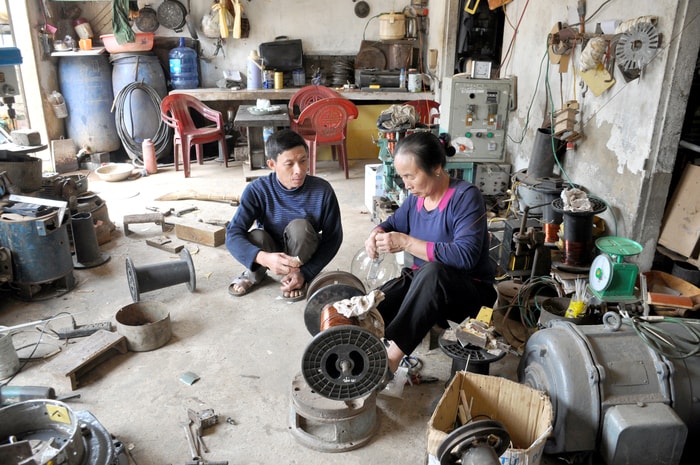 |
| The production facility for household goods serving the fishing industry, owned by the Nguyen Thai Bai family, is located in Duc Xuan hamlet, Tien Thuy commune (Quynh Luu district). Photo: TH |
In Hamlet 9, the only predominantly Catholic hamlet in Son Hai commune, although only 20% of households are involved in fishing logistics and processing, with the remaining 80% being fishermen, many households in the hamlet have become well-off or wealthy thanks to their long-standing commitment to these professions. The Bui Van Chau family has a traditional fish sauce making business. With over 100 fermentation vats, each containing 160 kg of fresh fish, he sells thousands of liters of delicious fish sauce annually to markets both within and outside the province, bringing in a considerable income.
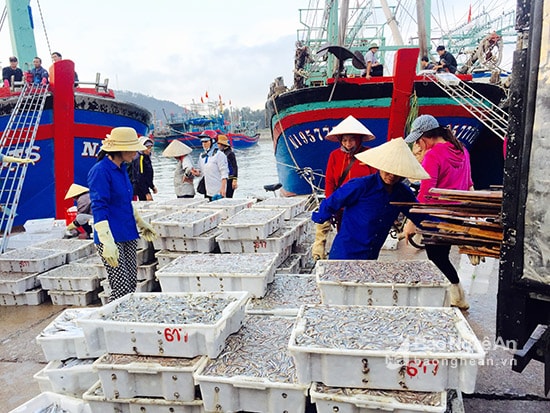 |
| Fish purchasing at Lach Quen fishing port. (Photo: Archival image) |
Along with Quynh Luu district, Hoang Mai town is a locality with a strong fishing industry that plays a leading role in economic development. The town currently has 896 fishing vessels, of which 397 have a capacity of over 90 horsepower. Mr. Hoang Ngoc Thuy, Head of the Economic Department of the Hoang Mai Town People's Committee, said: To contribute to the consumption and increase the value of fishing products, the seafood processing industry has developed very strongly in Hoang Mai. Currently, there are 2 seafood processing villages (Phu Loi and Phuong Can); 5 limited liability companies; 15 facilities processing dried and steamed seafood; 35 collection and preliminary processing facilities; 64 cold storage warehouses with a total capacity of over 2,500 tons; and over 500 facilities and households processing shrimp paste and fish sauce. The total processing output in 2016 reached over 13,500 tons.
The marine logistics supply services have also developed strongly. The entire town has 12 shipbuilding and repair workshops to meet the development requirements for building, modifying, and repairing fishing vessels for fishermen in the area. Of these, 2 workshops have been approved by the Provincial People's Committee as having sufficient capacity to build new fishing vessels according to Decree 67; 26 ice production facilities with a total capacity of over 25,000 tons/year; 14 fuel stations and 8 oil tankers supplying approximately over 12 million liters of fuel annually to fishing vessels.
The operation of cold storage systems, in addition to playing an extremely important role in the large-scale, centralized purchase and export of seafood products from fishermen, is also an effective economic development direction for people in coastal areas. Ms. Nguyen Thi Dao's family in Quyet Tien Hamlet, Quynh Phuong Ward (Hoang Mai Town) has three cold storage facilities with a total capacity of up to 170 tons of goods. After the marine environmental incident, business slowed down for a period, but since October 2016, the main products, mackerel and scad, have started to be consumed strongly again. Ms. Dao said that currently, her family's facility sells about 5 tons of seafood retail to local traders, and nearly 10 tons wholesale to Vinh City and the provinces of Thanh Hoa, Hai Phong, and even to the Lao market. Prices have increased and stabilized.
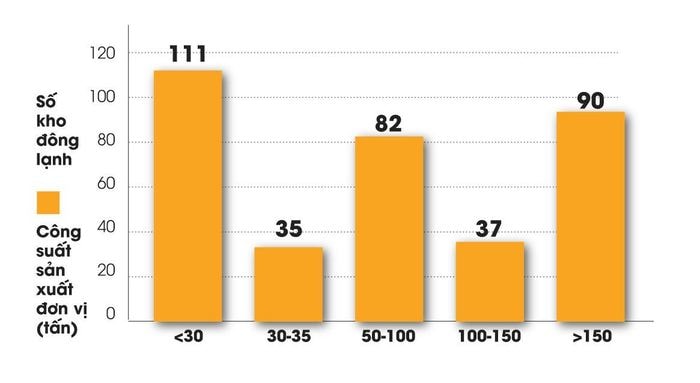 |
| Diagram of a cold storage system with ice production capacity. Graphic: Nam Phong |
It can be seen that logistics and seafood processing services are developing strongly in all coastal localities such as Quynh Luu, Hoang Mai town, Dien Chau, Nghi Loc, and Cua Lo town. The operation of cold storage systems, in addition to playing an extremely important role in purchasing and selling large quantities of seafood products from fishermen, is also an effective economic development direction for people in coastal areas.
This demonstrates that not only offshore voyages bring economic value, but also contribute to the efficient development of logistics, freezing, processing, and export services.
Phu Huong
| RELATED NEWS |
|---|


