
The man left his arm on Hill A1.
(Baonghean)From birth until now (86 years old), he has borne the name given to him by his parents; a gentle name, like the name of the land and village, simple and unassuming like the people of Nghe An: Vo Van Khuyen. His mother gave birth to him in 1929, a year later when the entire village of Phu Van and the whole district of Hung Nguyen were ablaze with the spirit of the Nghe Tinh Soviet Uprising. Growing up, Vo Van Khuyen had two sources of pride: firstly, being a citizen of the heroic Nghe An Soviet, and secondly, being from the same village and commune as the martyr Pham Hong Thai - who bombed the party of Governor-General McLanh on the night of June 18, 1924.
In 1945, Vietnam gained independence and became a sovereign nation, but the French colonialists wanted to return and conquer our country a second time. The Bình Trị Thiên region was engulfed in flames, and the Lô River roared, drowning the corpses of enemy soldiers.
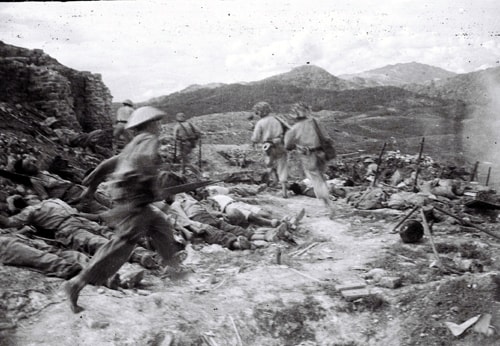 |
| Our infantry charged forward and annihilated the French forces at Hill A1. (Photo: VNA) |
One bitterly cold afternoon in late 1950, the young men of the village gathered before the temple of King Le, the familiar land suddenly becoming sacred before their farewell. Young Vo Van Khuyen bid farewell to the bamboo groves of Phu Van village, joining the army and singing loudly, "Let's go, brothers..." Dressed in a brown uniform, without a hat or shoes, he set off to join the army. After training in Dien Chau, his unit traveled along Highway 48, then followed the red dirt road of Phu Quy to Cam Thuy, Ba Thuoc, Kim Tan, Thach Thanh (Thanh Hoa), and finally to the slopes of Cun and Kem (Hoa Binh). His footprints were imprinted on battlefields from Hoa Binh, to Upper Laos, and to the furthest reaches of the border.
In late 1953, as the deputy platoon leader of the 102nd Regiment, Comrade Hung Sinh commanded the 308th Division, which was then commanded by Comrade Vuong Thua Vu, the division commander, and Comrade Song Hao, the political commissar. The 308th Division, known as the vanguard division, was the first to arrive at Dien Bien Phu. The "Determined to Fight, Determined to Win" flag, bestowed by President Ho Chi Minh upon each division and each military region, instilled determination and courage in the soldiers throughout the campaign.
Before the fighting broke out, his unit had only one task: digging trenches. They dug at night and withdrew during the day, about 2,000 meters from the battlefield, only for the enemy to send tanks and soldiers to destroy them… and then they dug again at night. For months they lived in constant rain, sleeping in bunkers, and eating dried rice rations, as the encirclement of trenches gradually tightened from 300 to 200 meters. Regiment 102 was tasked with penetrating deep into Hill A1. Due to its strategically important location, Hill A1 became the strongest resistance stronghold in Dien Bien Phu, comprising numerous machine gun emplacements, loopholes, and fortified underground bunkers. Surrounding it was a system of pillboxes on Hills C1, D1, D2… constantly providing support and reinforcements to A1.
On the morning of March 30, 1954, our troops advanced on Hill A1. Dozens of planes roared overhead, and artillery from Muong Thanh fired intensely to defend Hill A1. All kinds of weapons—cannons, mortars, 60mm and 82mm mortars, machine guns—fired incessantly. The A1, C1, and D1 strongholds were engulfed in smoke and fire. We occupied half of Hill A1, while the other half belonged to the enemy. The fighting raged on, vying for every square meter and every trench, with both sides suffering heavy casualties. During those days of fierce, continuous fighting, soldiers ate rations while firing their guns and moving in the direction of their unit's advance. The battle became increasingly brutal and bloody, "blood mixed with black mud," yet the determination to win of the Dien Bien Phu soldiers remained unwavering. On the afternoon of April 1st, while throwing a grenade at the enemy, Mr. Vo Van Khuyen was hit by a 60mm mortar shell that severed his left arm. Two soldiers bent down to lift him onto a stretcher and carried him to the back. The stretcher dragged along the ground for less than 10 meters when a shrapnel fragment struck the soldier in the abdomen. Blood gushed out, and he collapsed onto the stretcher. That soldier was killed! He, however, was saved. Later, while recovering from his wounds, Vo Van Khuyen learned that our troops had dug an underground tunnel all the way to the foot of Hill A1 and detonated a ton of explosives to bring down this fortified stronghold.
In the spring of 1955, when the peach blossoms bloomed, people came together in warmth and love. Phan Thi Huong, then 22 years old and a women's affairs officer in Hung Khanh commune, welcomed him home from the convalescent center as part of the "Welcoming the Wounded Soldier Back to the Village" movement. That young woman became his wife.
For over 50 years, Mr. Vo Van Khuyen has carried a deep sense of nostalgia, a mark etched into his very being. In early 2007, he and 15 officers made a trip to Dien Bien Phu, revisiting the old battlefield. After spending a day in Hanoi visiting the Ho Chi Minh Mausoleum, the next day the vehicle followed National Highway 279 to Tuan Giao, then turned onto Highway 6, crossing the Pha Din Pass… The Northwest sun cast a magical golden hue, filling his heart with a mix of familiar and strange emotions: “Where did we march, where did we intercept the enemy…?”
The car stopped beside the cemetery, rows of tombstones lined up neatly side by side. Everyone lit incense to pay respects to their fallen comrades, the smoke rising in circular plumes against the blue sky. Mr. Vo Van Khuyen stood silently, his eyes welling up as if searching for someone buried beneath the grave. "Comrade! Where are you buried? Your blood and flesh have become wind and mist, making the sky of Dien Bien even bluer…" In the shimmering golden sunlight, his vision blurred; the image of the fallen soldier lying on the stretcher, covered in blood, yet with the innocent, bright face of a 20-year-old.
Mr. Vo Van Khuyen retired by the Nam Ton River (Quang Hung hamlet, Chau Quang commune, Quy Hop district) to a place with lush gardens, ponds, and fruit trees. His children have grown up and become successful: Mr. Vo Van Dung, a disabled veteran (category 4/4), now owns a sawmill and produces wooden furniture. Mr. Vo Van Doai is a serving officer in Military Region 4. During our conversation, Mrs. Huong told us: “To be honest with you, we are very happy to have this now. Life was very hard in the past; we lacked everything, from money to rice; our houses were dilapidated, nothing like today.”
Mr. Vo Van Khuyen, a wounded veteran and former Dien Bien Phu soldier, still lives like everyone else. In his distant memories, there remain countless bittersweet recollections of a time of war, like the waters of the Nam Ton River still stirring with the sound of his heart.
Nguyen Van Nhi
Chau Quang Commune - Quy Hop District


