
The beauty of Quy village
(Baonghean) - The Thi River embraces the upper half of Quy Village like the flowing hair of a beautiful girl. Perhaps it's because they drink the water of the Thi River that most of the girls here are beautiful. Their beauty is charming and gentle, like the young cornfields beside the tranquil, ever-flowing river...
At sixteen, I moved from the city to my village, staying at my maternal grandfather's house. My parents said it would be hard to go astray in the countryside. Most students in Quỳ village spent their time tending buffaloes in the morning and attending school in the afternoon. On my first day in the village, I was very sad. I was sitting by the riverbank watching the water flow when I heard a voice:
Hey, I had a real scare yesterday.
- Why?
He held my hand and then kissed me.
- And then what?
- I ran away in panic.
- So you're not seeing him off today?
No, I'm too shy. He said he would write to me.
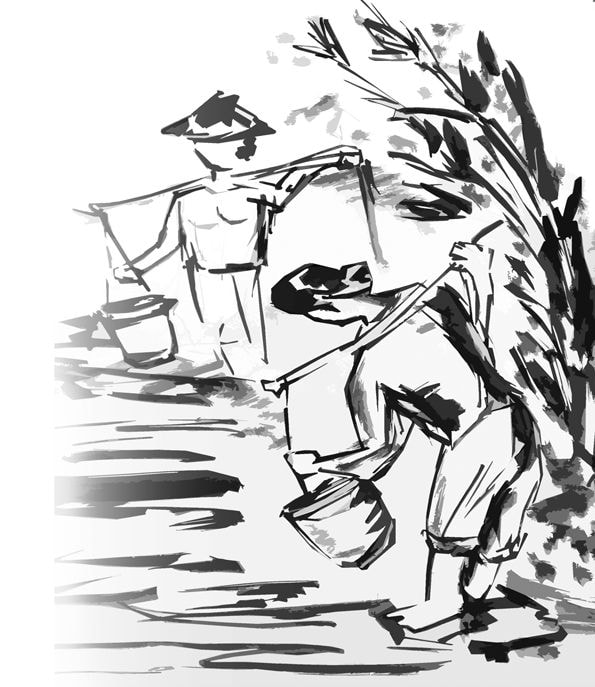
The voices of two girls, or rather, two sisters around nineteen or twenty years old. One, wearing a brown dress that hugged her slender figure, was bending down to scoop water with two buckets. On the bank, the lush young cornfield swayed in the breeze, a breathtakingly beautiful sight.
A few months later, having become accustomed to village life, I became close friends with Tú, whose house was separated from my maternal grandfather's by a clear village pond. Tú was in the same class as me; Tú was better than me in Literature, while I was better than Tú in Math. Therefore, when I joined the same class, Tú proactively came to my maternal grandfather's house to get acquainted and ask for help with homework. I wasn't a better student than Tú, but because I had access to reference books earlier, I knew how to solve math problems that Tú didn't know.
Tú and I often studied in the outer house. It was an earthen house with a thatched roof. The three outer rooms were the common living area for the whole family, while the two side rooms were where Tú's mother and older sister slept. Tú's older sister was the girl I first met by the riverbank when I first arrived in the village. She had her hair neatly tied up, but occasionally she would let it down like a sudden downpour. Any boy lucky enough to see her then would be captivated by her beauty.
 |
One time, Tú and I were studying in the outer room when we heard sobbing. We went downstairs and saw Tú's older sister, Thanh, with red eyes, holding a letter. She said:
- You two read the letter for me, then I'll boil some corn and we'll eat it together.
I held the letter, reading through all four pages. The handwriting was dense, filled only with love and longing. At the bottom, the signature read: Nguyen Tien Toan. At the beginning of the letter was a drawing of a gun with a rose branch on its barrel. The rose was skillfully stylized, with the letters T's faintly intertwined.
Tú and I went upstairs to study, and I asked Tú:
- Is Ms. Tú illiterate?
- My sister wasn't allowed to go to school. My mother said: girls who study too much only end up arguing with their husbands.
- My mom also finished college, but she never argued with her husband.
- I don't know, that's what my mom told me.
In Quỳ village, my mother was the only woman who completed high school, went to college, and then settled in the city. Many girls in the village were illiterate. During the literacy campaign, some attended classes, but over time they forgot how to read. Later, the government and schools encouraged girls to attend school, but some families still refused. Quỳ village is like an oasis, bordered on one side by the Mai River and on the other by a vast field, further separated by the expansive Thủy Hội swamp. It is little affected by the outside world.
Toan kept writing letters to Thanh regularly. Each time, Thanh would ask me or Tu to read the letter, and we would get to eat boiled sticky corn. Therefore, every time the postman delivered the mail to the village, we were overjoyed. We were less happy about getting the boiled corn and more excited about our curiosity. Seeing Thanh's name on the stack of letters, we'd grab them and rush back to show her.
Toan was a military engineer. He stayed in Quy village for six months, building a pontoon bridge across the Thi River before leaving. During the two months he was in the village, his sister grew rapidly, like rice plants after a heavy rain. She started wearing bras to discreetly conceal her breasts under her clothes, like someone hiding a ripening fruit.
During my three years of high school in the village, Tú and I took turns reading and copying letters for Thanh, then going to the post office to send them to Toàn. Those passionate love letters are still vividly etched in my mind to this day. All the longing, promises, village stories, and unit matters made Tú and I love the life of a soldier in the engineering corps even more. So much so that we made a promise to each other that after finishing high school, we would both apply to the Engineering Officer School so that one day we could be like Toàn.
Once, Thanh wrote a letter to Toan, which included the passage: "The pontoon bridge you built across the Thi River is now in the flood season. Every time we cross the river, we miss you, we miss the soldiers. When will you come back so we can go to the bridge to welcome you like we did when you returned to the village?" Then Toan sent a letter back, and I read it to Thanh. Once, I jokingly told her I misread the content, making her cry. That time, Toan recounted how his unit was building a pontoon bridge in the waterways of Southern Vietnam, and a Khmer girl was swept away by the current while washing clothes in the river. Luckily, he and his comrades managed to rescue her in time. I also read another passage about how the girl insisted on following Toan to the North to become his wife. And so, I spent my adulthood in Quy village, and Thanh's love story with Toan became a part of my life.
In my final year of high school, Thanh once told me:
- Tomorrow, you and Tan (my name) will go to the riverbank to pick some corn to boil, okay?
The next day, I went to the riverbank and, as usual, sat reading her letter. Occasionally, I would look up at her hair, which was loose, revealing a patch of her neck and shoulders as white as a half-peeled banana. Thanh looked at me and smiled, revealing her white teeth and a smile as bright as moonlight shining into the eyes of the person opposite her. She said:
- When Tan returns to the city, will he ever come back to Quy village again?
"As long as you still remember me," I said, my voice mumbling like a schoolboy who hadn't memorized his lesson.
The next time, my sister and I went to the banks of the Thi River, where the grass was as smooth as the skin of a teenage girl. She sat there, gazing into the distance, but still listening to every word I read:
“He’s receiving treatment at Hospital A in the Southwest of our country…” That day, I saw Thanh crying again. Her tears were like drops of acid seeping into my heart, causing excruciating pain…
Then I went to university, far away from Quy village. During my years of study, life swept me away, and Quy village faded from my mind, just like Thanh's hair, like a hazy cloud on the distant horizon.
Tú didn't go to the same school as me; he attended military school. As for me, after romantic days in Quỳ village with dreams of becoming an officer and a beautiful love story like Toàn's, I followed my father's advice and became a transportation engineer after 5 years of university.
Once, I worked with an engineering unit. Working alongside me was a major who was wounded and limped slightly. After work, we sat and chatted, and he poured out his heart when he asked about Quỳ village and the Thi River from those days. Through him, I relived my high school days in Quỳ village. I remember Thanh, whose hair flowed like the Thi River, forming a seductive curve. The wounded soldier recounted: Toàn died after saving a Khmer girl by the river that year. A week after Toàn's death, the unit received a letter from Thanh. Being Toàn's close friend, he decided not to tell Thanh the sudden news. Regularly, he wrote letters on Toàn's behalf, gradually trying to help Thanh forget Toàn and find new happiness. Then he lied, saying Toàn was seriously wounded and needed a long period of recuperation at a military camp in the far southwestern region. When I returned to the city, I visited her home to say goodbye. Thanh said:
- Everyone's leaving, hardly anyone's left in the village. Tan, when you come back later, I'll probably be an old woman by then!
I walked on, the village of Quỳ, Sister Thanh lingering behind me like a question mark or a debt, not knowing when I would ever be able to repay it...
Short stories byTuyen Duy
Yen Thanh


