
'Leaders must be truly exemplary and willing to take responsibility.'
(Baonghean) - Baonghean Newspaper had an interview with Comrade Nguyen Quang Tung - Standing Deputy Secretary of the Party Committee of the Provincial Agencies Bloc - about the model of unifying the positions of Party Secretary and Head of the agency/unit.
PV:Could you briefly outline the process of implementing the model of unifying the positions of Party Secretary with the heads of agencies and units?
Comrade Nguyen Quang Tung:In fact, the practice of linking the position of Party Committee Secretary with the head of a specialized department in administrative agencies and public service units under the Provincial Agencies Bloc has been considered and implemented for quite some time. However, after the Provincial Party Committee issued Resolution No. 09/NQ-TU on: Enhancing the leadership capacity and fighting strength of grassroots Party organizations in Nghe An province, this issue has been implemented more decisively and comprehensively.
One of the solutions proposed in Resolution 09/NQ-TU of the Provincial Party Committee to enhance the capacity and fighting strength of grassroots Party organizations is to unify the positions: the Party committee secretary is also the head of the agency or unit.
This is a sound policy, very suitable for the type of grassroots Party organization in administrative agencies and public service units. The Party Committee of the Provincial Agencies Bloc has proactively disseminated and is determined to effectively implement this policy.
Initially, we implemented this at the grassroots Party branch level, in conjunction with the Party branch congresses for the 2013-2015 term. Subsequently, we expanded it to the grassroots Party committee level, in conjunction with the Party congresses at all levels for the 2015-2020 term. Encouragingly, after the policy was implemented, Party committees at all levels and heads of specialized departments in agencies and units showed a high level of consensus and determination to carry it out.
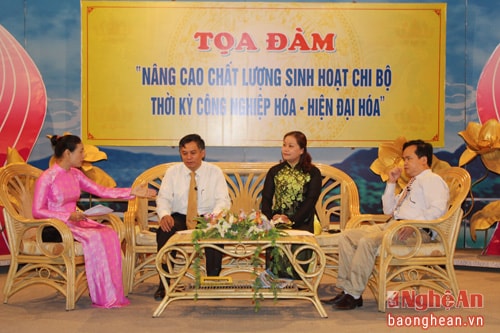 |
| Comrade Nguyen Thi Thu Huong, member of the Standing Committee of the Provincial Party Committee and Secretary of the Party Committee of the Provincial Agencies Bloc, attended the seminar to exchange ideas on improving the quality of Party branch activities. |
To date, 40 out of 57 subordinate Party branches have implemented the unification of the positions of Party committee secretary and head of agency/unit, and 356 out of 410 Party branch secretaries under the grassroots Party committees are also heads of specialized departments or divisions.
In practice, implementing this model results in a more streamlined organizational structure, fostering unity and consensus from policy formulation to leadership and guidance in carrying out political tasks, and linking the fulfillment of political tasks with organizational, personnel, and ideological work.
The head of the unit's Party committee has a comprehensive understanding of the overall situation, promptly absorbs the directives from higher levels, and quickly resolves emerging issues within the unit. This saves meeting time, maximizes the capabilities of the head of the unit, and overcomes the tendency to shirk or avoid responsibility.
When this mechanism is implemented, the responsibility of the head of the organization is enhanced; decisions and work are made faster, more closely, and more focused, overcoming the situation where there is still a "discrepancy" between the Party Secretary and the head of the agency or unit in directing and managing the implementation of political tasks at the grassroots level. Having the Party Secretary also serve as the head of the agency or unit also creates greater unity between the Party Committee's policies and resolutions and the action program, and ensures a more seamless and effective implementation of the unit's professional and political tasks.
Overall, the implementation of this policy has yielded good results, creating new progress in Party building work throughout the entire Party organization.
| The results of professional activities in 2015 show that, in the provincial government sector, 48 out of 57 units were rated excellent (84.2%), 9 out of 57 units were rated well (15.8%), and there were no weak units. The Fatherland Front and other provincial-level mass organizations were all rated excellent by the central mass organizations. |
PV:So, in order to fulfill both roles, what requirements must a leader meet, Comrade?
Comrade Nguyen Quang Tung:Implementing a model that unifies the positions of Party committee secretary and head of agency/unit requires the leader to possess strong Party loyalty, be exemplary, courageous, and responsible, and to "match words with actions." It also requires the leader to have comprehensive capabilities in both areas: Party leadership and the management of professional tasks.
First and foremost, the responsibilities of the head of the unit must be clearly defined in the Party Committee's regulations: what matters must be approved by the Party Committee and what falls within the individual authority of the head of the unit. Defining rights and responsibilities must ensure adherence to principles of democracy, transparency, and that responsibility matches authority.
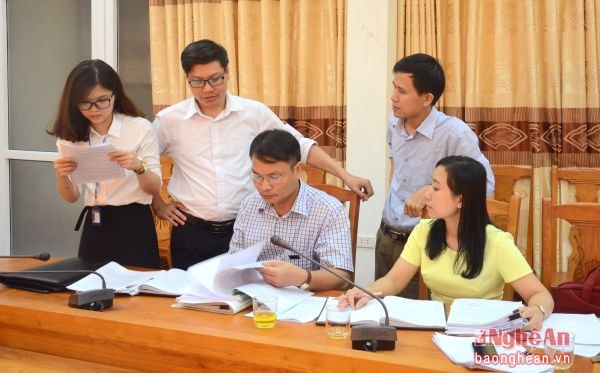 |
| The inspection team is reviewing administrative reforms at the Department of Science and Technology. |
Furthermore, it is necessary to establish coordination regulations between the Party committee and the head of the professional department, strictly implementing the principle of "collective leadership, individual responsibility," avoiding authoritarianism, abuse of power, and lack of democracy. In addition, fulfilling these "two roles" requires not only the efforts of the leader but also the unity and high spirit of cooperation of the staff and Party members, especially each member of the Executive Committee. If the Executive Committee lacks a high fighting spirit and fails to promote criticism and self-criticism, especially in formulating policies and guidelines, it can lead to subjective and voluntaristic behavior.
And it would be a "burden" for the leader if the Party organization chose the wrong person or assigned the wrong task; it would be "manageable" if the right person was chosen and the chosen person was wholeheartedly committed to the assigned work.
PV:To mitigate potential problems arising from the implementation of the unified job title model, what solutions has the Party Committee of the bloc implemented, Comrade?
Comrade Nguyen Quang Tung:To ensure the model's positive aspects are maximized, its effectiveness is enhanced, and potential negative consequences are prevented, the Party Committee of the bloc has actively implemented inspection and supervision work in various forms: thematic supervision, surprise inspections, etc. Emphasis has been placed on inspecting and supervising the responsibility of Party organizations in leading the implementation of political tasks, personnel work, administrative reform, and grassroots democracy; and inspecting and supervising the responsibility of Party members, especially leading Party members, in fulfilling their assigned duties and responsibilities. Attention has been paid to areas prone to violations. The guiding principles of "focused and targeted inspection" and "broadened supervision" have been effectively implemented.
Currently, the Party Committee of the Provincial Agencies Bloc is focusing on developing and issuing a resolution to enhance the leadership capacity of grassroots Party organizations in carrying out political tasks within the Provincial Agencies Bloc. This includes emphasizing the inspection and supervision of Party members' responsibilities in performing assigned tasks, encompassing progress, accountability, ethics, communication skills, discipline, and administrative order while on duty. Annually, it directs the collection of confidence ratings for cadres and Party members, especially leading and managerial cadres.
Linking the inspection and supervision of Party members with the inspection of the performance of duties and powers of cadres, civil servants, and public employees. Clearly defining the responsibility of heads of agencies in reporting to Party committees and branches on the political tasks, policies, and objectives of their agencies and units; clearly defining the responsibility of Party committees regarding organizational, personnel, and ideological work to promote the completion of political tasks; overcoming the situation where many Party organizations today are afraid to defend what is right and afraid to fight against what is wrong.
In addition, effectively implement the regulations on supervision and criticism by mass organizations within agencies and units to minimize potential negative consequences arising from the implementation of the integration model.
PV:Thank you, comrade!
| Opinion: Comrade Trinh Ba Vinh - Member of the Party Committee Executive Board, Deputy Head of the Party Organization Department of the Provincial Agencies Bloc "To effectively implement this model in practice, in addition to building and selecting capable personnel to undertake the tasks, and enhancing the leadership, guidance, management, and operational capacity of the heads of units, it is necessary to focus on building a high-quality advisory staff. At the same time, it is crucial to strengthen the leadership, guidance, inspection, and support of higher-level Party organizations for units implementing the unified job title model." Comrade Nguyen Van Do - Member of the Provincial Party Committee, Implementing this model helps to integrate Party work more closely, specifically, and comprehensively with professional tasks; creating a high degree of unity in leading both Party and professional work. Previously, in the Party Committee of the Department of Planning and Investment, a Deputy Director was also the Party Secretary, so typically, after the leadership of professional work had finished discussing key tasks, they would seek guidance from the Party Committee. Now, with the model of the Party Secretary also serving as the head of the agency, this process can be shortened. This makes it easier for the head of the agency to direct and manage. However, to do this "2 in 1" effectively requires the head of the agency to have comprehensive thinking abilities, decisiveness, and a sense of responsibility to the collective. |
Gia Huy
(Perform)


