
Keepers of Thai culture
(Baonghean) - When mentioning Mr. Luong Viet Thoai from Con village, Chau Quang commune (Quy Hop district), everyone in the Thai ethnic community knows him because of his insightful articles and excellent novels that realistically and vividly reflect the life and culture of the Thai people. His works have contributed valuable resources to the transmission of the traditional culture of the Thai ethnic group to present and future generations.
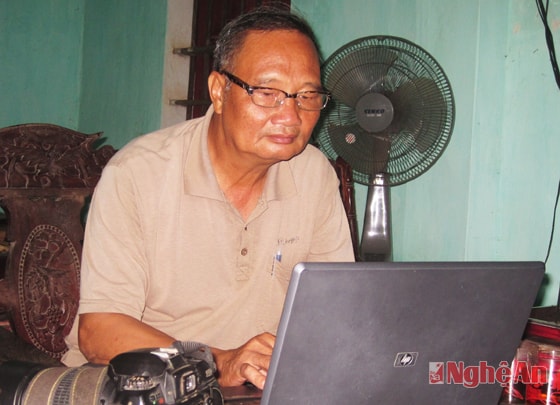 |
| Mr. Luong Viet Thoai. |
Pouring a cup of fragrant, sweet-smelling pagoda flower tea, he said, "Drink a cup of tea to warm your stomach, my dear." His enthusiasm and friendly way of speaking were enough to warm my heart. I sipped the tea, glancing around the small, three-room house, its furniture neatly arranged. Both sons were married and working far away, leaving only the two of them at home. At sixty years old, long retired, his military demeanor seemed deeply ingrained in his blood, evident in his voice and daily life.
At the age of 16, Luong Viet Thoai, a young man of the Thai ethnic group, left his mountains, forests, and village to answer the sacred call of the Fatherland. After training for a time in the 22nd Regiment – Military Region 4, Luong Viet Thoai was reinforced to the Tri Thien Military Region, operating in the Hue Citadel Special Forces Unit, stationed at C2 – Huong Tra. After the liberation of Hue City (March 26, 1975), Luong Viet Thoai attended a foreign language and culture class in Lang Son and then studied History at Hanoi University. After graduating, while working as a contributor for the Army Newspaper, Luong Viet Thoai was sent to study journalism at the Political-Military Academy of the Ministry of National Defense. Upon completion, he was assigned to work at the Naval Command in Nha Trang, spending his days and nights at sea. Throughout his time in the military, from his time as a recruit to becoming a political officer and participating in many major campaigns, Luong Viet Thoai maintained the habit of writing whenever he had free time. The soldier's emotions—joy, sadness, longing, and even his anxieties and reflections—are conveyed through each of his writings. His poems and articles have appeared in an increasing number of Army, Navy, and Women's newspapers. This passion seems to have become an inherent need and a natural calling.
He often humorously explained to friends and colleagues the meaning of his pen name, Thái Tâm, which, when reversed, means "sounding," implying that his writing must be constructive, offer constructive feedback, and be educational... But the deeper reason behind this pen name stems from a memory from the bloody battlefield of Trị Thiên with a reporter from Thừa Thiên Huế. For over 40 years, the image of that journalist-martyr has haunted him. At that time, he was working in the Huế City Special Forces Unit, tasked with guiding a reporter with the pen name Thái Tâm on a field trip to the outskirts of the city. The journey was long, and the cassava he was carrying on his back was slipping. Mr. Thoại stopped to adjust it and told the reporter to keep going and he would catch up. About ten minutes later, a series of gunshots rang out, and the sky seemed to darken. His traveling companion was gone forever. He suppressed his grief and continued his mission. Even now, he still blames himself: "If only I hadn't told him to go first," even though he understands better than anyone that the line between life and death in war is very thin. Since then, all of Mr. Thoai's literary works have borne the pen name Thai Tam as a profound tribute. Mr. Thoai has returned to the old battlefield many times, following the meager information he has gathered to try and find the family of that journalist-martyr, but he still hasn't succeeded. He read me the poem "Mourning Thai Tam," and suddenly his voice faltered, his eyes blinking as if trying to hide his emotions…
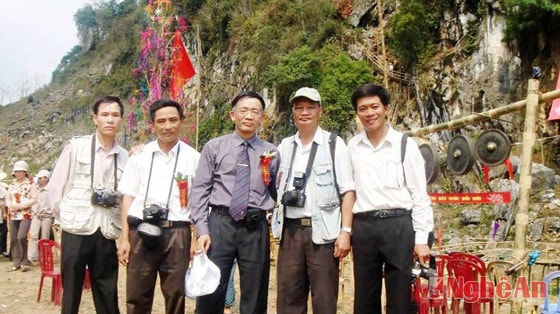 |
| Luong Viet Thoai (second from the right) at the Muong Ham Festival. |
Returning to his hometown, he actively participated in local work, serving as the head of Con village from 1995 to 2000. This was also the time when the Nghe Tinh Non-Ferrous Metals Company established its base and began mining. Rumors spread that tin could be found everywhere in Quy Hop. As a result, locals and people from all over flocked to the area to cut down trees and excavate the forest. The forest in his hometown of Con was ravaged by illegal loggers, and many ancient trees were felled. Mr. Thoai felt like he was sitting on a powder keg, powerless to stop the problem. He suddenly thought of writing articles to appeal to the local authorities. His article, "Tears of the Con Village Forest," became a wake-up call to relevant agencies to quickly intervene and save the forest. It was also the first work he submitted to the Nghe An newspaper. Since then, the pen name Thai Tam has become familiar to readers because of its timely articles, presented simply, with rigorous and insightful arguments. From then on, he actively wrote articles and sent them to many places. Besides being a journalist, Thai Tam is also a member of the Nghe An Provincial Association of Literature and Arts, a member of the Nghe An Photography and Journalism Club, and a member of the Association of Literature and Arts of Ethnic Minorities in Vietnam. Whether writing poetry, short stories, articles, or researching folklore, he leaves his own unique mark in every field.
He considers himself fortunate, fortunate to have been born and raised in the cradle of Thai culture, rich in identity, and fortunate to have received a thorough education in folklore from dedicated teachers at the university. Therefore, in his research, he possesses both a macroscopic view of folklore and a keen understanding of the microscopic aspects of local customs and traditions. He passionately studies the folklore of the Thai people like a child diligently searching for his ancestors and roots, cherishing, nurturing, and preserving them. His footsteps have left their mark on the streams and ravines throughout the nine villages and ten districts. The villagers cherish him like family. The uniqueness of traditional culture, the pristine and majestic beauty of nature, the peacefulness of the villages with their glimpses of stilt houses, and the open and hospitable nature of the villagers... all seem to beckon the artistic soul within him, making him forget all the hardships and difficulties of the long and arduous journey.
He traveled extensively and met many people, but for over ten years, the image of the Thai woman teaching by the stream has left a lasting impression on him. One time, while reporting on a tree-planting campaign in Chau Thai commune, he saw some children picking horse chestnut flowers – a characteristic flower of the mountainous region, small and yellow. He stopped his car and asked, and the children told him they were picking them for their teacher. He was surprised, because in this remote mountainous area, there were no schools, so how could there be a teacher? He stopped his car by the roadside and followed the children to find their teacher. A simple classroom perched precariously by the stream, with a wooden blackboard made from a tree trunk, moved him deeply. He learned that this "special teacher" had followed her husband to the fields and, seeing the children unable to attend school, had voluntarily built a hut to teach them. In the 1990s, few Thai women were literate, yet this woman boldly opened a school, leaving him with much to ponder. He felt immense compassion for the children and profound gratitude for her dedication. He decided to write an article about this "special teacher" with the title "Flower of Horse Music"...
His hometown is changing day by day, and he is very happy but also very worried. Seeing the younger generation growing up with little interest in traditional culture, some not even knowing how to speak Thai, and the folk songs and dances of the Thai people gradually fading away, saddened him. He took out his historical novel "The Song of Tong Loi" from his bookshelf, signed it for me, and instructed: "Don't use Kinh culture to interpret the customs and traditions of ethnic minorities. If you want to write more about the culture of ethnic minorities in western Nghe An, including the Thai people, then refer to this novel." His novel, "The Song of Tong Loi," was approved by the Nghe An Provincial Association of Literature and Arts and received an A rating (October 2010). Historical documents that might seem dry were transformed by his pen in a soft and gentle way. The customs, traditions, and daily habits of the people here are clearly depicted, helping readers better understand the traditional culture of the Thai people. Holding the thick book in my hands, I understood the immense effort and dedication that an artist, a researcher, and above all, a son of the Thai ethnic group had poured into it.
Outside, the rain continued to fall, bitterly cold. But Mr. Luong Viet Thoai's genuine kindness warmed my heart. It suddenly occurred to me that Mr. Thoai's passion and dedication are the flame that illuminates the beauty of traditional culture amidst the chaos of modern life.
Nguyen Le


