
The Li family worships sacred drums.
(Baonghean) - In Nghe An, the Hmong are the most numerous minority community, concentrated in the mountainous district of Ky Son. During the feudal era, they had their own districts and were less influenced by the Thai people. Therefore, the Hmong have many unique customs rarely found in other communities, including the drum worship tradition of the Li clan...
For many communities, the drum, before becoming a musical instrument as we know it today, was originally a sacred object. Many might think of bronze drums in harvest festivals or other celebrations in modern cultural life. But few communities view it as an object of worship as the Hmong, especially the Li clan.
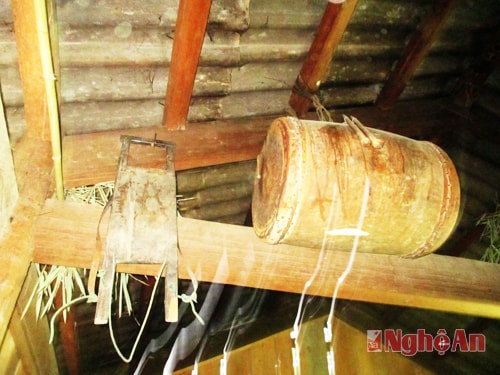 |
| Mr. Li Thai Co's drum has been around for many decades. |
It should also be added that, among the Hmong people, each clan has its own unique taboo. We also see this custom among the Thai and Khmu people, but there are quite fundamental differences. We will certainly return to this issue in future articles, as it is a very interesting aspect of Hmong culture and the Hmong people in Nghe An in particular.
The Li family is widely distributed in the communes of Muong Long and Huoi Tu (Ky Son district). However, during the "descending from the mountains," a portion of the Hmong people moved to Hop Thanh village (very few Hmong villages have such a name), Xa Luong commune, Tuong Duong district. Here, there are 25 households with the Li family. In early April 2014, the village received the title of Cultural Village. The village has implemented its own customs according to the new way of life. Pigs are no longer allowed to roam freely to protect the clean environment. Buffaloes and cows are herded to prevent damage to the community's crops.
In the village, only Mr. Li Thai Co's (72 years old) house still has a drum placed prominently on the rafters. This is considered the highest and most important position in the house. Mr. Li Nhia Ho, Mr. Li Thai Co's younger brother, said that the drum was usually only kept at the head of the clan's house. He recalled: "Back then, when my brother Li Thai Co reached the age to get married, around 15 or 16 years old, our parents had to make a drum for him." Mr. Li Nhia Ho said that this was a custom of the Tu clan. The drum, placed on the rafters, was only taken down when someone in the village died and they borrowed it. Mr. Li Thai Co's family has had to replace the drum twice, and he can't remember how many times the drumhead has been covered because the villagers have borrowed it so many times!
The custom of worshipping the drum among the Li clan is as follows: At the end of the year, the household with the drum, usually the head of the clan, will slaughter a chicken to offer to the drum. In addition, a bottle of wine is also offered. The head of the household will light nine incense sticks and pray. The prayer says: Twelve months have passed, a year has ended; may sickness depart, and may prosperity, warmth, and good health remain. The drum is only worshipped once a year, which is considered a rare annual ritual for the Hmong people.
Regarding this worship custom, there's a story told by Mr. Li Tong Khu (42 years old), residing in Hop Thanh village: Long ago, when the ancestor of the Li family passed away, there was no longer any place for him to build a house, cultivate fields, or raise buffaloes and cows. He had to return to his descendants for refuge. Before leaving, he appeared in a dream to his descendants, instructing them to make a drum for him to use as a shelter. Because he was now a person of the past, he could no longer stay at home like a living person. The family followed his instructions, went to find good wood in the forest, hollowed it out, and covered both ends with cowhide to make a drum. Since then, the drum has been worshipped alongside the deceased and is considered the ancestor of the Li family.
As a sacred object, the drum is carefully guarded by the Li family. The drum sits on the rafters almost year-round. When someone in the community passes away, the family comes to borrow it. The family takes the drum down for a prayer ceremony, then strikes it three times with nine beats if the deceased was male, or three times with seven beats if female. The prayer says: "Today, someone has come to ask to serve someone. When you leave, take away all bad and unpleasant things. When you return, bring money and good fortune home." If the person handing over the drum is unsure of the deceased's gender, they simply strike the drum three times and then hand it to the person borrowing it.
Not only in the Li family, but in the Hmong villages of Nghe An, drumming only occurs during funerals. When a member of the community passes away, the drums sound to inform the villagers of the sad news. Like the sound of the flute, the drums guide the deceased to breakfast, lunch, and dinner, welcome mourners, and help them mount their horses to ascend to heaven.
The Hmong people also have a rule that the tasks of taking down the drum, carrying the drum, and playing the drum are all performed by men. Women are not even allowed to touch the drum. The person performing the drum-taking and drum-carrying ceremony must be knowledgeable and mature...
Text and photos:Huu Vi


