
"The legless man" Pistorius makes Olympic history.
On the eighth day of competition (August 4th) of the London 2012 Olympics, South African athlete Oscar Pistorius made Olympic history as the first disabled person (without both legs) to compete in an athletics event.
Pistorius, 25, qualified for the men's 400m semi-finals with an impressive time of 45.44 seconds. At just 11 months old, he had both legs amputated (below the knees) due to a congenital defect: the absence of fibula bones. Despite this, Pistorius remained passionate about pursuing his dream of becoming a track and field athlete and persevered with his carbon fiber prosthetic legs.
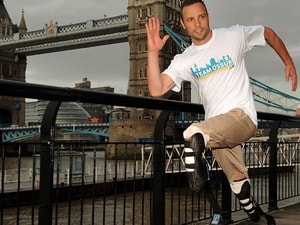
South African athlete Oscar Pistorius is about to make Olympic history. (Source: AFP)
He was hailed as "the fastest legless runner on the planet" and won four Paralympic gold medals, while also holding records in the 100m, 200m, and 400m races for disabled athletes. Pistorius competed in the Athens 2004 and Beijing 2008 Paralympics. Not stopping there, he decided to make history by competing in the Olympic Games.
Pistorius nearly missed the London Olympics after failing to qualify for the 400m race with a time of 45.52 seconds at the South African Athletics Championships last June. However, he was selected for the men's relay team, opening up opportunities to compete in individual events. In addition to the men's 400m, Pistorius will also compete in the 4x400m relay with his teammates.
Beyond the issue of performance, Pistorius's prosthetic legs have been the subject of considerable controversy. The International Athletics Federation (IAAF) once refused to allow Pistorius to compete in regular competitions, arguing that the prosthetic legs allowed him to conserve energy compared to non-athletes. However, in 2008, the Court of Arbitration for Sport (CAS) ruled that Pistorius did not have such an advantage due to lower blood volume and a lack of muscle mass in his lower legs.
To qualify for the London Olympics, Pistorius once again had to undergo rigorous research and testing to be deemed to have prosthetic legs that offered no advantage. However, a mandatory condition was that Pistorius had to use the same type of prosthetic leg he had used in Paralympic competitions since 1996.
Also in the men's 400m event, a major surprise occurred when American athlete LaShawn Merritt, the Olympic gold medalist, was disqualified. He only managed to compete for about 250m before suffering an injury. At the US Olympic qualifying round last month, Merritt achieved a time of 44.12 seconds, which is the world best time in the men's 400m this year.
Merritt, 26, is trying to restore his image after a doping scandal. In late 2009, he was found to have used a banned substance and received a 21-month ban from competition.
Merritt then appealed to the CAS and overturned a ruling that banned him from participating in the London Olympics. Last year, Merritt returned after his ban and finished second in the 400m at the World Athletics Championships held in South Korea.
According to (VNA) - DT


