
Buyers are caught in the middle of the fish sauce war.
The current fish sauce market has hundreds of brands with a wide variety of types and prices, but the quality does not adhere to any standards, leaving consumers confused.
Surveys at supermarkets and food stores reveal dozens of types of fish sauce, priced from tens to hundreds of thousands of dong per liter. Many products are labeled as dipping sauce but advertised as fish sauce, and are prominently displayed in easily visible locations, misleading consumers.
A bottle of commercially produced fish sauce contains 17 ingredients.
Nam Ngu 3-in-1 and Chinsu salmon fish sauce are the two most commonly sold brands in supermarkets, grocery stores, and food shops. Some shelves are even dedicated solely to displaying these two types of fish sauce. On the packaging, besides anchovy extract and salt (in unclear proportions), these two brands contain 15 other ingredients, including flavor enhancers, colorings, and preservatives. The price of Nam Ngu 10% protein fish sauce is 43,000 VND/liter and Chinsu is 62,000 VND/liter.
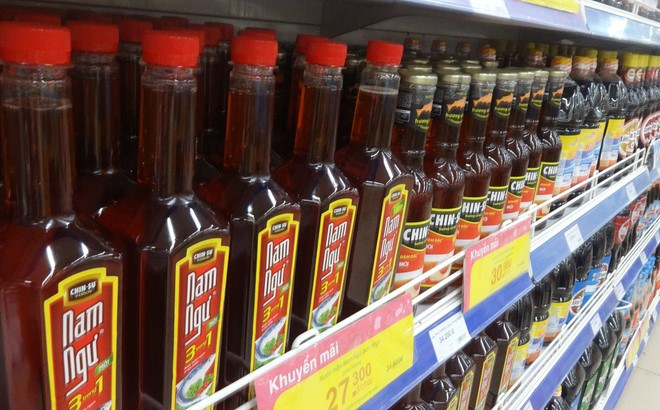 |
| Dozens of types of fish sauce are sold in supermarkets, but Masan's products still hold a dominant position. Photo: Pham Oanh. |
Meanwhile, traditional fish sauce, with ingredients clearly stated on the packaging including fish and salt, sells for 3-5 times more than industrially produced fish sauce. Specifically, Nam Phan brand fish sauce, 30% protein content, originating from Ninh Thuan, costs 237,000 VND/liter. Phu Quoc Ong Ky fish sauce, 35% protein content, originating from Phu Quoc, costs 160,000 VND/liter...
Additionally, there are some types of fish sauce that only list anchovies and salt as ingredients, but only contain about 10-15 degrees of protein, priced from 38,000 VND/liter to 66,000 VND/liter.
According to a salesperson promoting Nam Phan fish sauce, the product is homemade by the family and sold in supermarkets. She explained that the market currently offers two types: fish sauce and dipping sauce. Fish sauce consists only of fish and salt, while dipping sauce, in addition to fish extract, also contains various additives and flavor enhancers.
"Although it contains many other ingredients besides fish sauce concentrate and salt, the dipping sauce is not too salty and suits the taste of most Vietnamese people. Moreover, industrially produced fish sauce is 3-4 times cheaper than traditional fish sauce, so its consumption is many times greater," she added.
Convenience stores and traditional markets currently only sell industrially produced fish sauce. A survey of nearly 10 consecutive grocery stalls selling fish sauce at Ba Chieu Market (Binh Thanh District) revealed that none sold traditional fish sauce. Most were Nam Ngu and Chinsu branded fish sauces.
Some grocery store owners in District 1, Ho Chi Minh City, said they don't import traditional fish sauce because it's expensive, difficult to sell, and much saltier than other types of fish sauce.
Vietnamese people consume 75% of their fish sauce through industrial processes.
According to data from the General Statistics Office, of the 200 million liters of fish sauce consumed annually, 75% is industrially produced fish sauce (i.e., not produced using traditional methods).
Masan's 2015 annual report also showed that the company alone contributed 65% of the entire fish sauce market share.
These figures are consistent with a report by market research firm Euromonitor. According to this firm, the size of the Vietnamese fish sauce market in 2015 was 11.3 trillion VND, with industrially produced fish sauce accounting for 76% and traditional fish sauce only 24% of the market share.
Many fish sauce manufacturers confirm that in this unequal battle, traditional fish sauce will need a considerable amount of time to regain its firm foothold. Furthermore, in this financial struggle, many small businesses and production facilities will be forced to scale back or temporarily suspend production, if they don't want to revert to contract manufacturing for industrial fish sauce brands.
Recently, Prime Minister Nguyen Xuan Phuc requested the Ministry of Health to take the lead and coordinate with the Ministry of Industry and Trade and other relevant agencies to urgently investigate and clarify the situation regarding industrial fish sauce containing chemicals dominating the market, and to promptly inform the public. These agencies must submit a report to the Prime Minister before October 22nd.
Research by Kantar Worldpanel shows that each Vietnamese person uses approximately 4 liters of fish sauce per year. Thus, with a population of 93 million in 2016, the Vietnamese people used 372 million liters of fish sauce annually (not including Vietnamese people living abroad). |
According to Zing


