
The listener hears the birds crying...
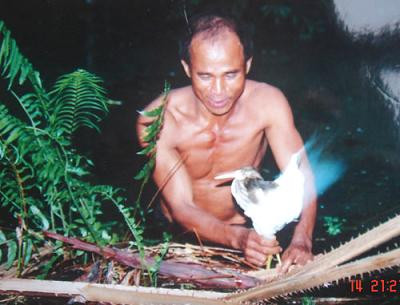 |
| Mr. Thin is treating the stork's wounds. |
(Baonghean.vn) -Every evening, tens of thousands of egrets and many other bird species return to Mr. Tran Dinh Thin's garden in Ngoc Lam (Thanh Chuong district, Nghe An province). His fertile land and kind heart have become a welcoming home for these birds, and he, in harmony with nature, has created a unique ecological bird sanctuary in western Nghe An.
A blessed land...
Following Mr. Nguyen Van Cong (our guide), we crossed the valley and arrived at Ngoc Lam hamlet. Stopping at the beginning of the hamlet, we heard the chirping and calls of various birds, creating a lively atmosphere, but we only saw about ten egrets flying around. Mr. Cong, sensing our confusion, jokingly said: "Egrets are only abundant in the morning and afternoon; they're all out foraging now. Come back in the evening, you'll see them return, turning the trees white. Journalists, be careful not to hide in a house, or they might fly right on your head!"
Mr. Thin's house is located at the end of the village, in a large orchard of about 1 hectare. When we arrived, he was swimming in the pond rescuing baby storks that had fallen from their nests due to their playful nature. It turned out that countless stork nests hung from the branches, the chicks chirping as they waited for food. Mr. Thin gently climbed a ladder, placed the stork back in its nest, and then invited us inside. His house was small and low, but very neat and tidy; the furniture inside was nothing of value except for an old wooden bed and a long bench.
He said sadly, "When the wind was strong at night, many bird eggs fell and broke, and more than twenty baby storks were thrown down. Some died, others were injured. I felt so sorry for them. I used leaves and medicine to treat the injured ones and then put them back in their nests. Poor things."
When asked about the flock of birds, he excitedly said: “A long time ago, around mid-March 1990, it was afternoon and I was inside the house when I suddenly heard a rushing sound like wind, followed by a deafening noise. I went outside and saw white egrets flying everywhere, covering my garden. It was terrifying; they even defecated on my head, making a terrible mess. Children used slingshots, adults used air guns to shoot them, and some people, seeing so many egrets, panicked and threw bricks and stones at them, causing them to fly away in all directions. They all flew away, but the next afternoon they came back. At first, I ignored it, but then I thought it was strange. Why didn't the egrets choose my garden instead, when there were many better gardens in the village? Perhaps it was a good place for birds to stay. Since they had chosen my garden, I shouldn't drive them away. So I forbade hunting them. At first, about a few thousand birds came, then they flew away again, only a few remained to build nests, lay eggs, and give birth. That day I counted more than 70 nests. That year…” Later, around the third lunar month, they come back in huge numbers, about 3,000-4,000 of them, I don't know where they come from. It seems they warn each other to come, because each year there are more than the year before, too many to count. In the evening, they fly back and perch all over the garden; some even fly into the house to take shelter, bumping into people without fear. Just wait and see, when they come back, it's like a huge cloud shading the whole area. I'm used to it now; whenever I go away for a few days, I miss the storks terribly and want to come back immediately."
Fate
Mrs. Ngũ, Mr. Thìn's wife, confided: "At first, the children used slingshots, the adults used air guns, and plastic traps to raid the garden day and night. When Mr. Thìn tried to stop them, they said, 'These are wild birds, not yours, so why forbid them?' I lost sleep for days. Then he sawed planks of wood into pieces. I didn't know what he was going to do with them, but it turned out he used paint to write 'No Hunting of Birds' and stuck them around the garden. My children and I were very worried, thinking he was crazy. Who would lose sleep over those wild birds? I suddenly felt a strange dislike for him..."
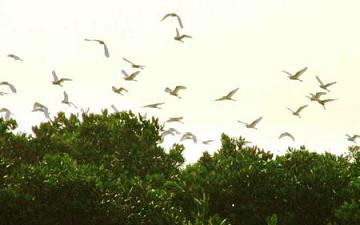 |
The storks return to Mr. Thin's garden. |
No one supported him, not even his wife and children. Mr. Thin single-handedly waged war against the majority to protect the birds. He went from house to house with children, advising them and telling parents to remind their children not to use slingshots to shoot birds. He even went to schools to ask them to spread awareness about protecting the birds as protecting the environment. When hunters refused, he used force, confiscating their guns. He refused even relatives who asked for a few birds to improve their meals. He also firmly refused some district and commune officials who came to his garden to shoot birds. Mrs. Ngũ shook her head: “My husband and I have six children, and our few acres of rice fields aren't enough to feed us. Some months we have to eat cassava and vegetables to survive. It's so hard, yet some people came and offered to buy the whole flock of birds, which they caught with nets, for 2000-3000 dong each, but my husband refused to sell and even yelled at them to leave the house. At first, I was very angry, but gradually I understood that what my husband was doing was right, so I and our children have been working hard to protect the birds for him.”
Mr. Thin took a sip of his herbal tea, his voice tinged with sadness: "I've offended some of my neighbors because I'm protecting the birds. But I'd rather offend them than offend the birds. People may not understand now, but they will eventually. If the birds leave, it's unlikely they'll ever return."
One year, when the storks were supposed to return (March 15-20), the garden was deserted, and Mr. Thin paced back and forth like a man possessed. He burst into tears when he waited and waited but saw not a single stork. The flock of white birds had become a part of his life. But then, a few days later, flocks of white storks returned to him. He jumped up and down with joy like a child, saying to his wife, "I have a special connection with the storks; they remember me, so they can't leave me, do you see?" Mrs. Ngu, both annoyed and amused, retorted, "You only care about birds and storks. Go live in the garden with them forever! If the storks don't leave you, then I will..."
We were talking when suddenly we heard a rustling sound, followed by a commotion that filled the whole area. Mr. Thin said, "The storks are back, gentlemen." He led us to his bird garden, which mainly consisted of old trees like the dung tree, bamboo, palm, and bời lời (a type of tree). We asked to go inside, but he wouldn't let us. He said, "You have to wait until tomorrow morning to go foraging. Now that they're back, we can't disturb them. I'm always afraid they'll leave." So we had to stand outside and admire the hundreds of nests hanging from the branches, and the thousands of birds flying around and perching, covering the entire garden in white.
That night, Mr. Thin invited us to stay and listen to the cries of the baby birds. As the countryside settled into sleep, we began to hear many baby birds chirping, their calls sometimes weak, sometimes rapid, echoing through the night. His eyes welled up with tears: "These days, in every district and commune, people trap egrets to sell. The cries you're hearing are the cries of baby birds that have lost their parents. Hearing the baby birds cry from hunger and loss keeps me awake many nights."
Perhaps because of his deep affection and love for the birds, for eighteen years – as if by appointment – flocks of white egrets would gather in his garden between the 15th and 20th of the third lunar month to roost and build nests, only temporarily leaving him in October to escape the cold.
Currently, Mr. Thin is planting more melaleuca and acacia trees and expanding the pond in the middle of his garden to create more favorable conditions for the flock of birds to roost and nest. All of his work seems like a destined connection with the white birds, without any income from it.
Today, Mr. Thin's garden is not only home to egrets, but many other bird species also flock there to build their nests. His fertile land and kind heart have become a welcoming home for these birds; his being is in harmony with nature, creating the only ecological bird sanctuary in Thanh Chuong, in the western part of Nghe An province.
Lam Thuy -Yen Thanh, Nghe An