
City dwellers
(Baonghean) - She's a true farmer. In her youth, she was always by herself with her buffalo; no matter how strong or fierce the buffalo was, it was always obedient in her hands. Sometimes, while plowing, the buffalo would break free and run away, but she would jump over the ditch with the plow instead of abandoning it. Her husband is a mediocre factory worker. Yet, she managed to raise five children, each strong and robust, and still built a comfortable house with a tiled roof and brick courtyard. Every year, she even earned the title of outstanding cooperative member.
Suddenly, my older brother retired, and my sister closed down that comfortable business, bringing the whole family, young and old, to the city. A whole bunch of strong laborers crammed into the small, standard-sized apartment of just over ten square meters that the city allocated to him during the subsidy era. My brother's reasoning was, "Being rich in the countryside is not as good as loitering in the city." He figured that there were plenty of rich people in the city; he could sit on the sidewalk pumping tires and earn a few pennies from them, which would be enough to make him feel good, far better than being back in the countryside, barefoot and working the land under the sun.
Just try calculating: the whole family owns five acres of rice paddies. If they're skilled at tending the land, using plenty of seeds, fertilizer, pesticides, herbicides, and rodenticides, they can harvest two tons of rice a year, and at high prices, that's over ten million dong. That's without even deducting the initial investment in seeds and other materials – and even then, it's just for show. If they sold it, they'd all be penniless. Not to mention the countless expenses, funerals, weddings, illnesses, children's education… Where would they even find the money for all those things?
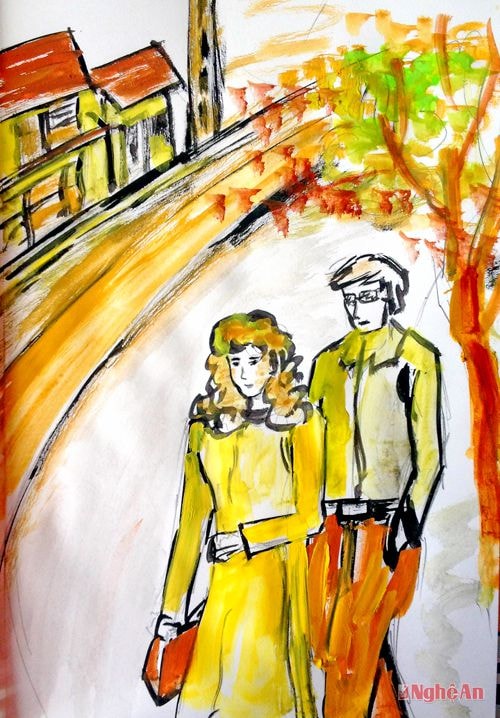 |
| Illustration: Hong Toai |
Just go out into the city and sit by a lamppost, pumping up tires, sometimes a little, sometimes a lot. Divide the money up, and you'll still earn a couple of hundred thousand dong, which adds up to five or six million dong a month – a sweet deal! Those who don't like the hassle of pumping and repairing tires can just get a decent motorbike and do a few rides a day, still pocketing a couple of hundred thousand dong, and you can cruise through the streets, seeing all sorts of things. A more relaxed and lucrative option is to carry a set of scissors, find a "prime spot," hang a mirror on a fence, and do about twenty repairs a day, earning thirty thousand dong per repair – isn't that a lot of money, over ten million dong a month?
Her father had planned everything meticulously, and they marched towards the city. Initially, when she first arrived in the city, she didn't know what to do, so she decided to scavenge through trash to sell to scrap dealers. She would get up at three in the morning and go to the garbage dump, picking up discarded items. By six o'clock, when the city dwellers went to work, her day was over. She absolutely kept her job a secret from everyone, not even her friends or family; reputation mattered, and she couldn't let people look down on a trash collector.
Speaking of those "hardworking" guys, crammed into a "box" of just over ten square meters. One worker's pension and one garbage scavenger's salary weren't enough to feed seven or eight gap-mouthed mouths. So each of them found their own way to "collect loose change," strictly following their father's logic. One became a motorbike taxi driver, another a barber...
With little effort and careful saving, she finally managed to set up a stall selling groceries right at the gate of the house. Everything from needles and thread to bowls of pickles, onions, and garlic... It was all about collecting loose change. It was also time for the strong men in the house to double their household registration. What to do? Everyone had internalized their father's "method" of collecting loose change, but how long would it take to buy a place to live with all that loose change? So they racked their brains trying to figure out how to build walls, partitions, folding tables and chairs, expanding the space... It wasn't time to worry about aesthetics or convenience yet; as long as all four families could sleep and have children, that was good enough. The important thing was maintaining their "city person" image.
City dwellers have to be better than country folk in everything. Women have to meticulously style their hair, curling it like a bunch of longan fruit, and apply a little makeup. Even men have to wear tucked-in shirts, and those feet still stained from wading in the mud should at least wear a pair of stylish shoes, even if they're as cheap as pennies. Slouching in those yellow and red recycled plastic flip-flops, the color of crab shells, is just plain provincial.
Every time my sister goes back to our hometown, she dresses up in her traditional ao dai dress and shiny velvet trousers. Even in the sweltering summer heat, she still casually throws on a woolen scarf and wears a string of plastic beads—thankfully, they're high-quality plastic, so the villagers admire them as "pearls." Of course, her hair and makeup are meticulously styled, giving her a very ladylike appearance. The whole family always rents a private car to show off. Upon arriving at the edge of the village, the first thing she does is remind the driver: "The villagers are very disorganized, so you have to honk the horn loudly!" Poor old folks in the countryside, hearing the car horn roar like thunder, quickly scatter into the bamboo thickets. Stepping out of the car, my sister is very graceful, retracing her steps if she stumbles. She has the air of a city dweller; if anyone greets her, she only offers a few words and a haughty smirk, unlike in the old days when she was working in the fields and would flaunt herself to everyone she met. That wouldn't be the mark of a city person anymore.
On the anniversary of her father's death, with the food almost ready, the group from the city leisurely and confidently approached the altar. They arranged pears and apples respectfully and meticulously, offered incense, and inhaled deeply for a while. City dwellers, after all, had to perform their prayers properly; if they acted casually and carelessly like country folk, the ancestors would surely be angry. When it came time to sit down, she meticulously questioned everyone about where the meat and fish came from, how they were cooked, and even the vegetables, crabs, and snails—she scoffed, "How did they season them so badly that they smell like fish?" Then she pointed out how the meat and sticky rice should be arranged, and how each dish she described, explaining it in detail and with flowery language, as if it were the natural order of things for city dwellers.
Throughout the conversation, she kept complaining about how dark and smelly the house was, how the blankets and mats smelled so bad, and how she couldn't sleep all night. "In the city, I just lay down and didn't know what was going on," she said. "Coming back to the countryside, I realize how miserable it is. I have to go back to the city sooner or later; if I stay another night, I'll get sick!" After dinner, her nephew brought toothpicks and water for the aunts and uncles. Holding the toothpick container to her nose and sniffing, frowning, she said, like a singer announcing her arrival, "Let me ask him to bring back the cinnamon toothpicks he brought from the city, because these smell terrible." How pathetic, her nephew was so clueless; why didn't he know his aunt was from the city?
When she fell ill with a stroke, making it difficult for her to walk, her relatives advised her to return to her hometown, where she could live in a spacious house, rest peacefully, and perhaps her condition would improve. But she resolutely refused to return home. After so many years in the city, learning to be a city dweller, to be told to return to the countryside and become a country person again would be a waste of all her efforts. But fate was hard to resist, and she couldn't overcome it. Once illness strikes, it snatches away a person's life in an instant, regardless of wealth or poverty, whether they live in the countryside or the city.
My sister, while she lived in the city, even sleeping under a blanket in the countryside was difficult for her, but when she died, she still wanted to be laid to rest in the middle of a windy field, in a peaceful and beautiful grave.
Their mother died, their father was frequently ill, and they had a small, dilapidated apartment of just over ten square meters in a dark, run-down old housing complex. With prices skyrocketing, the strong men in the family couldn't divide the inheritance, each refusing to accept even a penny. They glared at each other, wielding knives and chasing each other like bandits in broad daylight. Even their mother's ancestral altar hadn't been set up for seven weeks yet, and none of them would take a share for the memorial service. After much arguing, the eldest son, in a fit of bravado, took the altar and scattered the ashes of his sister's spirit into the river.
Even now, her children and grandchildren only occasionally see each other at ancestral commemorations. Despite their grumpy faces, they share the same pride as their parents: they are all city dwellers.
Short stories byDinh Nam Nghi


