
The one who breathes life into memories.
(Baonghean)When I was little, my house was near the Nga Sau market, and I would toddle along with my grandmother to the market all day. If I misbehaved and got spanked by my mother and had to stay home, I would be so sad because I wouldn't get to eat the rice cakes from the chubby lady at the beginning of the market. Calling the Nga Sau market "sacred" is a bit of an exaggeration; in reality, there was only one corner of the market that gave me a creepy feeling, something otherworldly. That was the stall selling portraits and tombstone carvings of an old man with graying hair. Now, it seems that craft has faded away.
One day, at a high school friend's wedding, I was startled by a portrait instead of a wedding photo, unlike the usual weddings. Everyone was exclaiming how skillful the artist was, saying the portrait looked so real, so lifelike, so soulful. My friend pulled me aside and whispered where and who painted it, so that "when you get married, you'll know where to go." I giggled shyly; the bride in the painting seemed to be winking at me. I was completely taken aback!
It wasn't because of my friend's glowing recommendation, but perhaps because of a touch of nostalgia, a haunting memory of the old portrait painter from the Nga Sau market, that I sought out the art studio of Chu Vinh Duc – the only portrait painter in Vinh City. The house, built in the old tube-house style from the 80s and 90s, located near the railway tracks, exuded a pensive atmosphere amidst the hustle and bustle of traffic. The entire first floor of the house was rented by Mr. Duc as his studio; it looked a bit cluttered and disorganized, with racks for brushes and paints, easels, and a frame-cutting machine. One wall displayed brightly colored ink and watercolor paintings, contrasting sharply with the black and white portraits hanging opposite. The people in the paintings exuded an old-fashioned air, their gazes creating a vague sense of pressure. It was as if the atmosphere in the room suddenly became suffocating, enveloped in a feeling of being watched by strange eyes through the dusty windows of time. Or perhaps it was the lingering smell of paint, mingled with memories of the old portrait painter, that left me dazed in that ancient-looking room.
The owner of this room is as contradictory as the contrasting colors on the two walls. He greets his guests with a cheerful tone, but his stories, tinged with sadness, evoke memories of a bygone era. He recounts how, at the age of four, his legs became paralyzed after a fever, adding jokingly, "That afternoon, I still went with my dad to pick peanuts!" Then he talks about his father's discharge from the army and his journeys to seek treatment in both the North and South, the painful and difficult process of learning to walk, his insistence on his parents buying him books and school supplies to study at home, his English studies... but perhaps the most striking story is about him stubbornly sitting in front of an artist's studio in Ho Chi Minh City, insisting on becoming his apprentice. He laughed as he recounted, "Actually, when I was a child, I also loved to draw and went to art classes in Ten-lerman. One time, I happened to pass by an art gallery and was so impressed that I begged to be allowed to learn. At first, the teacher refused, but I was persistent, sitting there and 'pleading' for a long time. Eventually, the teacher gave in, telling me to go home, ask my father for money to buy paint, paper, and brushes, and then come back. It's true that 'being handsome isn't as important as being persistent!' I learned the trade until 1998, then returned to Vinh, and in 2000 I opened my own art studio."
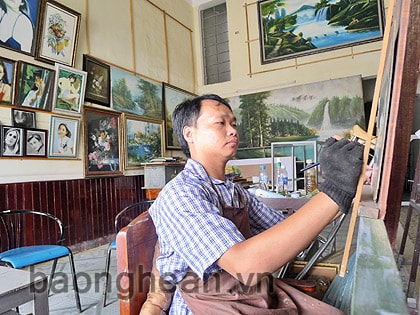
Mr. Chu Vinh Duc at his art gallery at 10 Nguyen Truong To Street (Vinh City).
Photo: Thuc Anh
Looking at the portraits painted on old, ivory-white silk paper, one might imagine that these silent, motionless figures would suddenly strike up a conversation. Anh Đức spoke about each painting with passion and affection, as if talking about old friends and acquaintances. This is Lê Công Tuấn Anh, a painting he created around the time the actor passed away. This is Bae Yong Joon, the star of "Winter Sonata," whom young women adored back then. And here, a painting a friend asked him to create, based on a high school photo, so innocent and childlike, perhaps to preserve a lost time of naivety, a time he now cherishes with a husband and children. These paintings, over ten years old, he can't bring himself to sell – paintings that never age, preserving a youth, a person seemingly defying the cyclical nature of life.
The art of portrait painting has truly faded away – my encounter with Mr. Duc confirmed this belief. People mainly seek him out to commission ink paintings for display. During Tet (Vietnamese New Year), he sometimes receives orders for up to 10 paintings a day, while portrait painting is only accepted on regular days. In fact, portrait painting is much more difficult than landscape painting, because what people need isn't to make the painting more beautiful than the real thing, but to make it look like the subject. And is just looking like the subject enough? It must breathe the soul and spirit of the subject into the painting, so that decades later, the painting will remind people of that person. To achieve this, the painter must live within the painting, and the subject must live within each brushstroke. Then, when the painting is finished, the subject's story becomes the painter's story – a form of telepathy, perhaps?
But never mind, I'm getting carried away with my thoughts drifting to some other worldly realm. Meanwhile, the artist before me is so real, so down-to-earth, so human. He doesn't lecture about painting with the tone of an artist who has distanced himself from worldly life. In a nonchalant tone, he talks about couples who painted commemorative pictures and then parted ways, about elderly people who have been painting portraits for three or four years but still enthusiastically jog in front of his house every morning. He talks about the students he teaches English to in the evenings, about the songs that won awards at the Disabled People's Singing Festival, about the trip the City Disabled People's Club is organizing tomorrow, about the art studio that will soon be built on land granted by the city government to disabled people with a strong will to succeed... The life of this artist with his disability is like a painting that preserves not only his own memories but also those of an entire era. I hope that the "painting" I'm painting can convey his spirit and soul into the black ink on white paper.
Hai Trieu - Thanh Phuc


