
The man who returned from "hell on earth"
(Baonghean) - The story I'm about to tell you probably won't be found in any book you can find about the "hell on earth" of Con Dao. Nor will any tour guide explain what I'm about to say, because this is my own story. My father's story.
"...My father's name is Huynh Van Bien, a former prisoner who survived his time in this hellish Con Dao prison. He went to the battlefield when I was very young and never saw him, and we've been missing ever since. The whole family was convinced he had died somewhere under enemy bullets... Then, after the liberation of the South, amidst the shared joy of the nation, there was inevitably the private pain of wives, mothers, and children who suffered separation and mourning."
I remember the day my father came home vividly. My mother was working in the fields, and I was idly following along, helping with chores, when I saw my older sister, Tư, running frantically, shouting, "Dad's alive, Mom! He's home!" My mother snapped, "What nonsense are you talking about? Your father died!" - "He's not dead, he's alive, Mom! He's home waiting for you! Come home quickly, or he'll be worried!" My mother, half-believing, half-doubting, dropped everything and hurried home with me. I was twelve years old then, no longer as naive as a five or three-year-old, but in my mind, my father only appeared as a figure whose face was never clear. I only knew that "Dad's home" was a very special event. Entering the house, I saw a man with a haggard face, his eyes reflecting sadness, perhaps because he had just gone through some not-so-pleasant years. He looked up at me and said affectionately, "Is that you, little one? You've grown so big, I almost didn't recognize you. You were so small when I left." I burst into tears and ran to hug him tightly. That's how I got to see my father.
After settling his affairs and belongings in his hometown of Can Tho, my father took my mother and us children to Con Dao Island, where, along with 152 other prisoners, he helped to revive life from the very mass grave that had buried the blood, bones, and youth of countless comrades. My father was appointed Deputy Head of the Con Dao Prison Relic Management Board, directly guiding people in explaining the bloody history of this "massacre camp," one of the largest in Indochina. I often wandered around the island with my father, listening to him recount the darkest days of his life, days he would never forget.
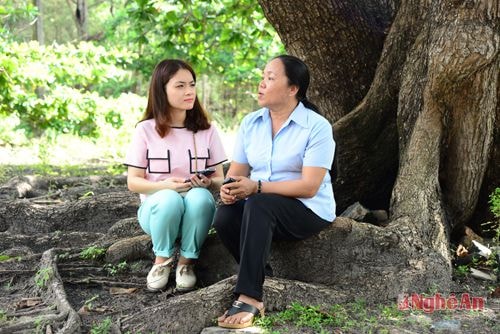 |
| Ms. Huynh Thi Kim Loan reminisced about her father's story. Photo: T. A. |
That was when we passed by Hang Duong Cemetery, where countless comrades were executed and their bodies thrown into the sea. “Ten thousand people lie silently beneath that clear blue water, Ut. Do you see how blue and beautiful the sea is here? As for me, every time I close my eyes, I shudder, imagining the entire sea has been stained red with blood.” Ten thousand people! When the remains were collected, only 74 sets were found; the exact number could only be estimated based on the records and notes of the prison warden and the island governor.
That was when we passed by the lime kiln – where prisoners forced into hard labor had to dive into the sea to collect coral to make lime powder. According to my father, it was the most terrifying forced labor, not because it was the hardest, but because that lime powder was used to torture their own comrades. Among the countless brutal torture methods in Con Dao prison, sprinkling lime powder on people and pouring dirty water on them was the most frequently used. When lime powder came into contact with water, it became burning hot and caused the prisoners' skin to ulcerate; in the poor sanitary conditions, it would rot and eventually lead to necrosis.
That was when they passed through Nhat Beach, where escaped prisoners would gather, build rafts, and flee back to the mainland. In winter, with favorable winds, it only took 30 hours to reach the shore. In 1952, 198 forced labor prisoners staged an armed struggle and took control of the situation, but due to unfavorable weather, their escape by sea failed. More than 100 were recaptured and subjected to brutal torture and execution. The rest perished in the waters once teeming with sharks. "But it's better to die under the jaws of a wild beast than to suffer humiliation and torture, to live a life worse than death at the hands of the enemy," my father exclaimed, his voice filled with indignation but also profound sorrow.
But it wasn't until my father led me into the American Tiger Cage that I truly understood why people called Con Dao "hell on earth." The 384 solitary confinement cells were 384 cramped, airtight rooms, stiflingly hot in the summer. In each cell, 15-20 people were crammed together, with no sleeping platforms; in fact, it was impossible to lie down. During periods of intense confinement, the guards wouldn't let anyone out for nearly two months. Small wooden buckets filled with feces and urine spilled onto the floor, turning the room into nothing more than a cesspool. To lie down, you had to take off your shirt to scoop up the feces and urine, leaving just enough space to rest your head. Only the weakest and most seriously ill were given priority to lie down. The more comrades became ill, the more space there was for them. I stared intently at my father's face, still etched with fear and burning hatred for the enemy's crimes.
He asked me, his voice cold and sharp, "Do you know why this prison has such narrow rows of cells, with only enough space for one person between them, thick metal cell doors, and large, heavy bolts?" I shook my head fearfully. "It's for this reason!" he said, opening the heavy door and slamming it shut with a deafening bang. I jumped. "That's not all, little one," my father said with a bitter smile. He grabbed the bolt and slammed it shut, the sound jarring and ear-splitting. Those chilling sounds echoed hundreds, even thousands of times. I covered my ears in fear, looking at my father—his face contorted as if the past had returned to torment and torture me.
My father led me to sit under an ancient banyan tree – probably over a hundred years old. This spacious courtyard and its green foliage had once instilled in him, as well as in all the other prisoners, a burning desire for freedom, a desire that consumed their souls more than any torture or humiliation inflicted by the enemy. My father picked up a banyan leaf and said that back then, every time he was released into the courtyard, he would try to hide banyan leaves and blades of grass to eat, because the lack of vegetables in prison meals had darkened his skin. “If I was caught by the guards, not only would I not have any leaves to eat, but I would also get a good beating. They would say: This grass was planted by the state; if you want to eat it, you have to salute the flag and sing the national anthem.”
But they were wrong. Revolutionary prisoners would never submit or kneel before the enemy who plundered their country. With the liberation of the South and the reunification of the nation, the enemy forces on the island were like a headless snake, and the situation was chaotic. On the night of April 30th and the early morning of May 1st, 1975, news of liberation reached the prison camps, spreading like a powerful wave. Prisoners in Camp 7 managed to open the doors and ran to other camps to rescue their comrades. In the first telephone call with the mainland, the question was asked: "What do you need, Con Dao prisoners?", and on this side, choked with emotion, the reply was: "We need a picture of Uncle Ho." Hope, faith in the light, in the green skies and foliage, all the burning desires of those years, were encapsulated in that simple answer that brought tears to everyone's eyes…
This is the story of my father, a former prisoner who came and witnessed things even more horrific than death. Fear, darkness, physical and mental pain slowly killed life; perhaps there was nothing left in this life that they couldn't overcome once they returned from "hell on earth." I am Huynh Thi Kim Loan, the daughter of my father, Huynh Van Bien. I have lived on Con Dao for 30 years and will remain here so that my father's story, the story of our country, will live on forever, for generations to come…”
Thuc Anh (Recorded)
| RELATED NEWS |
|---|


