"People of Vinh"
Among the six first-class cities directly under provincial administration nationwide, perhaps the citizens of Vinh are the most difficult to consistently define as "Vinh people".
Perhaps it's because Vinh is a relatively young market town, originating from a small administrative area more than 110 years ago when King Thanh Thai issued a decree establishing Vinh as a town.
And the inhabitants of the old Vinh region were originally people from the time when it was still called Ke Van. Over the course of history, many have dispersed, and a few have clustered together in small clans, or a few families that have lived for three or four generations, and today it is even impossible to determine their original place of origin, or who their ancestors were.
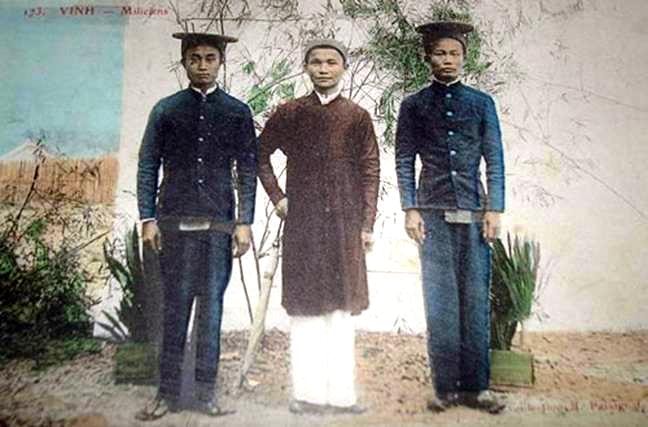 |
A photograph of a "Vinh resident" taken by a photographer. |
At the same time, with the rapid development after the August Revolution of 1945 and especially after 1975, people from all regions of the province and the country "migrated" to Vinh in many ways and for many reasons; including recently, the addition of localities from Hung Nguyen and Nghi Loc districts according to the new Vinh expansion plan; Vinh has blended and "added" many cultural features and rural customs from various regions, making it even more difficult to identify a distinct "Vinhian character".
The previous generation, meaning the residents born and raised in what is now the heart of Vinh city, are now mostly in their 70s and 80s; they can be categorized by their backgrounds: agricultural laborers, craftsmen, small-scale artisans and traders, and intellectuals.
This generation, depending on their living circumstances, work, and social awareness, still tries to preserve family traditions to some extent; but fundamentally, they live in isolation, if not indifferent to the vibrant new pace of development in the city, and therefore fail to portray any distinctive "Vinh people" characteristics in their social life and interactions.
Younger people, born and raised in Vinh since the 1960s and 70s, still have the right to be proud of being "Vinh residents," but partly because their parents were among the first to migrate to Vinh, and partly because they were born during the scorched-earth war in Vinh, they lack the sense of self-respect representing a new generation of Vinh city dwellers. Instead, they quickly and passively accept and integrate a mixed lifestyle, and at their core, they still clearly exhibit a rural ideology, a regional origin that largely doesn't belong to the original Vinh residents.
In urban life in Vinh today, it's easy to encounter the common question: "Where are you from, sir/madam/gentleman/lady, etc.?" This means that simply asking this question immediately elicits an answer from the person being asked, specifying their hometown and district/province; regardless of whether the person being asked is a retiree, a government official, a businessman, a soldier, a police officer, an intellectual, or a laborer.
Even students today, including the third and fourth generations born and raised in Vinh, are very aware of and know their hometown and family origins very well, and they don't naturally identify themselves as "Vinh people."
Thus, the concept of "Vinh people" is almost exclusively used by people from other provinces to understand someone who has permanent residency in Vinh, or by people from Vinh to introduce themselves simply in social interactions, work, or temporary relationships. When praising or criticizing, people from other provinces simply refer to them as "people from Nghe An!". Therefore, despite having a rich urban history comparable to Da Lat or Nam Dinh, Vinh has yet to create a distinct "Vinh people" culture and character.
This discussion is based on the premise that Vinh is developing into a major development center in North Central Vietnam. Understanding, selecting, preserving, building, and nurturing a unique "Vinh culture" is perhaps a worthwhile endeavor for the city's future development, a future that requires significant internal strength, including a sense of self-respect to generate its own distinct spiritual value.