
Human resources: A decisive factor in development.
Nguyen Xuan Duong - Deputy Secretary of the Provincial Party Committee, Chairman of the Provincial People's Committee
(Baonghean) - The first quarter of 2015 marked a positive start to the year, with promising signs of socio-economic development. Nghe An is striving to accelerate its efforts to achieve the highest possible results in fulfilling the targets of the 17th Provincial Party Congress Resolution, looking towards the 18th Provincial Party Congress and beyond. To keep pace with the development trends of industrialization and modernization, human resources are a key issue that Nghe An needs to focus on.
Looking back at 2014 and the first few months of 2015, the socio-economic situation of the province highlighted the following points:
Firstly, the transportation infrastructure system has been upgraded and newly constructed relatively comprehensively. In rural areas, 4,455 km of various types of roads have been upgraded, making a significant contribution to the implementation of the national program for building new rural areas (currently, Nghe An has 33 out of 431 communes meeting the standards for new rural areas). In urban transportation, 3 railway overpasses have been put into use and 2 new overpasses are under construction, ensuring the needs of the people and traffic safety. Regarding aviation, the adjustment of the Vinh Airport master plan to become an international airport has been officially announced. In maritime transportation, the Cua Lo Port upgrade project officially commenced with the groundbreaking ceremony for berths 5 and 6, with Tuan Loc Construction Investment Joint Stock Company as the investor, in April of this year.
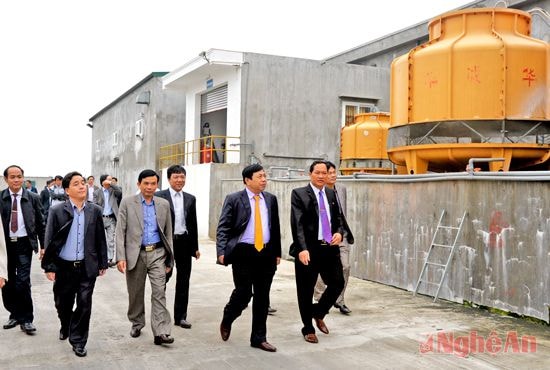 |
| Visiting the fishmeal factory in Dien Chau. Photo: SM |
Secondly, attracting numerous investors and projects of diverse scales, including national and regional projects such as the Song Lam Cement Plant of The Vissai Cement Group (capital of VND 10,500 billion); the Hoa Sen Group's steel and sheet metal production plant (VND 2,300 billion); the Lan Chau - Song Ngu eco-tourism resort complex (VND 1,969 billion);... In addition, there are many projects in social welfare-related fields such as the raw water supply plant project in Nam Dan, hydropower projects in western Nghe An;... Investment promotion is and will continue to be oriented as a lever for the province's socio-economic development, creating a breakthrough.
The city of Vinh has officially received approval from the Prime Minister for its revised planning until 2030, with a vision to 2050, expanding into the Vinh - Cua Lo urban area. This is a highlight of the province in its orientation to build Nghe An into a prosperous province nationwide, in accordance with Resolution 26 of the Politburo.
It can be said that Nghe An is entering a crucial stage of socio-economic development. Therefore, in addition to "hard" factors such as infrastructure, the "soft" factor – human resources – plays an extremely important role. This is for two reasons: firstly, to effectively utilize and maximize the value of modern infrastructure, it is essential to have people with modern thinking and working styles. Secondly, infrastructure is a fixed framework. We are taking the first steps in construction, but once this process reaches a complete and synchronized level of infrastructure, only the human element will have the flexibility to constantly adapt to the daily and hourly changes of the times.
Regarding the issue of human resource training, the following two tasks need to be clearly defined:
Improving the skills of the workforce is crucial to keeping pace with industrialization and modernization trends. Currently, agricultural and industrial production (especially processing and materials industries) remain key drivers of economic development. The long-term economic development orientation of Nghe An province emphasizes industry (industry within industry and industry within agriculture). This means that even the most traditional production sectors, such as crop cultivation and livestock farming, must undergo significant improvements. We have begun a "revolution" in agriculture with large-scale, industrial-style agricultural projects such as the TH Group's fresh milk factory and farm, and the MDF fiberboard factory.
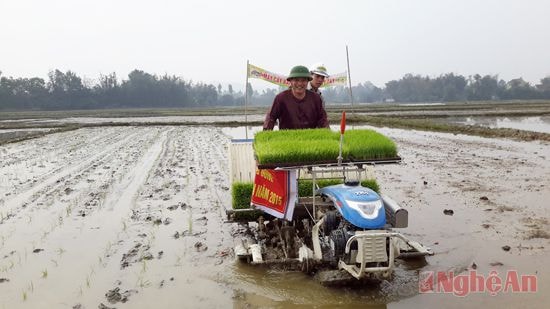 |
| Demonstration of agricultural machinery in Hung Nguyen. Photo: PH |
With favorable conditions in terms of land and forest resources, agriculture has been, is, and will continue to be an important sector in the province's economic development. However, clinging to traditional production methods and mindsets will waste labor while reducing efficiency, value, and impact. In line with the demands and trends of the times, agricultural workers need to consciously learn, update their knowledge and production skills to find their place in the industrial production chain. Only through technology transfer and the application of scientific and technical advancements can agriculture and farmers maintain the value of this long-standing traditional sector, and even enhance that value many times over.
Orange trees are a prime example: thanks to the application of scientific advancements in grafting, ripening, and sweetness adjustment, we have successfully built and protected the Vinh orange brand on the national agricultural map. However, the production chain of the orange tree model has not yet been fully modernized and industrialized: innovation in production and cultivation is needed, but so is innovation in preservation and consumption methods. To enhance and fully exploit the value of orange trees, the following options can be considered: building cold storage facilities, expanding the consumer market (Japanese investors have expressed particular interest in the Vinh orange brand, opening up hopes for exporting Vinh oranges abroad); diversifying processed orange products such as orange juice, orange jam, etc. To implement these ideas, it is necessary to improve the quality of agricultural products, aiming for more "refined" products - which means farmers must cultivate knowledge both in depth and breadth.
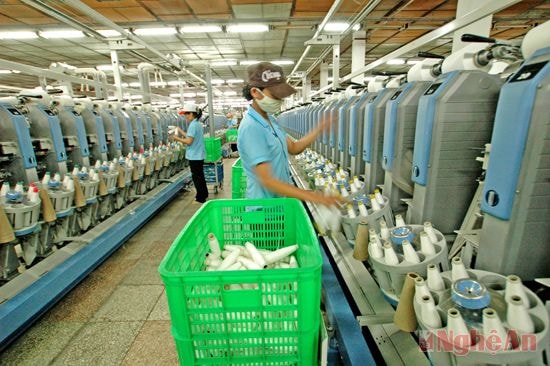 |
| Production line at Hoang Thi Loan Textile and Garment Joint Stock Company. Photo: An Vinh |
The above lesson is not only true for agriculture but also valuable for industrial development. Emphasis should be placed on improving quality alongside the strength of quantity – especially in a province with abundant labor resources like Nghe An (population over 3 million; of which: 2,385,800 people aged 15 and over, accounting for 78.94% of the population; 1,651,500 people of working age. The number of people employed in the national economy is 1,921,100; of which: 1,206,450 people are employed in agriculture, forestry, and fisheries, accounting for 62.8%; 261,270 people in industry and construction, accounting for 13.6%; and 453,400 people in services and trade, accounting for 23.6%).
The reality is that each year, Nghe An province has approximately 20,000-21,000 graduates from colleges, universities, and vocational training programs, but only about 1,000 are employed. Meanwhile, workers from other provinces and cities still have job opportunities in Nghe An in large industrial zones, taking on positions requiring high skills (especially in factories of foreign investors in the electronics industry). This is an unnecessary waste, because we have many quality vocational training institutions, such as the Vietnam-Korea Industrial Technical College.
With the "Upgrading the Vietnam-Korea Vocational College of Technology - Phase III" project, funded by the Korean government through KOICA, and the project to develop it into a high-quality college from 2015 to 2020, vocational training needs to be strengthened to ensure a workforce that meets the requirements of large and modern projects. A closer link between training institutions and employers is necessary. On the one hand, this reduces production costs by utilizing local labor for employers. On the other hand, it creates jobs, increases income for workers in the province, and promotes socio-economic development.
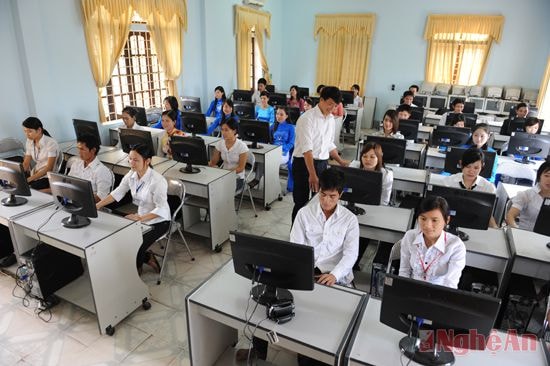 |
| Information Technology class at Nghe An College of Tourism and Commerce. Photo: Sy Minh |
To achieve this, it is necessary to adapt supply to demand: identifying industry trends and the labor needs of businesses in the area, and then focusing on developing and innovating training programs. Furthermore, it is essential to build a brand for Nghe An workers in specific industries, aligning with current development trends. Combined with the province's natural advantages, this will not only increase its attractiveness to investors but also attract targeted and selective investment that aligns with the province's development direction.
The second task in human resource training is to innovate thinking and awareness. The new generation needs a proactive, dynamic, and open-minded approach to production and work. They need to be quick and proactive in grasping and seeking markets for their products. For example, agricultural production can be combined with ecotourism, the business of processing products from raw agricultural produce, and partnerships with other businesses to become satellite distributors, etc. This is an integrated mindset that workers in any field need to fully exploit the value of their products and create linkages with other industries and professions, building a closed value chain to minimize intermediary costs and increase professionalism in production. We can integrate not only tangible values and products, but also intangible values – this is the secret of the renowned "soft" industries of tourism, services, and trade.
Currently, we have three key highlights in the field of culture and tourism: a diverse and rich network of natural landscapes spread throughout the province, with Cua Lo beach as a highlight in the East and the Pu Mat National Nature Reserve as a "gateway" in the West. Secondly, we have a rich spiritual culture with a long tradition that has significantly spread beyond the boundaries of Nghe An province. Finally, we have the Vi and Giam folk songs, recently recognized by UNESCO as a representative intangible cultural heritage of humanity. With such abundant cultural and tourism resources, there is no reason why tourism and other related industries in Nghe An should not develop strongly.
According to experts, we have only exploited a very small fraction of the province's tourism potential. Infrastructure is only a secondary reason; the main reason remains the mindset and awareness of the people, especially those working in tourism. From small things like maintaining cleanliness, environmental landscapes, and public facilities; behaving in a cultured and civilized manner towards tourists;... to more macro-level issues such as developing programs and itineraries that continuously and synchronously traverse a chain of tourist destinations throughout the province; building and protecting the brand for tangible and intangible tourism products... people remain the unifying factor in all these tasks. This is essential because tourism and services are industries that cater to human feelings, and only through human innovation can we thoroughly innovate the way tourism and services are conducted.
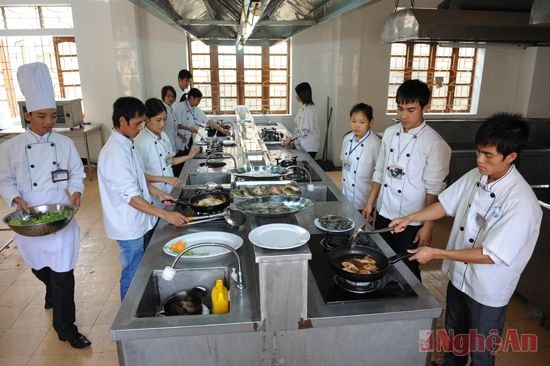 |
| Students at the College of Tourism are having a practical session. Photo: SM |
Paying attention to and valuing the role of people is an inevitable trend in society. In March 2015, the 4th "Golden Cup for Nghe An Entrepreneurs" award ceremony was held in Vinh City as an opportunity to honor and encourage individuals and groups who have made significant achievements and positive contributions to the socio-economic development of the province. These are crucial factors for Nghe An province to make breakthroughs on the path of industrialization and modernization. Natural resources can only diminish, not increase; infrastructure is a fixed, inanimate object; only human resources can be enriched if we consciously nurture and develop them.
On all fronts and in all areas of development, the greatest and most urgent reform is human reform: building new rural areas essentially requires building a new type of farmer; industrial development focuses on highly skilled workers; and tourism requires, above all, civility and a sophisticated mindset from those involved in tourism and services. However, it is also the people who preserve traditional spiritual and cultural values. Innovating while maintaining the identity and characteristics – the values that make up the brand and name of Nghe An on the national and international map – that is the true "liberation revolution" awaiting the people of Nghe An to enter a new era. Human resources are the strength and advantage of Nghe An province.


