
Endless Thanh Thuy
After two years, the tea hills remained the same, lush even under the scorching summer sun, and many new, beautiful houses had sprung up, their bright red tiled roofs gleaming amidst the endless green of tea and cassava fields...
The early days of clearing the forest.
The leader of the 5th Youth Volunteer Brigade (Thanh Chuong) - Mr. Thai Hong Thanh - once proudly boasted that the team members were "super" motorbike riders, no less skilled than the motorbike taxi drivers in the mountainous regions! This was because, in the early days of settling in this wild land, they always had to walk through the forest, or if they were lucky, they could ride motorbikes along roads that would send shivers down their spines just from hearing about them.
Now, the road to the headquarters is wide and beautiful, following the new national highway. Few could imagine that just five years ago, the path was like a thread winding through a wild, dense forest, often requiring clearing trees to make way. During the rainy season, those roads became slippery and full of danger. The mountains and forests were wild and untamed, and illegal logging was rampant. Every day, dozens of ox-tired carts carrying timber passed through the roads leading to the headquarters, making it a hotspot not only for the district but also for the province.
Faced with this situation, the team was determined to push back and put an end to illegal logging first, ensuring the forest's stability before focusing on economic development. A security team was established, with nearly 15 members out of a total of 25 at the time, coordinating with forest rangers and the district police to conduct raids. To counter this, illegal loggers often acted at dusk, using chainsaws to cut wood very quickly. The following night, they would cut the logs into sections, roll them down the road, and transport them to collection points in hard-to-reach locations, or bury the wood in the sand along the riverbanks. They guarded each route, listening for any activity, and retreated when things seemed "calm." They especially often transported the wood at night, in the dark, rainy, and windy weather. The team had to take turns manning checkpoints at the forest entrances. Many nights, while staking out to "catch the wood," the loggers would lie around warming themselves by fires, chatting freely, while the raiding force didn't dare swat away the mosquitoes. But with determination and decisive measures, after only a short time, the forest was almost completely pacified.
To date, many forest areas have been "cleaned," although not completely eradicated because the local people have traditionally relied almost entirely on the forest for their livelihood. However, now most only dare to exploit the forest in a "opportunistic" manner. Many forest areas have regenerated and turned green again, and as Vy, the security team leader, said, "Looking at that is enough to know the effort our team has put in, because before, those were many dead forest areas."
New life today
|
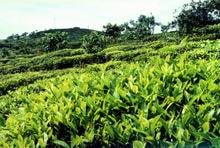
In 2002, Production Team No. 2 was formed with 29 households. The early days were not without difficulties. The river, which the locals still commonly call the Rao Ro River, overflowed and flowed fiercely during the rainy season, forcing the team members to stand on one bank and throw instant noodles across to supply the forces engaged in "land reclamation." That same year, Production Team No. 3 was established. And to date, the entire unit has 150 members, with nearly 50 people and 300 laborers, currently receiving about 10 households per year, aiming to concentrate over 200 households in the future. The entire unit has planted 245 hectares of LDP1,2 industrial tea, with an average yield of 8 tons/ha, some households achieving 14 tons/ha; 60 hectares of fruit trees and disease-free oranges have begun to yield harvests; in addition, there are 40 hectares of high-yield cassava, 20 hectares of various crops, and an expansion of the existing 15 hectares of bamboo for shoot production. The 300 hectares of protective forest are currently very well protected, with forest cover increasing from 45% to 70%. The average income of team members is 25 million VND/household/year, with more than 10 households earning between 40-50 million VND. Living standards have improved significantly; from makeshift houses, 70% of team members now have solid houses, 95% own motorbikes, and 90% have audio-visual equipment.
Besides economic development, the unit also focuses on the spiritual well-being of its members' families. The General Team has organized over 10 weddings, and all production teams have sports fields and regularly purchase cultural and artistic equipment. In 2005, the unit was recognized as a Cultural Unit by the Thanh Chuong District People's Committee. Visiting the General Team now, the most striking impression remains the large, beautiful houses built on the lush green tea and orange groves. A new life has arrived in what was once a desolate and deserted land...
Text and photos: Lan-Huong


