
Risk to the next sugarcane crop.
(Baonghean) - Despite the efforts of the agricultural sector, the progress of destroying sugarcane fields infected with sugarcane grassy shoot disease in localities remains very slow. Meanwhile, there is less than a month left until the end of the best time of year for destruction as recommended by the authorities. Significantly, at present, neither the disease-transmitting agent nor a specific cure is available.
(Baonghean) - Despite the efforts of the agricultural sector, the progress of destroying sugarcane fields infected with sugarcane grassy shoot disease in localities remains very slow. Meanwhile, there is less than a month left until the end of the best time of year for destruction as recommended by the authorities. Significantly, at present, neither the disease-transmitting agent nor a specific cure is available.
As the locality with the largest area of sugarcane infected with sugarcane grassy shoot disease in the province (over 3000 hectares), to date, only 1,180 hectares of diseased sugarcane have been destroyed, leaving 2,191 hectares still affected. Particularly in the Doc Dai area (Ha Son district), there are still over 400 hectares of sugarcane that farmers have not been able to harvest because they are waiting for compensation from another economic development project in the area. Thus, after more than 3 months of implementing the destruction policy, the entire district has only treated 30% of the infected area. Currently, the prevention and control of sugarcane grassy shoot disease in Quy Hop is very difficult.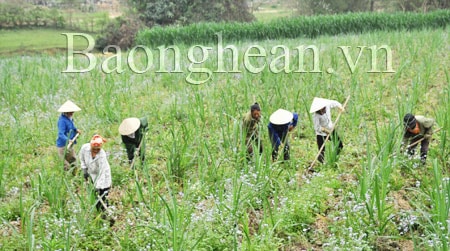
Farmers in Tan Ky are actively weeding their sugarcane fields. Photo: Chau Lan
In recent times, Tate & Lyle Sugar Company has proactively sought out disease-free seed sources for planting in the area, but the infected or re-infected area continues to increase rapidly. According to Mr. Trinh Huu Hien, Head of the Plant Protection Station in Quy Hop district, the people and authorities in some localities have not cooperated with the factory. To date, only about 10% of the lightly infected sugarcane area has been destroyed by farmers, mainly in areas near their homes, while areas planted far away, in hilly and mountainous regions, have not yet been destroyed.
In the sugarcane growing areas of Song Con Sugar Company, the task of destroying disease sources and uprooting plants to treat pathogens is facing many difficulties. Mr. Tran Doan Le, Deputy Head of the Agricultural Department of Song Con Sugar Company, expressed concern: Although the company has implemented various mechanisms such as providing fertilizer, lime, herbicides, and money for farmers to buy disease-free seeds, sugarcane growers in Tan Ky and Anh Son districts are still not seriously implementing the destruction of disease sources. In particular, in the hilly areas and key disease-prone regions of Tan Ky district, such as Tan Xuan, Giai Xuan, and Tan Phu (bordering Nghia Dan), due to heavy rain and difficult transportation, farmers have not yet harvested their crops – posing a significant risk of disease outbreaks in subsequent seasons. Currently, the company has replanted over 2,400 hectares with disease-free sugarcane seeds and imported more than 2,000 tons of disease-free sugarcane seeds from Lam Son (Thanh Hoa) to prepare for the new planting season.
But with the current negligence and carelessness in eradicating disease sources, will newly planted sugarcane fields using disease-free varieties be safe? Mr. Le said: To effectively control the disease, the responsibility of the people, localities, and businesses alone is not enough; the involvement of the entire political system in raising awareness is also crucial. The company is ready to provide financial support and technical guidance to eradicate sugarcane grassy shoot disease as soon as possible.
According to statistics from the Department of Agriculture, the province currently has over 4,400 hectares of sugarcane affected by sugarcane grassy shoot disease, with nearly 800 hectares severely or moderately infected. The Director of the Department of Agriculture and Rural Development, Mr. Nguyen Tho Canh, stated: The development and persistence of sugarcane grassy shoot disease is the responsibility of the government, local authorities, and the people. Although the causative agent and specific treatments have not yet been identified, after declaring the outbreak, based on foreign documents and advice from scientific research and state management agencies, the Nghe An Department of Agriculture and Rural Development has developed a very effective disease prevention and control plan. However, the responsibility of local authorities in organizing outbreak control and the implementation by the people have not been serious or thorough. People have not fully understood the danger posed by sugarcane grassy shoot disease. "According to the State's decision, only two types of crops are eligible for State support when affected by disease: rice yellow dwarf and black stripe dwarf diseases, and sugarcane grassy shoots. The agricultural sector has fulfilled its responsibilities well, but the Department of Finance and the districts have not fully done their part, therefore the support money for the people is always delayed," Mr. Nguyen Tho Canh commented.
In reality, many farmers are not yet focusing on investing in proper care to achieve high yields. In many areas, farmers leave sugarcane ratoons for too long, neglecting weeding, leaf stripping, and adequate fertilization. This results in low yields, which in turn contributes to the spread of diseases and severe damage. The rapid development and spread of the disease is due to many factors, both objective and subjective. The fundamental cause is the failure to thoroughly destroy the source of infection, along with improper care, especially in areas with mild infections.
In the coming period, localities and plant protection stations in the raw material areas must regularly monitor the disease's development, specifically determine the extent of damage, propose treatment plans, and direct timely and decisive control measures. Sugar companies must urgently harvest all sugarcane infected with sugarcane grassy shoot disease, replant according to the agricultural calendar, ensure sufficient disease-free seeds for farmers to replant, and promptly implement policies to support farmers in treating the disease, striving to complete the process before April 30, 2012.
Phu Huong


