
Risk of A/H7N9 influenza entering Vietnam.
The most recent case of influenza A/H7N9 in China was recorded in Guangdong province, near the border with Vietnam.
Due to the frequent travel and interaction between Vietnamese people and the southern provinces of China, the risk of the A/H7N9 influenza virus entering Vietnam is also very high.
According to the Ministry of Health, the A/H7N9 influenza outbreak in China has recorded 161 cases with 51 deaths. Cases are occurring continuously and are tending to spread to southern provinces of China and areas near the Vietnamese border.
Besides the interaction between people of the two countries near the border, the H7N9 influenza virus also poses a risk of entering Vietnam due to the poorly controlled transportation and trade of poultry.
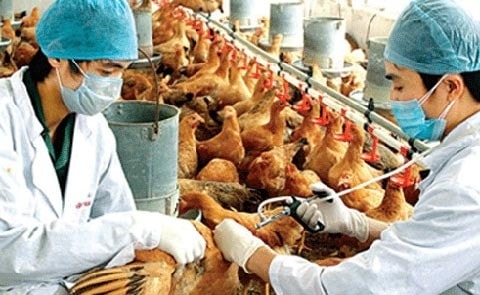 |
| The A/H7N9 influenza virus is circulating in poultry flocks but without symptoms, making it difficult to detect the source of the infection and control outbreaks in poultry. |
According to a report by the Ministry of Industry and Trade, the situation regarding smuggled poultry remains serious in border provinces. Over the past year of implementing Project 2088, functional forces have inspected and handled 1,849 cases, imposing administrative fines totaling 3.13 billion VND; confiscating 55.5 tons of live chickens, 201.5 tons of chicken meat, 2.8 million eggs, 73.9 tons of poultry by-products (offal, feet, necks, wings), 2.1 million chicks, 8.5 tons and 34,797 ducklings, and 1.8 tons of other birds, with the value of confiscated goods destroyed totaling 3.63 billion VND.
In addition, the A/H7N9 influenza virus is circulating in poultry flocks but without symptoms, making it difficult to detect the source of the disease and control outbreaks in poultry.
Meanwhile, there has been clear evidence of a decrease in human cases following the closure of live poultry markets in China.
Investigation results showed that 69% of patients had been exposed to poultry. Testing 605,000 poultry samples in China revealed 53 samples positive for influenza A/H7N9.
Another difficulty in the current fight against the A/H7N9 influenza epidemic is that the community lacks immunity, there is no vaccine to prevent the disease, and there is no specific treatment. Therefore, people who come into contact with the pathogen are easily infected and treatment is difficult.
During an emergency meeting of the Ministries of Health and Agriculture and Rural Development on the afternoon of January 13th, the leaders of the Ministry of Health advised people not to eat raw blood pudding and not to use sick or dead poultry.
Previously, the Ministry of Agriculture and Rural Development stated that the actual results of monitoring the circulation of avian influenza virus showed that 80% of communes, 66% of districts, and 63% of markets had avian influenza virus. In particular, 5.7% of live ducks tested positive for the virus, demonstrating that avian influenza virus is circulating strongly and that prevention and control measures (vaccination and other coordinated measures, including raising awareness among small-scale households) need to be intensified.
The H5N1 avian influenza outbreak is also developing in a complex manner; in 2013, cases were recorded in areas bordering our country. On January 2nd, the H5N1 virus reappeared in poultry flocks in Bac Ninh province. Inspections of 147 poultry markets in 44 provinces and cities from 2013 to the present have revealed that 90 markets had poultry testing positive for H5N1, accounting for over 60%.
They still freely sell poultry without inspection.
According to our reporter's observations, at small local markets, the demand for poultry meat has increased sharply in the last days of the year. However, it seems that both sellers and buyers are not yet aware of the disease situation and are not taking preventive measures.
At a local market on Vu Thanh Street (Ba Dinh District, Hanoi), when asked about the quality of poultry, a poultry vendor asserted, "The chicken is guaranteed, imported from Yen The - Bac Giang." However, none of the poultry showed any signs of quarantine inspection.
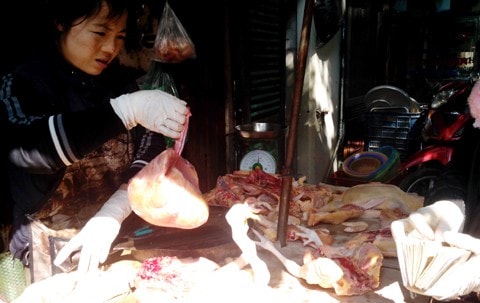 |
Poultry meat of unknown origin is still being sold at wholesale markets and local markets.
In fact, in 2013, there were two cases of A/H5N1 avian influenza in Dong Thap and Long An provinces, including one death in Dong Thap. Both cases had a history of contact with infected poultry. Sellers also failed to prove the origin of their products when customers inquired, only giving vague answers like "Tam Hoang chicken from Bac Giang tastes as good as our local free-range chicken," while people continued to buy uninspected, unverified chickens without realizing the lurking threat of disease.
What is worrying is that this situation is also occurring in many other wholesale markets with high population density in Hanoi.
The Ministry of Agriculture and Rural Development announced that it will submit an urgent directive to the Prime Minister requesting localities to quickly implement measures to prevent and control the spread and outbreak of the disease. Meanwhile, the Ministry of Health is intensifying close monitoring of passengers, vehicles, and goods entering the country at border gates, especially in the northern border region. The Ministry is also monitoring cases of severe pneumonia suspected to be caused by a virus; and collecting samples to identify the causative agent.
In 2013, the world recorded 34 cases of H5N1 avian influenza with 21 deaths, including in neighboring countries Cambodia and China. Cambodia alone had 23 cases with 12 deaths, the outbreak occurring in the area bordering the southwestern border of Vietnam.
According to Vietnamnet


