
Safety risks at the river ferry terminal.
(Baonghean)With the arrival of the rainy and stormy season, it's also a critical time for rectifying and restoring order on inland waterways. However, ensuring safety at passenger terminals on the rivers remains a challenging problem.
Nghe An currently has 14 large and small rivers with a total length of over 1,000km. Major routes such as the Lam River and Con River have steep slopes, and during the rainy season, the water often flows swiftly, creating many dangerous whirlpools. Due to the construction of many suspension bridges and concrete bridges across the rivers in Anh Son, Do Luong, and Tuong Duong districts, the entire province now only has 36 ferry crossings, a decrease of 10 compared to 2012. There are 3 ferry crossings along the river: the upstream ferry crossing at Ban Ve hydropower plant (Tuong Duong), the Lai Ferry crossing in Mon Son commune (Con Cuong), and the Hua Na hydropower plant crossing (Que Phong).
According to statistics from the Provincial Traffic Safety Committee, currently 28 out of 36 river ferry terminals in the province meet the operating requirements, 36 out of 39 vessels operate in accordance with the law, and 53 out of 55 operators at these terminals possess professional certificates. In addition, 94 out of 95 passenger vessels along the river have undergone technical safety inspections, and 100% of ferry operators (94 people) at the river ferry terminals have professional certificates. After three years of implementing the "Traffic Culture for Peaceful Rivers" campaign launched by the province, units and localities have built 15 model projects. Among these, there are 9 model ferry terminals, including self-managed safe ferry terminals such as Cung and Nguoc ferry terminals in Thanh Chuong, Nam Thuong - Nam Dan ferry terminal, Se - Nghia Dan ferry terminal, Cam Lam - Con Cuong ferry terminal, and Trung - Do Luong ferry terminal.
However, according to the assessment of the Transport Inspectorate - Department of Transport, the management and safety assurance at passenger ferry terminals along and across the river still have many shortcomings. In early 2013, through inspections, the inter-agency team issued fines to 70 cases of administrative violations regarding inland waterway safety, with a total fine of over 93 million VND; suspended 9 ferry terminals, 5 passenger vessels that violated registration and inspection regulations or were in poor condition, and 2 temporary bamboo pontoon bridges operating spontaneously across the Hoang Mai River - Hoang Mai Town.
In particular, during the crackdown on illegal sand and gravel mining on the Con River in Tan Ky, dozens of boats and vessels engaged in illegal sand and gravel extraction were seized and processed. At ferry terminals along the lake in Que Phong and Tuong Duong, initial attention has been paid to managing tourist transportation. However, due to the long distances traveled by boats at these terminals, the wide lake, and the deep water, the risk of water transport accidents is unpredictable. Notably, most localities do not manage the terminals themselves, leaving the operation of passenger transport across the river to ferry owners on a "self-financing" basis.
The awareness of ferry operators can predict safety at passenger ferry terminals. The Linh-Lang ferry terminal (Linh Son - Anh Son) is a terminal with a fairly large number of people and students crossing (nearly 300 people/day). According to regulations, the steel passenger boat (15CV) owned by the ferry owners Nguyen Van Tung and his wife is allowed to carry 14 people per trip.
However, this ferry often carries 40-50 people per trip. This is mainly concentrated in the early morning, after the market closes, and during school dismissal times. The ferry owner explained, "Some secondary school students live 4-5 km away from the ferry terminal, and the roads are rough, so they have to walk. Some children wake up late and are afraid of being late for school, so they all rush onto the boat. Making many trips means not only missing school but also wasting fuel." Meanwhile, at Huong ferry terminal in Hamlet 8, Thanh Giang (Thanh Chuong district) – considered a safe, self-managed ferry terminal model – ferry operators still "work" at night. According to Mr. Nguyen Minh, the ferry owner (contracted to transport passengers for Thanh Yen commune at Huong terminal), the high demand for ferry services at night makes up for the long, rainy, or drought-stricken days when they have to paddle kilometers "for free" on the river...
The negligence of both boat operators and passengers is also evident in the "neglect" of wearing life jackets. At Huong ferry terminal (Thanh Giang), which serves residents and teachers from six communes in the Bich Hao area of Nam Dan town, Mr. Minh, the ferry owner, said, "The boat is fully equipped with life jackets, but no one wears them, so they're just stored away." At Tao-Linh ferry terminal (Anh Son), Bai Da ferry terminal (Nghia Thai-Tan Ky)..., we witnessed similar scenes. At hand-rowed ferry terminals, the situation is no better, such as at Binh Son (Anh Son), where life jackets are neglected, old, and damaged.
The infrastructure at the ferry crossings is also alarming. Most are at risk of serious subsidence and deterioration. The Lang-Linh ferry crossing (Anh Son district) was upgraded with provincial funding (8 crossings in the district, each costing nearly 300 million VND to build cement access roads). However, to date, the road section at the Lang Son crossing has been completely "wiped out". This makes it very difficult for residents of Lang Son and students to get to school.
During the rainy season, the road to the ferry terminal is muddy and slippery. The access road to and from the ferry terminal at Hamlet 2, Linh Son, is often dug up and encroached upon by local residents, hindering passengers. The cement access road at Linh Son terminal is frequently buried, forcing ferry operators to constantly change the landing point. The ferry terminal here is always just a sandy area. In all eight ferry terminals in Anh Son, the waiting areas are of poor quality, not operational, and the price list and regulations are damaged. At Bai Da terminal (Nghia Thai), the access road to and from the ferry terminal is eroded and damaged, and the embankment is crumbling...
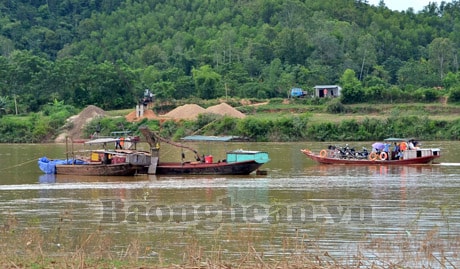
Sand mining on the Lam River affects traffic safety at the ferry terminal. (Photo taken at Linh-Tao ferry terminal, Anh Son district).
In addition, over 355 vehicles involved in mining and transporting sand and gravel, and 87 sand and gravel collection and trading yards (mainly in districts along the Lam and Con rivers), have significantly impacted passenger terminal operations.
According to Mr. Nguyen Viet Hung, Deputy Chief Inspector of the Department of Transport, the management of ferry terminals and passenger terminal operations must be closely linked to the responsibilities of the People's Committees at the district and commune levels. Inspections at many terminals have shown that compliance with waterway safety regulations is only temporary. Many districts have issued written policies on management, but have not conducted inspections of their implementation, resulting in low effectiveness. Most communes, wards, and towns do not issue written directives. Some have issued directives, but they are merely ceremonial, without directing implementation or checking compliance.
Mr. Bui Dinh Canh, Vice Chairman of the People's Committee of Nghia Thai commune (Tan Ky district), acknowledged: "The commune is responsible for urging and reminding boat owners to ensure the safety of passengers crossing the river. However, it is impossible to control all the activities of the boat operators, and even less so to have the right to stop the operation of passenger docks in the area." Support for vehicle registration and inspection procedures, as well as guidance on purchasing river accident insurance for boats and boat drivers, has mostly not been implemented.
To ensure inland waterway safety, especially at passenger ferry terminals during the rainy and stormy season, the Provincial People's Committee issued Decision No. 1030/QD-UBND and Official Letter No. 3285/UBND-NC on strengthening the work of ensuring order and safety of inland waterway traffic during the tourist season and the rainy and stormy season of 2013. Accordingly, the People's Committees of the districts need to continue to promote awareness among ferry owners, households, villages, and especially students about the campaign "traffic culture for peaceful waterways". Strengthen state management of order and safety of waterway traffic, invest in and upgrade ferry terminals promptly, eliminate terminals that do not meet the requirements; immediately suspend the operation of long-distance and cross-river ferries when floods occur. The People's Committees of districts, cities, and towns should organize the signing of commitments to strictly comply with regulations on ferry operation and exploitation on the river. Establish self-governing teams to inspect, supervise, and remind people to wear life jackets. The province has provided over 800 life vests to localities in need and with many active ferry terminals. However, the question remains: how will these facilities utilize this large quantity of life vests?
Luong Mai


