
Causes and solutions to address project implementation delays.
(Baonghean.vn) - On the afternoon of December 11, 2014, during the questioning session, a series of questions were sent to the Director of the Department of Planning and Investment regarding the slow implementation of projects after investment licensing; the causes, responsibilities, and solutions. Six difficult questions were sent to the Director of the Department of Planning and Investment, Nguyen Van Do.
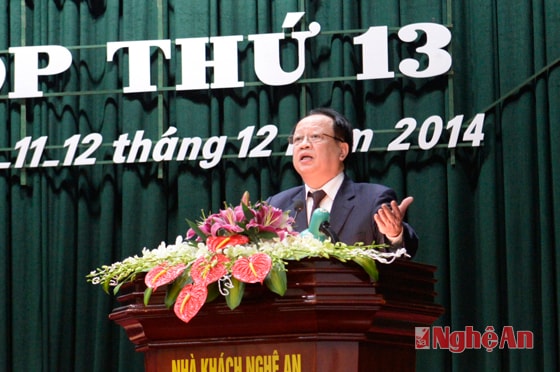 |
| Director of the Department of Planning and Investment Nguyen Van Do answered directly and without avoiding the questions raised by the provincial People's Council representatives. |
Explaining this, Mr. Nguyen Van Do stated that, thanks to efforts in improving the investment and business environment and enhancing the effectiveness of investment promotion, the results of attracting investment in 2014 in the province were very positive. As of November 30, 2014, 127 projects had been newly granted or had their investment certificates adjusted, with a registered investment capital of VND 27,384 billion (achieving the highest results ever in terms of both the number of projects and registered investment capital).
However, the implementation of projects after the issuance of investment certificates is still slow. According to Mr. Nguyen Van Do: This is due to the implementation of investment procedures at competent state agencies, in which the compensation, support, and resettlement procedures are the most time-consuming and problematic stage, and the main reason for the slow implementation of projects after the issuance of investment certificates. Currently, with 10 groups of procedures, the total implementation time according to regulations is from 129 - 225 working days (approximately 5.8 - 10.2 months excluding compensation, support, and resettlement time); 309 - 405 working days (from 14.1 months to 18.4 months including compensation, support, and resettlement time, with compensation and land clearance procedures alone taking about 6 months according to regulations). However, in reality, the time taken to complete these procedures at the agencies is sometimes even longer than stipulated.
The lengthy administrative procedures are one of the reasons for project delays. Compensation and land clearance are the main cause of the current project delays. Very few projects achieve "clean land" status. According to the results of inspections of delayed and unimplemented projects in the province by inter-agency inspection teams from 2011 to the present, over 90% of projects are delayed due to compensation, land clearance, support, and resettlement issues. In particular, some projects have dragged on for years due to compensation and land clearance procedures: (BMC Vinh Plaza Shopping Center, Renovation of Areas A and B of Quang Trung Apartment Complex, Hieu Thai Hoa Market Complex, Olecco Dien Ky Urban Area, Cua Tien - Vinh Tan New Urban Area Project, Residential Area in Nghi Phu Commune, Nam Do Luong New Urban Area, etc.).
Land clearance is the most difficult procedural step in project implementation due to its large scale and the need for simultaneous and decisive action. In some cases, improper handling can easily lead to dissatisfaction among the government and local residents, resulting in projects being "stalled," delayed, or experiencing slow progress. The delay in land clearance is largely due to the inability of investors and landowners to agree on compensation prices (residents demand compensation based on "market value" at the time of land handover. Many investors have to negotiate multiple times with landowners to agree on a price, but compensation costs are only deducted according to the state-determined compensation price...).
The second reason, according to Mr. Nguyen Van Do, is that investment projects are subject to regulation by numerous legal documents such as the Enterprise Law, the Investment Law, the Land Law, the Planning Law, the Construction Law, the Environmental Protection Law, and the Fire Prevention and Fighting Law, not to mention specialized laws and related sub-laws. Being subject to regulation by so many legal documents also makes investment procedures complicated, cumbersome, and time-consuming, slowing down project implementation.
The third reason is that assessing the feasibility of investment projects and screening for capable investors still faces many difficulties.
In practice, assessing the capabilities of investors is very difficult, even though their documentation and procedures meet the requirements and comply with the law. The verification of financial capacity and project implementation conditions is primarily based on the documents provided by the investor, lacking on-site verification and validation. Therefore, the quality of the verification sometimes fails to accurately reflect the investor's actual capabilities.
In many cases, especially for foreign investment projects, it is necessary to coordinate with the Provincial Police to verify the legal status and capacity of the investor as a basis for advising the Provincial People's Committee to consider and decide. In addition, because investors in the area come from outside the province and from abroad, gathering information and verifying the financial capacity of these investors before advising the Provincial People's Committee to issue investment certificates remains challenging.
The fourth reason stems from the lack of available land for attracting investment projects and relocating residents.
Mr. Nguyen Van Do also outlined the responsibilities of each sector and level, as well as solutions to address the issues. Specifically, the Department of Planning and Investment is assigned to lead the process of advising on and resolving the problems arising from 2 out of the 10 groups of procedures mentioned above, including: approving investment policies and issuing investment certificates. However, the delay in project implementation after the issuance of investment certificates is partly the responsibility of the Department of Planning and Investment in verifying the capacity and conditions for project implementation of investors. Many other sectors, such as the Department of Construction, the Department of Natural Resources and Environment, the districts, and the investors, all have responsibilities as stipulated by regulations.
Regarding solutions, Mr. Nguyen Van Do proposed several solutions, including the general solution of implementing the contents of the Project on Focusing on Effectively Attracting Investment into Nghe An Province until 2020, which has been approved by the Provincial Party Committee Standing Committee.
Following the explanation by the Director of the Department of Science and Technology, delegate Hoang Xuan Truong (Yen Thanh district) asked: According to feedback from investors and voters in the province, administrative procedures are still cumbersome during the implementation of projects, coordination between agencies is rigid, and the spirit of the province's directives is not truly understood. What is the solution to this situation? Mr. Nguyen Van Do said: The province and agencies are not allowed to create additional procedures, and there may be some shortcomings in the implementation process, but the 10 sets of procedures are in accordance with the Law. The Provincial People's Committee has directed departments and agencies to assign competent personnel to handle issues at the focal point. He also said that the One-Stop Service system has not been effective recently and the Provincial People's Committee is addressing this issue. While the One-Stop Service system has surveillance cameras, the assignment of tasks from leaders to the One-Stop Service department is not thorough. The department's meetings are not frequent, and information technology does not meet the requirements.
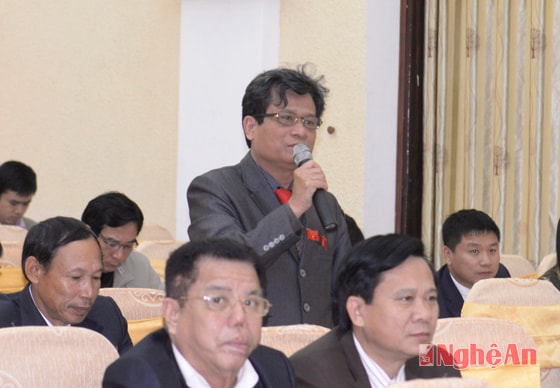 |
| Representative Hoang Xuan Truong (Yen Thanh) questioned the cumbersome investment procedures. |
Responding to a question from delegate Pham Van Tan (Nghi Loc district) regarding the need to clarify that out of 76 projects inspected, only 5% were implemented, and 20% were being considered for revocation, what about the remaining projects? Mr. Nguyen Van Do stated that these 76 projects were all projects that had been repeatedly reviewed and found to be behind schedule, hence the inspection, and were not random. Most of these projects were invested in as part of a trend. Besides these projects, the remaining projects are basically being resolved. Granting permits is easy, but revoking them is very difficult. And the most difficult part is land clearance.
Video clip of delegates questioning the director of the Department of Planning and Investment:
.
Representative Pham Van Tan also asked: "Which areas have the most violations during the inspection of projects?" Mr. Nguyen Van Do stated that it was the violation of planning regulations. Mr. Pham Van Tan continued to ask: Is the slow pace of investment attraction after licensing the reason why the proportion of industry and construction in the past term was low? Mr. Nguyen Van Do replied: Urban development projects currently account for a high proportion, over 70%, and the province is adjusting the structure. The sharp decline in industry and construction in recent years is due to reduced public investment and the economic recession, not because of slow project implementation. Key industrial products of the term, such as cement and beer, did not meet targets. However, this answer did not satisfy Representative Nguyen Van Tan.
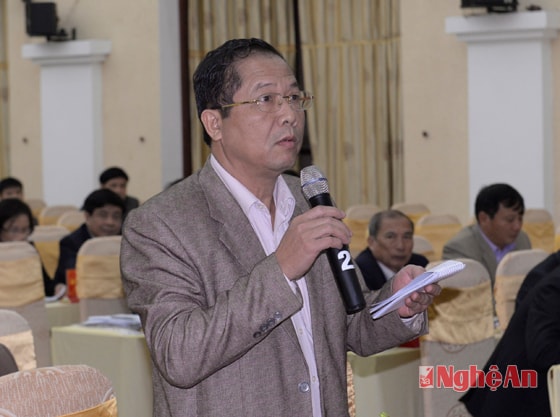 |
| Representative Pham Van Tan questioned the situation where many projects are not implemented after being granted permits. |
The delegate continued to ask: "So, what is the capacity and responsibility of state agencies and organizations when assessing investors regarding difficulties in land clearance for the project?" Mr. Nguyen Van Do replied: "With only 2-3 days to assess the application and procedures, it's impossible to assess the investor's capacity, taking into account the difficulties involved. It's truly unforeseen. Furthermore, land clearance is handled by a different agency, not the investment licensing agency."
Regarding the question: The Nguyen Kim supermarket project, which started construction nearly three months ago, still doesn't meet the construction requirements? Mr. Nguyen Van Do stated: The land allocation procedures are currently being processed as compensation is being paid to the previous investor.
Representative Dinh Thi An Phong (Nghi Loc) posed two questions to the Director of the Department of Science and Technology and Investment: What are the solutions for implementing the Vinh University Phase 2 project and the Vinh-Cua Lo Boulevard project? The provincial competitiveness index is still low, ranking 43rd out of 63 provinces and cities nationwide; what solutions are there to improve provincial competitiveness? Mr. Nguyen Van Do replied: Currently, the province is reviewing the situation. Regarding the Vinh-Cua Lo Boulevard project, the province is requesting central government support for funding, as the provincial budget cannot meet the requirements. Regarding the provincial competitiveness index, Mr. Nguyen Van Do stated that a low index is generally unfavorable for attracting investment, but this year's investment attraction results show that this index is not entirely accurate. Recently, the Department of Science and Technology and Investment advised the province to issue an action plan to improve the provincial competitiveness index. Consensus between businesses, the people, and the government at all levels is crucial for a good investment environment.
 |
| Ms. Dinh Thi An Phong - Representative from Nghi Loc district, raises questions. |
Regarding the question from delegate Pham Van Tan about the content mentioned in the exchange section of Nghe An Newspaper on December 10th, page 1, which stated that fundamental solutions are needed to overcome the "chronic problem" in many situations, including slow investment attraction after licensing, Mr. Nguyen Van Do acknowledged that the newspaper's statement was accurate.
Representative Thai Thi An Chung (Do Luong) continued her questioning: The report on the socio-economic situation shows that attracting projects to economic zones and industrial parks is still too limited, with only 11 projects. Recently, the Prime Minister's Decision 76/2014 expanded the Southeast Economic Zone; has the sector failed to promote and attract investment? Mr. Nguyen Van Do stated: Currently, the province has 1 economic zone, 8 industrial parks, and 32 small industrial clusters, of which 32 small industrial clusters are already fully occupied. The Southeast Economic Zone is attracting the VSIP 6 project. This is a strong investor with significant potential, and their arrival will create a breakthrough for the province. They will bring their own investors here.
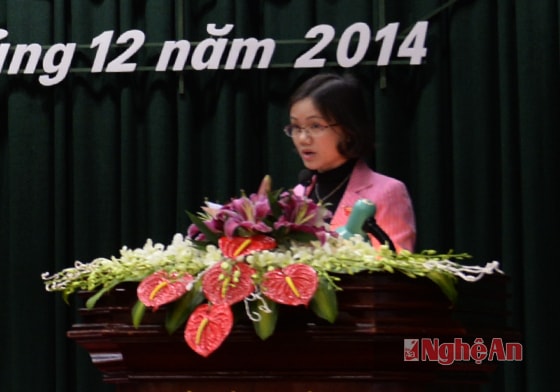 |
| Ms. Thai Thi An Chung - representative from Do Luong district - raised a question. |
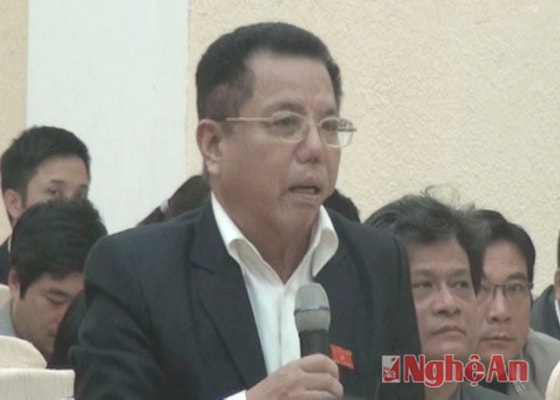 |
| Mr. Truong Van Hien - Representative from Yen Thanh District |
Representative Truong Van Hien (Yen Thanh) suggested that, as a business involved in investment projects, the Department of Science and Technology should advise the province to reduce investment procedures, as going through 10 steps is too time-consuming. Businesses could pay the Investment Promotion Center to handle the procedures for them. The Department of Science and Technology should prioritize investment projects and procedures, giving priority to high-tech agricultural projects. Mr. Nguyen Van Do acknowledged that this has not yet been done, but the Department of Science and Technology will consider and implement the representative's suggestion in the future, as it is a good solution.
Thus, there were 6 instances of questioning the Director of the Department of Science and Technology and Investment, and the Director provided specific answers to these questions. On behalf of the presiding officer of the session, Mr. Nguyen Xuan Son – Member of the Standing Committee of the Provincial Party Committee, Vice Chairman of the Provincial People's Council – concluded that the questioning of the Department of Science and Technology and Investment basically met the requirements of the delegates and the aspirations of the voters. Due to the slow implementation of many projects in the past, voters still have many concerns and obstacles. The presiding officer highly appreciated the accountability of the Department of Science and Technology and Investment, and the role of the Provincial People's Committee and relevant departments in effectively attracting investment in the past. He also proposed solutions to attract investment effectively and requested the Provincial People's Committee and relevant departments to resolutely revoke projects that are stalled, not implemented, and negatively impacting the province's investment environment. Strengthening leadership and leveraging the combined strength of the entire political system will contribute to a significant improvement in the investment environment, especially through effective and convincing administrative reforms.
Chau Lan -Sy Minh


