
Farmers combat drought during the summer-autumn crop season.
(Baonghean.vn) - The summer-autumn crop season is currently in its peak irrigation period for sowing rice seedlings and preparing the land for planting. Farmers in many localities in the province are struggling against drought and overcoming water shortages to continue production...
In Quynh Luu district during the hot days of early June, farmers in the communes are busy preparing the land for the 2015 summer-autumn planting season. For the past few weeks, the weather has been continuously hot, reaching 37°C.0C - 380The drought has caused the land to crack and dry up, leaving many localities at the end of the irrigation canal system constantly facing severe drought and water shortages for production. The family of Mr. Ho Duc Hai, in Hamlet 1, An Hoa Commune, is one of the households at the end of the Do Luong canal system that has to go to the fields every day to pump water from the drainage canal system into their rice paddies to irrigate the land. “Every year, during the summer-autumn planting season, we struggle because of the water shortage. Because we are at the end of the canal, the water source is insufficient to pump water into the fields, so we have to mobilize machinery to pump water from several canals, ditches, ponds, and lakes into the fields to ensure timely production,” Mr. Hai shared.
| Farmers in An Hoa commune (Quynh Luu district) pump water from the river into their fields for planting. |
An Hoa is located at the end of the Do Luong canal system, so it often suffers from severe water shortages during the summer-autumn crop season. Mr. Hoang Van Binh, Chairman of Toan Thang Cooperative (An Hoa), stated that the commune currently has two canal systems, N26-6 and 24-7, originating from the Do Luong Para system. However, due to its location at the end of the canal system, water is often lost by the time it reaches the area, leaving insufficient water for pumping into the fields. To combat drought and support production, the cooperative and local farmers continuously use pumps to irrigate the fields. Currently, with manual drought mitigation measures using pumps to irrigate from the river, farmers have planted about 30% of the rice crop. However, insufficient water supply will significantly affect the growth of the seedlings. Therefore, Toan Thang Cooperative is implementing necessary measures to combat drought during this period of intense heat, hoping to ensure the safe development of the seedlings.
Not only An Hoa commune, but also several other communes such as Quynh Thanh, Quynh Bang, Quynh Hoa... are experiencing drought due to water shortages. In Quynh Bang commune, due to the extremely hot weather and its location at the end of the N28 canal system, farmers are currently unable to sow rice seedlings. The entire commune has 390 hectares of agricultural land, of which 62 hectares are planted with rice, and the rest with vegetables and other crops. Currently, the hot weather has caused agricultural land to dry up; about 50% of households have not been able to sow rice seedlings, and vegetable growing areas are experiencing water shortages. The groundwater level in drilled wells has dropped significantly, making it impossible to pump water for irrigation, affecting crop yields. Mr. Vu Van Duong, Vice Chairman of the Commune People's Committee, said: To cope with the drought, the local government is actively directing cooperatives and people to pump and drain water from some canals, ponds and lakes to prepare rice seedlings. They are also advising farmers to sow short-day, high-yield rice varieties in a timely manner, avoiding late-season floods that could affect harvest yields.
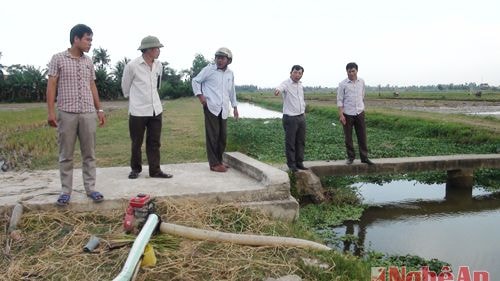 |
| Quynh Luu Irrigation Enterprise inspects water sources in canals, reservoirs and dams in An Hoa commune. |
According to information from the Quynh Luu District Irrigation Enterprise, the cause of the drought is the low water levels in three reservoirs: Ba Tuy, Reservoir 32, and Khe Than. Due to the low rainfall at the end of the 2014 rainy season, water storage was insufficient. Of the three reservoirs, Ba Tuy reservoir was drained for construction and dam upgrades, leaving no water for irrigating 145 hectares of agricultural land in Quynh Tan commune. To remedy this situation, the irrigation enterprise used pumps from the main canal of Vuc Mau Reservoir to irrigate 60 hectares, while the remaining land relies on weather conditions for irrigation. Regarding the plan, the irrigation enterprise will release water from Khe Than Reservoir to Reservoir 32, and simultaneously pump water from drainage canals to supply the water-scarce communes. In addition, they will regulate the sluice gates at the beginning of the canals managed by the enterprise to direct water to the downstream areas of the communes. They will also pump water from drainage canals, rivers, and streams to provide irrigation for planting and drought relief.
In Hoang Mai town, some localities that have finished harvesting the spring rice crop are urgently preparing the land for planting the summer-autumn crop, such as Quynh Xuan, Quynh Vinh, and Quynh Trang; while Quynh Loc and Quynh Lien communes are waiting for natural water sources before they can proceed with seedling cultivation. Quynh Loc is a commune located in a hilly, high-lying, and arid area, making agricultural production very difficult, especially during the summer-autumn season. The entire commune has 490 hectares of agricultural land, of which 250 hectares are used for rice production, and the rest for vegetables and other crops. The commune currently has 6 reservoirs, of which the largest reservoir is only about 2.9 hectares, sufficient for irrigating the spring crop, while the rest are dry. Therefore, during the summer-autumn season, farmers can only utilize stagnant water in ponds, lakes, and canals to pump water into their fields, and they have to wait for rain for water to cultivate.
In the mountainous district of Nghia Dan, prolonged hot weather has caused drought in many areas. In Nghia Lam commune, 13.5 hectares of spring rice crops were damaged by drought. In Nghia Lac commune, some highland areas are experiencing water shortages, resulting in lower yields compared to other seasons. To date, 70% of the spring rice crop in the district has been harvested. The prolonged hot weather and low water levels in reservoirs and dams are affecting summer-autumn rice production, making it difficult to meet the planned target of 3,500 hectares of summer-autumn rice in 2015. The district has more than 200 reservoirs of various sizes to irrigate all rice and other crops.
Currently, only the town area, Nghia Binh, Nghia Hoi, Nghia Trung, Nghia Khanh, Nghia Duc, Nghia Loc, and Nghia Thang communes still have irrigation water. Approximately 30% of the communes in the district are facing difficulties with water resources for the summer-autumn crop season. Mr. Truong Minh Hoai, Head of the Agriculture Department of Nghia Dan district, said: Given the critical water situation, the district is focusing on directing localities to actively prevent and combat drought using all available means and technical equipment. This includes repairing field embankments, dredging canals to ensure smooth water flow, utilizing returned water, and using water sparingly. They are also reviewing the number of electric and diesel pumps, and repairing existing pumps to ensure water supply for drought relief in the area.
According to a report from the Nghe An Irrigation Department, by the end of May 2015, only the Tan Thang reservoir (Quy Hop district) had run dry, while other reservoirs had water levels ranging from 30-70% of their designed capacity. The remaining reservoirs managed by communes and cooperatives had water levels of only 20-40% of their designed capacity, enough for only one or two more irrigation cycles. Meanwhile, the summer-autumn planting season, from May 25th to June 20th, must be completed. If there is no rain by June 20th, a severe drought will occur.
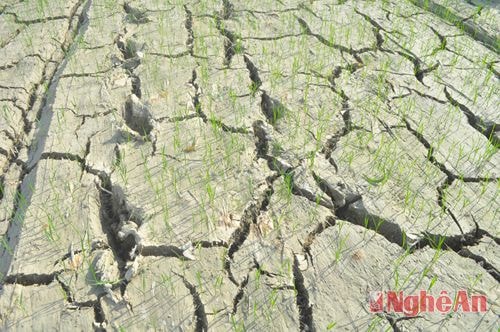 |
| Having just planted the summer-autumn crop, some areas in Hung Thang commune (Hung Nguyen district) are experiencing severe drought. |
Given this situation, to ensure water supply for the summer-autumn crop production, the Department of Agriculture and Rural Development requests the People's Committees of districts, cities, and towns, and irrigation limited liability companies to review and assess the balance of water resources to arrange summer-autumn crops suitable to the specific conditions of each locality. Based on this, they should direct the rational conversion of crops, and areas that do not have sufficient irrigation water throughout the season should be converted to planting other crops to ensure that the entire area and food production targets are met.
Focus all efforts on providing irrigation water for agricultural production; proactively mobilize forces, equipment, and pumps to utilize water sources from reservoirs, rivers, and streams, and be ready to pump water to combat drought. The Department of Agriculture and local irrigation organizations must strictly manage water resources, prevent leakage and loss, and distribute water rationally and efficiently; have a specific irrigation schedule and organize irrigation scientifically to save water. Irrigation companies must coordinate closely with localities, direct irrigation, and concentrate water to ensure water for areas at the end of the canals; for reservoir areas, calculate the specific amount of water and the number of irrigations, and based on that, manage irrigation to ensure crop growth and development, save water, and pay attention to the rice heading and flowering stages...
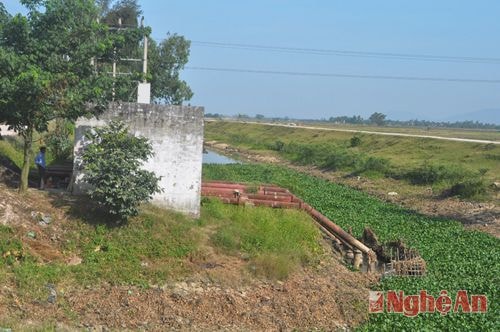 |
| Hung Nguyen 12-9 pumping station pumps water to combat drought. |
Quynh Lan - Viet Hung


