
State and religion
Religion is one of the defining characteristics of human society. Originating from the capacity for thought, perception of the world, and self-awareness, religion is the crystallization of thoughts, feelings, aspirations, and philosophies of life, and is one of the greatest achievements of human civilization. It is no coincidence that many religions exist, spanning across space and time, passed down from one community to another, undergoing preservation, transformation, assimilation, and enlightenment to create a diverse and vibrant spiritual culture of humanity.
(Baonghean)Religion is one of the defining characteristics of human society. Originating from the capacity for thought, perception of the world, and self-awareness, religion is the crystallization of thoughts, feelings, aspirations, and philosophies of life, and is one of the greatest achievements of human civilization. It is no coincidence that many religions exist, spanning across space and time, passed down from one community to another, undergoing preservation, transformation, assimilation, and enlightenment to create a diverse and vibrant spiritual culture of humanity.
The doctrines and dogmas of each religion may differ, but they intersect in belief in a supernatural force manifested in a form more or less familiar to "mortal beings." This Almighty, the Creator, is the symbol of what is good, ideal, and exemplary that humanity desires and consciously strives to emulate.
The history of religious development in Vietnam begins in the early centuries AD with the introduction of Buddhism from India. Buddhism flourished and reached its golden age during the Ly and Tran dynasties. Later to Buddhism was Catholicism, also known as Christianity or Christian religion, introduced by Spanish and Portuguese missionaries. Both religions experienced turbulent historical periods, witnessing the decline and rebirth of societies, gradually incorporating Vietnamese traditions and customs to harmonize with the long-standing Vietnamese culture, accompanying the country in its process of modernization.
To date, besides the two religions mentioned above, Vietnam also accepts other religions such as Protestantism, Cao Dai, Hoa Hao, Islam, etc. Religion, in its role of caring for spiritual life, ultimately guides people towards goodness and virtue. Thus, religion is an entity that is both independent and consistent with humanity: spiritual life should not influence or control other aspects of society such as politics, economics, education, etc., but at the same time, it serves as a foundation for our thoughts and beliefs to remain stable and undirected.
Achieving the harmonious coexistence of religion within society is not only the responsibility of religious organizations and individuals, but also requires attention and support from the government. Creating conditions for people to practice their spirituality and beliefs within legal frameworks and bringing benefits to society as a whole is a matter of constant concern for the Vietnamese Party and State in general, and in Nghe An in particular.
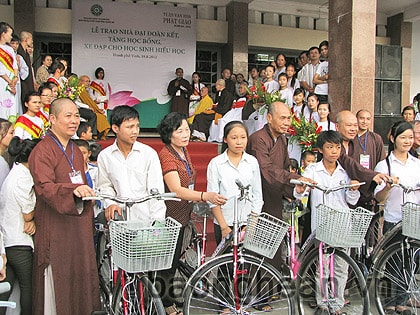
Donating bicycles to poor but academically excellent students during Buddhist Culture Week (2012)
Using traditional crafts to support religious practice.
Catholicism was introduced to Vietnam in 1533, but it wasn't until 1615, with the missionary work of Portuguese Jesuits, that it began to flourish. According to church documents, between 1615 and 1665, there were approximately 100,000 Catholics nationwide. In Nghe An province alone, in 1593, there were 12 villages that were entirely Catholic. (according to...)Some religions in Vietnam(Religious Publishing House).
Thus, Catholicism has a long history of development in Vietnam in general and Nghe An in particular, especially in the complex political and cultural context of the colonial wars waged by Western countries. However, overcoming contradictions and conflicts during a turbulent period, Catholicism has steadfastly accompanied the nation and become the second most popular religion in Vietnam. In Nghe An alone, Mr. Phan Hai Thanh, Vice Chairman of the Provincial Catholic Solidarity Committee, stated that there are currently 10 deaneries, 85 parishes, and 339 sub-parishes with 50,843 households, accounting for 8% of the province's total population. Under the attention of the Party and the State, many churches have been newly built and many places of worship have been repaired and upgraded, creating favorable conditions for Catholics to practice their faith and engage in secular activities. The Catholic community has also made significant contributions to preserving traditional values and developing the economy.
Visiting the traditional cake-making village of Vĩnh Hoà, recommended by a friend, my first impression was the rows of signs along the provincial road advertising shops selling sticky rice cakes, steamed rice rolls, thorny rice cakes, and peanut brittle. Vĩnh Hoà is the only predominantly Catholic village among the 11 villages (hamlets) of Hợp Thành commune, Yên Thành district, with over 200 households engaged in the traditional sticky rice cake making craft. We met Mr. Lưu Đức Bằng, the head of the Vĩnh Hoà village, while he was chatting at Mr. Trần Quốc Khánh's house.
Mr. Bang recounted that this craft has been passed down from his grandparents and great-grandparents. When he was only 12 or 13 years old, he saw his parents wrapping banh chung (Vietnamese rice cakes) and developed a passion for sticky rice and banana leaves from then on. Mr. Khanh's wife unwrapped a pair of banh chung and a packet of cu do candy to offer the guests. The banh chung, about the size of a hand, was a vibrant green, and when cut open, revealed a generous and firm filling of mung beans and meat. Mr. Bang urged us to try some to see if Vinh Hoa banh chung lived up to the hype, adding that Mr. Khanh was a renowned banh chung maker in the village.
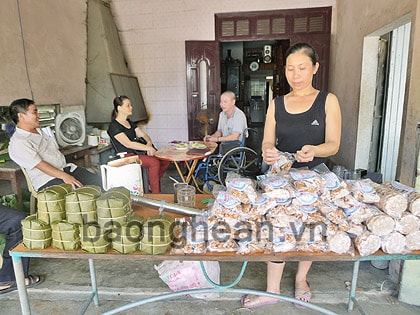
Ms. Hoang Thi Chau - a parishioner from Vinh Hoa village, stands beside her stall selling banh chung and cu do (traditional Vietnamese rice cakes).
The experience of eating banh chung (Vietnamese sticky rice cake) and cu do candy – two quintessential national dishes of Vietnam and Nghe An – under the loving gaze of Jesus and the Virgin Mary, is something we will probably never forget. How could a foreign ideology and philosophy, with its solemn and sacred rituals, blend so naturally and harmoniously with the simple, traditional values of Vietnam? The rich, chewy texture of the banh chung and the sweet, subtly ginger-flavored cu do candy intertwine and embrace each other. This loving-kindness is further enhanced by the strong tea of Do Luong, like a cool stream of gospel flowing through the ancient bamboo groves of our nation.
Inquiring about the economic situation of the people in Vinh Hoa Catholic village, village head Luu Duc Bang happily reported that thanks to the traditional cake-making craft, 100% of households now own motorbikes, and over 30% have achieved a comfortable or wealthy economic status. Notably, several young people from the village have graduated from universities and colleges and returned to their hometowns, joining the government or teaching in schools. This year, nearly 20 young people participated in the university and college entrance exams, and almost 50% were admitted. The continuous improvements in religious laws and policies, along with the religious work of the local government, have created favorable conditions for the Catholic community to fulfill their duties as parishioners and citizens, living virtuous lives. He happily recounted that during important Catholic holidays, the local government leaders are even busier than the Catholic families themselves, as they are invited by all the households to celebrate together.
Looking inside the house, one could see an altar dedicated to Jesus and the saints on the wall. Khanh's son placed the book "New Methods for Quickly Solving Physics Multiple Choice Questions" on the table and handed his mother a stack of survey forms for processed products bearing place names from Nghe An province. The people of Vinh Hoa, with their harmonious blend of religious and secular life, have preserved a valuable traditional craft, thereby nourishing their physical bodies while nurturing their souls.
Living the Gospel in the heart of the nation.
Leaving the traditional craft village of Vinh Hoa, we arrived at Nghi Xuan commune, Nghi Loc district, where a large number of people work abroad, bringing significant income to the locality. It is known that those who work abroad receive advice and loans from the Nghi Xuan Commune People's Credit Fund (established in 2006 under the direction of the Commune People's Council). The CEO and Chairman of the Board of Directors is Mr. Dang Hoang Phuong, who is also the owner of Hoang Thanh Seafood Exploitation Company.
When we arrived, the Nghi Xuan commune people's credit fund was quiet. Mr. Phuong said that the busiest time is when people come to pay interest at the end of each quarter. Starting with only 85 founding members and a capital of over 200 million VND, the credit fund now has 878 members with a capital of nearly 27 billion VND according to the summary report of the first six months of 2013 (exceeding the 2013 plan target of 25 billion VND). Since its establishment, the fund has provided loans totaling over 22 billion VND to more than 215 workers for export to countries such as South Korea and Taiwan. A particularly interesting point is that people from Nghi Xuan commune who are familiar with the river and sea trade, when they come to the credit fund, are advised to go abroad for work according to their "specialties": offshore fishing (Taiwan) or inshore fishing (South Korea).
Perhaps his connection to the sea and river was a matter of fate, Mr. Phuong said, recounting the story of the fishing boats drifting from Thanh Hoa to this place. In 1960, following the call of the Party and the State, his parents settled ashore in Nghi Xuan commune. Having been a member of the Van Xuan fishing cooperative in various positions: mechanic, captain, manager, and movement leader, this Party member from a Catholic community, with his determination to develop economically, once owned a stone production factory (with a capacity of 18 tons) and a 16-seater tourist bus running the Vinh-Hanoi route.
His life finally "anchored" itself at the Nghi Xuan People's Credit Fund and Hoang Thanh Seafood Exploitation Company with its 140CV "Two-Pillar" ship, nicknamed the "lucky ship" that never suffered losses. His Hoang Thanh Seafood Exploitation Company provided stable employment with an average income of 5-8 million VND per person per month for 16 direct employees, not including 12 indirect employees. Following the Lord's teachings on charity and the national tradition of "helping those in need," Mr. Phuong mobilized members of the credit fund and Hoang Thanh Company to raise funds for charitable work. In 2011 and 2012, they raised 32 million VND to build houses for two poor families, support elderly associations, and provide scholarships for underprivileged students in the locality.
Expressing our desire to see the "Two-masted" ship in person, Mr. Phuong regretfully informed us that the ship had been out fishing for three days and would likely not return for several more days. We then followed a credit union employee to the home of Ms. Dau Thi Hien, wife of Captain Dau Thanh Kinh, in Xuan Duong hamlet, Nghi Xuan, to inquire about the situation of her youngest son, who was studying Business Administration in Australia with a loan from the credit union. In their spacious house, sharing a large courtyard with a relative's family, Ms. Hien was busy feeding 50 chickens. Besides her husband's fishing work, she also raised pigs and chickens to supplement their income. Touring the house, we saw that beneath the altar to God were altars to her father-in-law and brother-in-law. She explained that her brother-in-law fought in the Cambodian war and died at the age of 23.
The woman, with her weathered, coastal complexion, recounted her husband's sea voyages with longing and nostalgia, but also with pride, mentioning that in 2003, the "Two-Column" ship saved the entire family of "Five-Beard" (Nghi Xuan) who were in distress while fishing. Every year, the ship that Mr. Kinh commands still cooperates with Border Guard Squadron 2 to patrol and monitor the security situation in the sea area. On July 19th, Mr. Kinh and his crew even participated in a training exercise with the district and provincial military commands.
Thus, within the heart of the nation, Catholics living the Gospel with a spirit of economic development have made Nghi Xuan even more vibrant. Moreover, the red flag with a yellow star fluttering above the altars of God on the ships serves as a watchful eye guarding every nautical mile of our homeland's seas and islands.
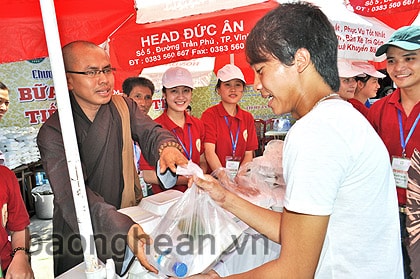
Buddhist monks and nuns from Phuc Thanh Pagoda (Hung Nguyen) participated in supporting students during the 2013 university entrance exams.
Taoism - Nation - Socialism
We met Venerable Thich Tho Lac, Deputy Chairman of the Standing Committee of the Vietnam Buddhist Association of Nghe An province and abbot of Dai Tue Pagoda, just before a meeting of 15 abbots from pagodas across the province. We learned that this meeting was to prepare for a conference on disseminating policies and laws on religion to monks, nuns, and Buddhist followers, scheduled for July 31st and August 1st, organized in collaboration with the Religious Affairs Department and the Department of Internal Affairs of Nghe An province.
Established in 2011, thanks to the support and attention of the authorities at all levels and the solidarity of monks, nuns, and Buddhist followers, the Executive Board's activities have gradually stabilized in terms of personnel and facilities. Currently, there are 40 monks residing in the area who are in the process of having their registration formalized, and 36 temples have been licensed by the State for restoration and renovation, such as Dai Tue, Trung Linh, Can Linh, Phuc Lac, Phuc Thanh, Cau Am, and Gam temples... In particular, Dai Tue temple has been planned on a large scale, and several items such as the main hall, monks' quarters, lay people's quarters, and Hue Son Great Buddha have been completed... As a result, Buddhist activities in the province are ensured, with the presence of functional agencies to maintain order and security so that monks, nuns, and Buddhist followers can practice their faith with peace of mind.
The Executive Board of the Vietnam Buddhist Association of Nghe An Province has determined that its activities should be guided by the principle of accompanying the nation, adhering to the legal framework and charter of the Central Vietnam Buddhist Association. Charitable and community activities such as the heart surgery program for the poor (Dai Tue Pagoda alone raised over 200 million VND), fundraising during the Buddha's Birthday celebration to support the poor, etc., are the clearest evidence of Buddhism's contributions to the benefit of the community.
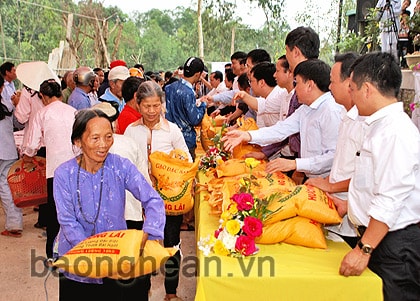
District leaders and the Thanh Chuong District Business Association
Giving gifts to poor households
Venerable Thich Tho Lac also expressed his wish for continued attention and support from the Party and the State to enrich the religious activities of the Buddhist community in Nghe An. Activities such as the Cultural Week, the Day of Peaceful Practice and Dharma Teaching, the Summer Retreat at Dai Tue Pagoda and Can Linh Pagoda, the Ordination Ceremony, and the Buddha's Birthday Celebration help monks, nuns, and Buddhists practice and propagate the Dharma while widely disseminating state regulations to promote healthy religious activities in both spiritual and worldly life.
Speaking at the conference, Comrade Nguyen Van Long, Deputy Head of the Religious Affairs Department of Nghe An province, openly and cordially discussed with the monks, nuns, and Buddhist followers attending the conference about the "circumstances" that led him to become involved in religious affairs. He also affirmed that to act correctly, one must have correct understanding, and to have correct understanding, one must have correct knowledge. To understand religion, as well as the thoughts and feelings of religious followers, there is no other way than to nurture faith and put oneself in the position of a believer instead of judging based on one's own existing knowledge. Through this, Comrade Nguyen Van Long conveyed the open stance of the Party and State on freedom of belief and religion, and affirmed: "If religious activities are legitimate and comply with the law, we will create all conditions for religion to develop sustainably."
Throughout its long history of existence and development in Vietnam in general and Nghe An in particular, religion has proven its positive influence on the spiritual lives of its followers without hindering the fulfillment of responsibilities and duties as good citizens. To achieve this, consistency and a combination of adhering to doctrine, preserving national traditions, and complying with state laws are necessary. The Communiqué of the 3rd Congress of the Vietnamese Bishops' Conference (1986) states: “We are both Catholics and citizens of the Socialist Republic of Vietnam; these two qualities cannot contradict each other if we live our faith authentically and have genuine patriotism.”
This means that Catholics are also Vietnamese, though the two names are of the same essence. The unity between religion and citizenship is also present in Buddhism, forming a unique characteristic of Vietnamese Buddhism. As Venerable Thich Gia Quang, Deputy Secretary General of the Executive Council and Chief of the Central Office of the Vietnam Buddhist Sangha, said: “The Vietnamese have instilled in Buddhism a high degree of patriotism, transforming it from an detached religion into an actively engaged one, making a significant contribution to strengthening people's hearts and uniting the community.”
Thus, although religions are diverse and differ in ideology and philosophy, they are not incapable of "unification." Ultimately, both religious and non-religious religions have certain beliefs and value systems, and if common ground is found, it is possible to harmonize religion with religion, and religion with non-religion, serving the common good. This mission of reconciliation lies in the hands of the Party and the State, and the key to this task is building a state "of the people, by the people, and for the people."
President Ho Chi Minh once said: “Today, Vietnam has only one political party: the entire people determined to win independence. Buddhists believe in Buddha; Christians believe in God; just as we believe in Confucianism. These are supreme beings, so we trust them. But as for the people, we must not go against their will. Whatever the people want, we must do.” This great and humane ideology of his has been, is, and will always be the core of the policy of freedom of religion and belief in Vietnam, contributing to strengthening national unity and leading the country forward on the path of reform.
Hai Trieu - Thanh Thuy


