
Poet Nguyen Khac Thach: "Knowing half my life is shattered, I still offer it up."
(Baonghean)Beside the Perfume River, its flow languid and slow, like the stagnation of centuries of life, a poet counts his steps, lost in thought. He walks silently, as if searching for something amidst the ups and downs of the world. This man, tall and imposing like an athlete, yet preferring to withdraw into himself, is the poet Nguyen Khac Thach, who created poetry that pierces the heart.
It's the kind of poetry meant for contemplation, for enlightenment. Thach confided: "Life has its laughs and its tears. Everyone can laugh in the way others laugh, but you must cry with your own tears." Therefore, for Thach, poetry is the negative image of tears. Reaching the depths of sorrow, Thach found his true poems. These poignant, heart-wrenching poems are like a hand lifting the human soul to its feet. Because of this, these tearful poems have resonated with dozens of musicians, who have set them to music, including Phu Quang, Ngoc Dai, Ha Sam, Tran Huu Phap, Ngoc Ban, Huy Chu, Phu An, Huy Tap, Dong Tam... Musician Ngoc Dai alone has set to music more than twenty of Nguyen Khac Thach's poems in the collection "The River with One Bank."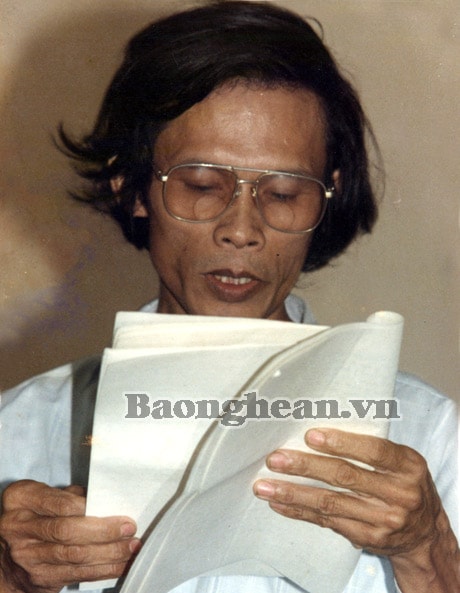
Like everyone else, Nguyen Khac Thach also has a village where he was born and raised. It's Dieu Oc village, Phuc Thanh commune, Yen Thanh district, Nghe An province. But fate forced him to leave his village early, wandering through many places. He was orphaned from his father while still in his mother's womb. Then his mother remarried in another rural area, and Thach said goodbye to her and returned to Dieu Oc village to live alone.
But back in his hometown, both his paternal and maternal families were classified as landlords, leading to their financial ruin. Thach had to endure the hardships of hunger, poverty, and ragged clothes typical of a sad orphan. At the age of 15, he had to go live with his cousin in Se village, Nghia Dong commune, Tan Ky district, more than 60 kilometers away from his village, to make a living.
He did countless arduous jobs like logging in the forest, carrying soil, plowing fields, building embankments, constructing dams, burning charcoal, harvesting rice... and at one time, he worked as a blacksmith, hammering and forging all day long. "I am a stranger in the village of Kieu, wearing the simple clothes of a villager / On the other side, greetings are not as grand as a feast / On the other side, people shake hands while haggling..." For him, his homeland was only the image of his frail, suffering mother, burdened by multiple marriages, children, and childbirths, whom he only visited occasionally. His mother had also wandered to many places like Dak Lak, Lam Dong, Vinh Linh, Dong Hoi… following her children and grandchildren.
Until, his mother became a mound of earth at the foot of the sim flower hill in Dong Hoi, Quang Binh... Thach wept for his mother: "I return to mourn you, Mother / The incense of farewell burns in the orphaned sky…" Perhaps Nguyen Khac Thach is one of the few Vietnamese poets who had the loneliest and most sorrowful childhood. Fortunately, heaven blessed him with extraordinary strength. In Se village, he plowed the fields and dug the soil all day without getting tired, carrying seventy or eighty kilograms of rice and fertilizer, running swiftly across the fields, earning the admiration of many girls. In his twenties in Dong Hoi, Quang Binh, on one occasion, in front of his colleagues, Thach single-handedly carried a heavy Tran Hung Dao water pump weighing hundreds of kilograms from the pond up a hill for more than a kilometer.
Those lonely years, lacking the warmth of a mother and father, and having to work as a hired hand, shaped Nguyen Khac Thach into a taciturn, thoughtful, and emotionally expressive man, possessing strong character and unwavering determination in his studies, constantly striving to find his own path. Living in that remote village in the Central Highlands, Thach always went to the house of his teacher, Mr. Nguyen Si Ngo, in Se village to read books and study music. The teacher's house had a library of thousands of books. The teacher was also a talented musician.
While in high school, Nguyen Khac Thach secretly learned to play the violin, zither, and two-stringed fiddle. Thach was a talented musician, so when he went to study at the Planning School in Ha Tay, he led a school art troupe to participate in the Northern professional schools' art festival. At the festival, seeing how skillfully others played the violin, he deliberately broke a string to cancel his performance. This was the first manifestation of his self-respect. Because of his passion for the violin, he later decided to have his son study it. And now, his son has become a skilled violinist in the Vietnam Symphony Orchestra.
Graduating from a school of economics and planning, and having worked in many different jobs, Thach felt that none of them were his true calling. Through those silent "migration" journeys, the final leg of his quest, Thach found his true calling: poetry! He wandered like a shadow in the sky, hoping to find something that would never be lost… That “something that would never be lost” was poetry – something few people appreciate, but it is what made the name of poet Nguyen Khac Thach in the Vietnamese literary world. There is a river with only one bank, the other side turns its back, a river he can never cross.
Perhaps because of his name, Thạch, he is very "stubborn" and extremely taciturn. Thạch's poetry is also concise and reserved. For Nguyễn Khắc Thạch, poetry is a laborious quest, a persistent struggle. For Thạch, each poem is an excavation, a dive to find words.
He wrote poetry like a "stone carver," meticulously chiseling and shaping each letter, toiling away with sweat and effort. I witnessed Thach's drafts many times. No one but Thach could read them. Entire pages were filled with scribbles, cross-outs, and messy corrections. He'd cross-checked until the paper was torn, yet still couldn't find the words he liked. It was truly the labor of poetry. It took weeks, even months, to produce a single poem of a few lines.
Perhaps that's why Nguyen Khac Thach started writing poetry very early, but after finishing a poem, he would tear it up because he wasn't satisfied. In 1988, at the age of 40, Thach published his first thin collection of poems, "A River with One Bank," printed in 300 silk-screen copies to give to friends... Six years later, the collection "Where We Will Return" was published in 1993; nine years after that, in 2002, the collection "Two-Sided Rain" was released. Now over sixty and retired, Thach has only published three collections of poetry. Each collection contains only around thirty poems, printed in very small quantities. But each collection by Nguyen Khac Thach is a "sensation" in the literary world. The number of people who love his poetry and eagerly await his new works is growing.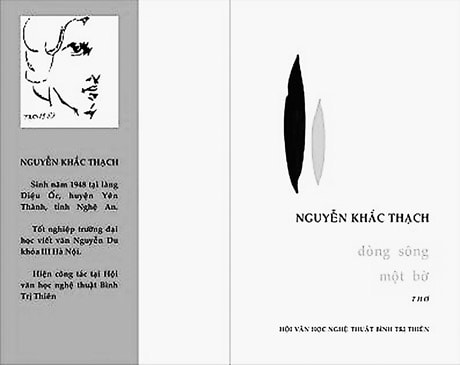
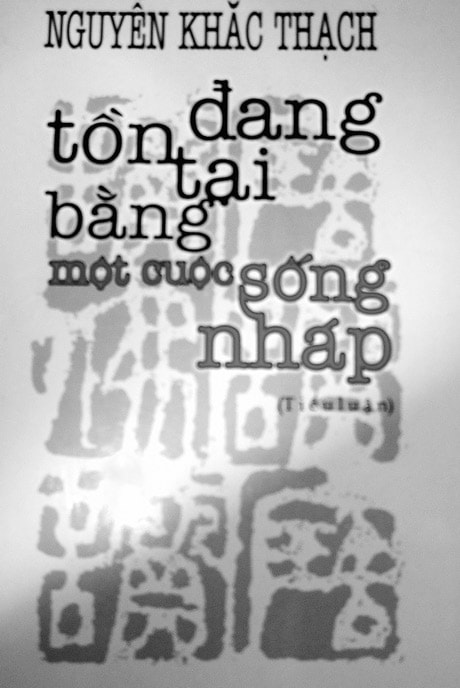
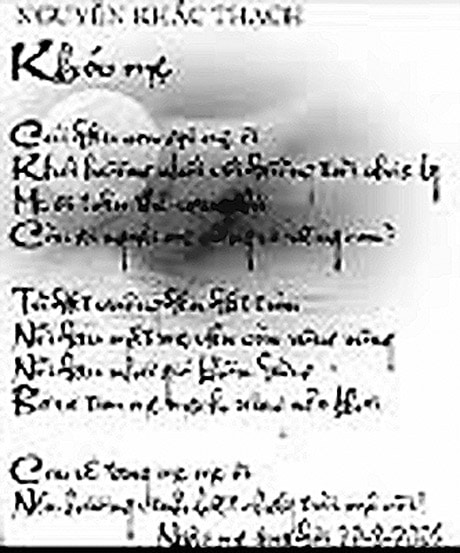
Works by Nguyen Khac Thach.
For Thach, "poetry is the negative of tears," so how many tears of life are needed to create a single word of poetry? To discover the bleeding wounds in the human soul, one must live wholeheartedly, love wholeheartedly. Nguyen Khac Thach ponders, searches, and always pushes to the very essence of things, even the most painful ones that many lack the courage to confront. Why didn't you lie? / So that this afternoon I no longer love you / I am like a broken bottle rolling out of the drinking party… Is it only the waves / Knowing half-heartedly breaking, yet still rising…
From an orphaned, lonely teenager forced to work odd jobs to make a living, Nguyen Khac Thach approached poetry belatedly and cautiously, yet with great success. He has etched his own image into the hearts of readers through profound philosophical and meditative poems. Nguyen Khac Thach's poetry is beautiful like sadness, for he himself is the negative image of tears. His poetry also points out the causes destroying humanity and disintegrating social order; therefore, his poetry is also useful, allowing people to hold their heads high and live more authentically.
Minh Khoi


