
Poet Vuong Trong - Heartfelt Rhythm of the Homeland
(Baonghean) - I only managed to meet poet Vuong Trong during the hurried moments he lingered in Vinh City waiting for the night train back to Hanoi. He said: “I just came down from Do Luong. Every year, around this time, I return to my hometown for my mother's death anniversary. It's a kind of destiny to return, to light incense at the ancestral altar, to pray at my mother's grave, to walk on the country road and witness the changes in the village…”
 |
| Poet Vuong Trong. |
Despite having been away from his hometown for more than half his life, poet Vuong Trong's voice still retains the distinctive accent of Nghe An. He constantly talks about his hometown, Trung Son commune, Do Luong district. Like many other parts of Nghe An, it was once impoverished to the point of desolation. The people had to struggle with hunger, natural disasters, and epidemics amidst countless hardships and toil.
One day in 1943, in a small house in Dong Bich village, Trung Son commune, everyone gathered to joyfully welcome the birth of Vuong Dinh Trong. As he grew older, Trong was immersed in the warm atmosphere of his family and the picturesque, poetic scenery of the traditional land of Nghe An. It was this poor, purely agricultural land that nurtured Vuong Trong's soul. “None of us want a poor childhood, but in some ways, the poverty of my childhood helped me a lot in my writing. It has ingrained my soul in my homeland and made my memories so vivid,” the poet Vuong Trong thoughtfully told me. He often teased his two children in Hanoi: “You two didn’t have a childhood.” For Vuong Trong, his childhood awakened the deepest, most humane parts of his subconscious and heart – things that we humans acquire when we struggle with life in its most challenging dimensions.
The Lam River was more than 1 km from Vuong Trong's house, but Quy Son mountain was right there, within the boy's daily gaze. Perhaps in the old days, the people were poor, so the mountain was barren. Nevertheless, Quy Son mountain was as closely associated with Vuong Trong as countless other mountains and rivers of his homeland have been with the souls of poets. Vuong Trong's father was a Confucian scholar, and his older brothers loved poetry and often read it at home. Therefore, before knowing poetry from books, or even before learning to read, Vuong Trong had memorized many poems from his family members. He had a special talent for memorizing poetry very quickly, as he said, "I memorize it whenever I see a poem." From a young age, Vuong Trong memorized "Chinh Phu Ngam," "Cung Oan Ngam Khuc," and "Truyen Kieu"—the longest narrative poems of medieval Vietnamese poetry. Above all, he deeply loved "Truyen Kieu" as he loved the most exquisite essence of Vietnamese literature from ancient times to the present. He said: "If you are a person of literature, you cannot help but love Truyen Kieu." Therefore, in recent literature competitions where he was invited to be a question setter, Vuong Trong insisted on including "Truyen Kieu" (The Tale of Kieu) as a benchmark for literary ability and appreciation.
From the fourth grade, Vuong Trong knew how to write poetry. “I tried sending my poems to a few newspapers, but they weren’t published,” the poet recounted with a wry smile, “However, when I received a confirmation from the editorial office that they had received my work, I was very happy.” Vuong Trong recited to me his first poem, titled in the style of his predecessors: “Ode to the Cow-Dropping Stream.” This is a memory that Vuong Trong will forever cherish, as it marked the first time he composed a complete poem, expressing his feelings for his homeland, where a stream with a very rustic name flowed in clear, small streams where he and his friends used to swim.
Vuong Trong was an excellent student in all subjects, and upon graduating from high school, he did not choose literature as his career path. In 1962, Vuong Trong passed the entrance exam to Hanoi University, majoring in Mathematics. His mathematical thinking gave him a remarkable ability in public speaking, with clear, well-structured, and concise speeches. However, poetry seemed to be in his blood; although he didn't choose it, it seemed to have chosen him, or perhaps it was "destiny." In 1966, he graduated from university and was assigned to work at the Military Intelligence Department, deciphering enemy codes. In 1970, Vuong Trong became a mathematics teacher preparing students for university entrance exams at the Ministry of National Defense's Cultural School in Lang Son town. Two years later, in 1972, he truly dedicated himself to literature, beginning with attending the Nguyen Du Writing Training Course and working until his retirement at the Military Arts and Literature Magazine.
Wang Zhong shared some amusing anecdotes from that time with me. While in the army, he once challenged his entire unit to each say a single meaningful word, and his task was to recite a poem containing that word. Everyone competed to find the most difficult, least heard words, but in the end, Wang Zhong still found his solution. His "poetic capital" seemed boundless; he was passionate about it, loved it, and enjoyed playing with it.
On another occasion, in 1981, while working at the Army Literature and Arts Magazine, Vuong Trong, along with several other writers and poets such as Nguyen Bui Voi and Mai Hong Nien, were invited by the Nam Dinh River Transport Company to go on a river tour. The group spread mats on the boat, sipped wine, and talked about poetry. A company emulation officer approached the group of writers, expressing his desire to recite a 14-line lục bát (six-eight syllable) poem he had composed. Just five minutes later, Vuong Trong recited the entire poem without a single mistake. Everyone was astonished by his memory. After telling me this story, he joked, "If the Vietnam Writers Association were to organize a poetry memorization contest, I would win first prize."
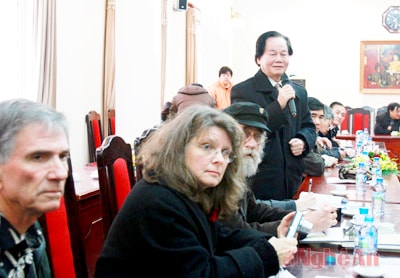 |
| Poet Vuong Trong introduced to the American veteran writers a poem about the 10 girls of Dong Loc. |
Although he didn't participate in any poetry competitions, Vuong Trong has won several prestigious literary awards: Third Prize for poetry from the Van Nghe weekly magazine in 1969, four times winning the Ministry of National Defense's poetry award, two times winning the Vietnam Writers Association award (in 1991 and 1996), and the State Award for Literature and Arts in 2007 for his poetry collections "Come Home, My Waiting Wife," "Sunken Island," "Looking Back," and "Cat Goes Fishing." Vuong Trong's poetry, like the man himself, is both coherent and profound, witty and humorous, yet deeply moving and heartfelt. To date, he has published 26 personal books, including 16 poetry collections and epics, with the remainder being translations, short stories, and essays. Vuong Trong believes: "Poetry is the voice of emotion. Innovation and reform that no one understands shouldn't be called poetry." According to him, contemporary literature, with its schools of thought that "unconventionally" transform poetry to the point of confusion and incomprehension, is suffering from regrettable "misconceptions." He, a passionate admirer of Nguyen Du's "The Tale of Kieu," cannot easily accept the naive and unconventional experiments being undertaken by some young poets, even though Vuong Trong has always supported all efforts at innovation.
Since his retirement, Vuong Trong has continued to dedicate much of his time to writing poetry, but he finds research more interesting. He has been working on translating Nguyen Du's classical Chinese poems, re-translating "Chinh Phu Ngam" (The Lament of the Warrior's Wife), and writing research on "Truyen Kieu" (The Tale of Kieu). Whenever he has the opportunity, Vuong Trong takes the train back to Vinh; if he has more time, he stays in the city to meet friends, otherwise, he takes a bus back to Do Luong, where he has poured his heart and soul. He says that many young people proudly boast about traveling far, the further the better, but the elderly long to return to their hometown, the more the better. Now, returning to Do Luong, Vuong Trong is happy to see his hometown transformed. There are no longer many old communal houses and temples, no longer the winding roads of "my small village, the narrow entrance to the village," but instead there are tall buildings and straight, paved roads. The barren mountains are gone, replaced by Quy Son with its lush green pine-covered mountain ranges. The people are no longer starving; instead of just farming, they work as laborers, extract pine resin, and so on. Vuong Trong gently smiled and recited to me verses written from the bottom of his heart, from his longing for the land where he was born: “When my eyes close/ Take me back to the place of my birth… Quy Son Mountain has a place for me to lie down/ Warm flowers and fire, earth fragrant with the scent of burning charcoal/ How happy I am to lie down there/ Regardless of wind and rain, I will never know the cold…”
Farewell, poet Vuong Trong. As I leave, I keep thinking about the train tonight, the train that will accompany him in his intense longing for home. It's just one night in over 50 years away from home, just the same train carrying him north to his beloved capital, just the rumbling of the railway, the familiar, heart-wrenching whistle. Longing, it's just one rhythm in the myriad of human emotions, but for him, it's the most poignant and sweet refrain that helps him live and work, makes him feel rich and full of energy, makes him feel renewed with yearning and hope…
Quynh Lam


