
Composer An Thuyên: Deeply concerned for his homeland
(Baonghean) - I've loved the songs of composer An Thuyên for a long time, but meeting him has been difficult. He's busy, even after retirement. Currently, he's been invited to be an art consultant for a large corporation owned by people from Nghe An province, and recently, he was also elected Chairman of the Vietnam Business Culture Association. But it's not just because he's busy, he said. If I were to meet him as a journalist, there would already be too many people writing about him. So I asked to meet him as a music lover from his hometown of Nghe An…
The milk of my homeland
The composer An Thuyên said that whenever he talks about his homeland, he feels a surge of nostalgia. It's about longing, affection, gratitude, dreams, and aspirations… For him, the sound of kites on the old dike, the sound of boats splashing on the river, the rustling of cornfields, the gongs and drums of the Thái ethnic people, and the folk songs of the villagers… have become the nourishing milk that nurtured his soul and influenced his entire creative life.
He recounted the story of the small village in Quynh Thang commune, Quynh Luu district, where young Nguyen An Thuyen was born in 1949, speaking of his parents with an unceasing sense of longing: “My mother was two years older than my father; they both lived to be 82 years old. When they were alive, our family was very poor. By the time we became more prosperous and could repay their kindness, they were no longer here. I remember that every time I returned to the village from Vinh City, my mother was so happy. She would say, ‘Yesterday, a magpie perched on the apple tree announced it, and sure enough, Thuyen came home the next day.’ Throughout my childhood, my siblings and I ate rice mixed with potatoes, mostly potatoes, and hunger was always present. Even when my mother passed away, there were only 5 dong in her brown coat pocket, and the earthenware jar in the room only contained a few measures of rice; the other half was dried sweet potatoes that we ate gradually…”
At the age of 11, Thuyen was already a talented musician, skilled at playing the zither and flute, and a gifted player of traditional instruments for his family's "theater troupe." A few years later, he made a memorable contribution to his village by composing the song "Following in the Footsteps of Heroes," on the occasion of several villagers in An Thuyen receiving the title of Hero of the People's Armed Forces. This first song, written with only a little music theory, earned him a notebook and a Chinese fountain pen as a reward. But far more precious, for young Thuyen at that time, was the encouragement and praise from the District Party Secretary and the affection of the villagers. Even now, having won many major music awards, An Thuyen has never again experienced the overwhelming emotion he felt that first time in his youth with that small award.
In 1967, An Thuyên began working at the Nghe An Provincial Department of Culture. In 1975, he joined the army. In 1977, he became a musician in the Military Arts Troupe of Military Region IV. In 1981, he was sent to study at the Hanoi Conservatory of Music. After graduating, he returned to the Army Arts and Culture Department, now the Military University of Culture and Arts, where he worked until his retirement.
An Thuyên composed quite prolifically and consistently. The public knows and loves him for many songs such as "Em chọn lối này" (I Choose This Path), "Đêm nghe hát đò đưa nhớ Bác" (Listening to Boat Songs at Night, Remembering Uncle Ho), "Hành quân lên Tây Bắc" (Marching to the Northwest), "Khi xe tăng qua miền quan họ" (When Tanks Pass Through the Quan Ho Region), "Thơ tình của núi" (Love Poem of the Mountains), "Chín bậc tình yêu" (Nine Steps of Love), "Huế thương" (Beloved Hue), "Neo đậu bến quê" (Anchoring at the Homeland's Harbor), "Mẹ Việt Nam anh hùng" (Heroic Vietnamese Mother), "Ca dao em và tôi" (Folk Songs of You and Me)...
However, An Thuyên captured the hearts of all Vietnamese music lovers thanks to his deeply heartfelt songs about his homeland, such as "Anchoring at the Homeland's Harbor" and "Folk Songs of You and Me." His love for his homeland resonated strongly in his songs, and it seemed to transform into his aesthetic emotions when he wrote about other regions and other themes. He loved his homeland so intensely that most of his musical works were imbued with the essence of his hometown's folk songs. Even after living in the capital for so many years, he still retained the Nghệ An accent in his voice, and still drank herbal tea sent from his hometown every day… Memories of his hometown remain vivid in his mind: In the late 1960s, despite the fierce war, the Nghệ An Department of Culture (then headed by Mr. Trần Nguyên Trinh) planned to collect folk culture. Despite the intense effort and hardship, no one complained. Everyone was passionate about their work, and they even organized a conference on folk culture. There was a conference held in an evacuated hall in Ha Tinh, where everyone was debating intensely when American planes dropped bombs a few hundred meters away. Everyone quickly grabbed their documents and took shelter in the bunker, only to resurface when the bombing stopped… and continue the debate. He also recounted the hardships, yet also the joys and good fortune, during his five years of collecting folk songs. Initially, he was just an errand boy, serving food and drinks to musicians from the Institute of Music Research. But his passion led him to be officially provided with a tape recorder, bicycle, reel-to-reel tapes, and batteries… becoming a collector. Quietly traveling along the Lam River, taking notes, learning, and recording, forgetting about drownings and malaria… he recorded hundreds of valuable folk songs from artisans on hundreds of self-made tapes…
The songsWritten with tears
An Thuyên's first famous song was "I Choose This Path," written in the style of Thai folk music from Nghe An, when he was only 23 years old. The following year (1973), he achieved further success with a deeply moving song about President Ho Chi Minh: "Listening to the Boatman's Song at Night, Remembering Uncle Ho." At that time, he was working in the Cultural Propaganda Team of the Nghe An Provincial Department of Culture. In 1969, when President Ho Chi Minh passed away, the Nghe An Provincial Department of Culture organized a memorial service in Kim Lien commune, and An Thuyên was one of the musicians in the orchestra playing during the service. The lingering affection and sorrow for the beloved leader haunted An Thuyên's soul for a long time afterward. In 1973, he returned to Lang Sen village to collect folk songs and traditional melodies. There, An Thuyên heard a woman singing a lullaby to her child in a creaking hammock, and her elderly mother told him that President Ho Chi Minh used to go to watch these folk songs. That very night, the composer wrote the song "Listening to the Boatman's Song at Night, Remembering Uncle Ho." He emotionally recounted, "I spent the whole night writing this song, my eyes constantly filled with tears." Immediately after its creation, this folk song from Nghe An province was successfully performed by singer Le Thanh of the Nghe An Provincial Military Command's Mobile Arts Troupe, gaining much popularity. Later, it reached the public nationwide through the Voice of Vietnam radio station with the voice of People's Artist Thanh Hoa.
“In my life, there have been times when I wrote music with tears in my eyes. The first time was when I wrote the song “Listening to the Boatman's Song at Night, Remembering Uncle Ho” in 1973. The second time was when I wrote “Anchoring at the Homeland's Harbor” in 1993, when I began to experience the bitterness of life, only longing to “bury my face in the river of my homeland.” The third time was when I wrote “Heroic Vietnamese Mother” in 1994, when the Politburo first decided to award the title of Heroic Vietnamese Mother to mothers who had contributed to the country. And once again, that was when I wrote “The Sound of the Guitar” upon hearing the news of General Vo Nguyen Giap's passing,” composer An Thuyen shared.
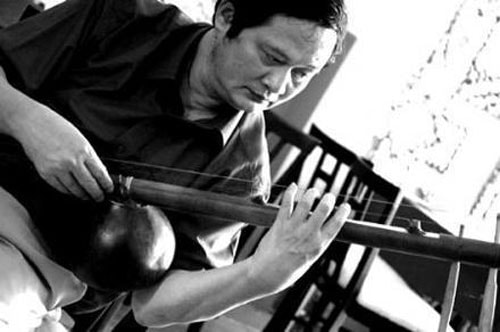 |
| Composer An Thuyên. (Photo provided by the subject) |
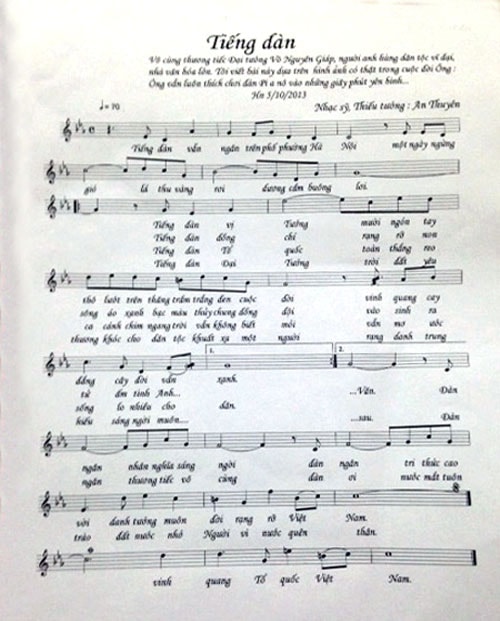 |
| The song "The Sound of the Guitar". |
Besides composing songs, composer An Thuyên also wrote several musical plays that were staged by many performing arts troupes, such as "Truong Chi," "Doi Dua Kim Giao," and "Bien Tinh Cay Dang." He also composed instrumental music, including a Concerto for flute and symphony orchestra. He also wrote music for films, dances, and composed the musical scores for approximately 60 plays, operas, and traditional Vietnamese theater productions.
| With his heartfelt compositions, composer An Thuyên was honored with numerous awards: First Prize in the 1985 National Song Contest: "The Balalaika Sound on the Da River" (based on a poem by Quang Huy); Official Award from the Ministry of National Defense: "Marching to the Northwest" (1984), "Love Poem of the Mountains" (1994); First Prize from the Ministry of Culture and Information and the Vietnam Musicians Association: "When Tanks Pass Through the Quan Ho Region" (1985), "Heroic Vietnamese Mother" (1995). He also won many awards from the Vietnam Musicians Association: Second Prize with the song "Nine Steps of Love" (1992), First Prize with the song "Song of the Intelligence Agent" (2000), First Prize with the song "Searching for the Shadow of the Mountain" (2004), Second Prize in the choral work "Greetings to Vietnam in the Vast Spring" (2004). Notably, in 2007 he was awarded the State Prize for Literature and Arts for his collection of works: "I Choose This Path," "Listening to the Boatman's Song at Night, Remembering Uncle Ho," and "Marching to the Northwest." |
Composer and Major General An Thuyên considers himself fortunate in his musical career, having been known from the very beginning of his songwriting. He recounts the numerous milestones he has left on the hearts of music lovers. However, he believes that perhaps it was when the song "Folk Song of You and Me" became popular that the name An Thuyên truly resonated and was widely recognized. A little-known fact is that he adapted this song from… a song for a musical. I told him that many people love and sing his song, but still don't fully understand why he "cut the moon in half, split the verses" in that way. He smiled, then became pensive. In the late 1980s, he was invited by the Opera and Ballet Theatre to compose music for the play "Truong Chi." In the play, upon returning to his familiar riverbank, Truong Chi exclaimed, "Cut the moon in half!" This is also the first line composer An Thuyên wrote for the musical. It haunted him with the pain of the young man, "ugly but with an exceptionally beautiful voice," whose love was shattered after meeting Mỵ Nương. It's the great tragedy of what people call "disillusionment," or the tragedy between dream and reality. And with "Folk Songs of You and Me," composer An Thuyên "reassured himself" and also wanted to send a message to everyone: Love and cherish this real life, what you have and what surrounds you; don't be deluded or chase after unrealistic illusions. Only then can people find happiness!
Perhaps that is why, amidst the glitz and glamour of life, composer An Thuyên still returned to the simple life of his "warm home of soldiers." That home was where his wife and two children, all of whom received military salaries and pursued artistic careers, lived. There, he could also be himself – a man from Nghe An, deeply immersed in the sorrows and joys expressed in his folk songs and melodies. He always spoke of his homeland's folk songs and melodies with pride and respect: "They have expressed the deepest sadness of humanity, touching the shared sorrow of many Vietnamese people. Therefore, folk songs and melodies will endure. I have relied on folk songs and melodies for all my personal sorrows."
Thuy Vinh


