
Increase the chances of survival.
(Baonghean.vn) - Previously, patients with severe acute pancreatitis were often transferred to higher-level hospitals with very slim chances of survival. Now, along with other solutions, the "continuous blood filtration" therapy has been applied at the Provincial Friendship General Hospital, saving the lives of many patients.
Battling with death
At 10 PM on July 27th, in a hospital bed at the Intensive Care and Toxicology Unit of Nghe An Friendship General Hospital, patient Lau Chong Vu (of the Mong ethnic group, from Ky Son district) was fully conscious after more than 10 days battling death. His face, still pale and tired, now shone with a radiant glow.
My great-grandfather told us, despite his wife's "warning" that he should speak less and take care of his health: "Honestly, my family and I didn't think I would live much longer. We had already made arrangements for my funeral. Unexpectedly, the doctors and equipment here are truly excellent, saving not only me but many others from this life-threatening illness."
Mr. Lau Chong Vu was admitted to Nghe An Friendship General Hospital on July 11th after being transferred from a district-level hospital in a state of severe abdominal pain. The district hospital had not yet determined the disease Mr. Vu was suffering from. All they knew was that the pain in his abdomen, radiating to his back "as if being stabbed with a knife," gradually exhausted him.
When the Intensive Care Unit received the patient, they were close to coma and in critical condition. Immediately, tests and a CT scan were performed, concluding that the patient had acute pancreatitis, severe pancreatic necrosis, high intra-abdominal pressure, and resulting ischemia in the abdominal organs (the final critical stage).
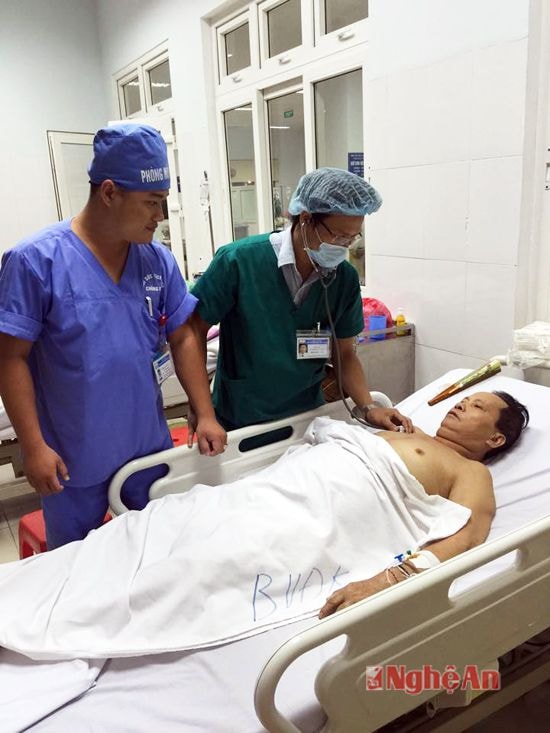 |
| After more than 10 days of "fighting" with death, patient Lau Chong Vu's health has temporarily stabilized. |
The patient's family considered two options: immediately transferring him to Hanoi in the faint hope that he could survive the 300-kilometer journey, or bringing him home so that "if he passes away, he can pass away at home." However, the final decision was to keep him at the provincial hospital because it now has a continuous blood dialysis machine and a team of highly skilled doctors and technicians who have received training from Bach Mai Hospital.
Mr. Vu's struggle with death had begun, but ultimately, his efforts and those of the medical team prevailed. He said emotionally, "In those moments of despair, all I wanted was to see the light. And when I opened my eyes, I always saw the lights in the hospital room. The dedication of the doctors and their skills fill me with admiration and trust." We asked him if he was tired of looking at the hospital room lights, and he chuckled, "I'm starting to get tired of staring at the ceiling, not knowing whether it's day or night. I long to go back to work; I miss the office, my colleagues, and my home so much." (Mr. Lau Chong Vu is currently the Standing Deputy Secretary of the Ky Son District Party Committee).
More chances of survival for patients.
Not only Mr. Vu, but many patients who come to the Intensive Care and Toxicology Unit think this is their "last resort," that they are very close to death. For patients with severe acute pancreatitis, in the past, they almost always had to be transferred to central hospitals, and even then, there was little chance of survival. Along with other intensive treatment methods, for almost a year now, the Intensive Care and Toxicology Unit has been equipped with a continuous blood filtration machine, contributing to saving the lives of many patients with acute pancreatitis and other life-threatening illnesses.
According to Dr. Nguyen Van Thuy, MD, MSc, Department of Intensive Care and Toxicology, Provincial Friendship General Hospital, continuous hemodialysis is a treatment method aimed at continuously and slowly filtering toxins (endogenous or exogenous), fluids, and electrolytes from the blood. It is applied to patients with unstable hemodynamics, with or without renal failure. Continuous hemodialysis machines, formerly known as "continuous renal replacement therapy - CRRT" and now as "continuous multi-organ support therapy," have significantly contributed to improving the prognosis of many diseases that have been challenges for humanity, such as patients with multiple organ failure, progressive acute respiratory failure, septic shock, acute liver failure, refractory edema, respiratory failure in myasthenia gravis or Guillain-Barre syndrome, acute pancreatitis, and especially patients with severe poisoning.
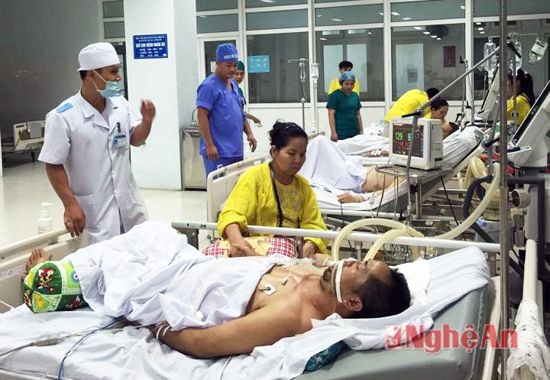 |
| It was 10 PM, but the doctors and nurses of the Intensive Care and Toxicology Department at Nghe An Friendship General Hospital were still very busy. |
For over a year now, doctors and technicians from the Intensive Care and Toxicology Department have been sent to Bach Mai Hospital (Hanoi) for training in this therapy, which they then use to treat patients at the provincial hospital. Although the cost of a hemodialysis session is quite high, this technique is covered by insurance. Many patients have been saved thanks to hemodialysis, notably recently the cases of patient Nguyen Thi Ngoc (Dien Trung - Dien Chau, acute pancreatitis due to gallstones), patient Nguyen Thi Cuc (Hoa Son, Do Luong) with pancreatitis due to high blood lipids, patient Ho Cong Duc with Guillain-Barre muscle paralysis, and patient Lau Chong Vu mentioned above.
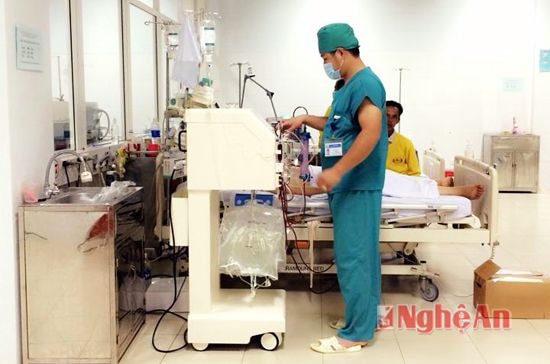 |
| Nurse Pham Van Dong performs hemodialysis on a patient using a continuous hemodialysis machine. |
Nurse Pham Van Dong, who was sent to learn dialysis techniques and is currently operating the dialysis machine in the department, said: "Although the work is hard (constantly monitoring patients undergoing dialysis), the patient's chance of survival is the joy of a doctor."
TV


