
Replicating economic models
(Baonghean) - Anh Son district is one of the localities that early planned its economic development based on key crops and livestock, and is now achieving positive results. Areas for sugarcane, tea, food crops, vegetables, and rubber are being developed in key regions and are gradually being linked with processing facilities and factories, contributing to increased income per unit area. Highly appreciating these successes, during a working visit to Anh Son district, Comrade Nguyen Xuan Duong - Deputy Secretary of the Provincial Party Committee and Chairman of the Provincial People's Committee - suggested that the Party Committee, government, and people of the district should replicate these successful models throughout the area.
(Baonghean) - Anh Son district is one of the localities that early planned its economic development based on key crops and livestock, and is now achieving positive results. Areas for sugarcane, tea, food crops, vegetables, and rubber are being developed in key regions and are gradually being linked with processing facilities and factories, contributing to increased income per unit area. Highly appreciating these successes, during a working visit to Anh Son district, Comrade Nguyen Xuan Duong - Deputy Secretary of the Provincial Party Committee and Chairman of the Provincial People's Committee - suggested that the Party Committee, government, and people of the district should replicate these successful models throughout the area.
According to the seasonal schedule, Ms. Vo Thi Huong from Hamlet 1-5, Cam Son Commune (Anh Son District) is tending to her 3 sao (approximately 0.3 hectares) of green squash on the riverside land. This squash season, her family has harvested over 10 tons of fruit. With favorable market conditions, businesses from the northern provinces come to buy directly from the fields, making green squash cultivation the most suitable "cash crop" on the riverside land at this time. While harvesting the last batch of green squash, Ms. Huong was truly delighted when the Chairman of the Provincial People's Committee and representatives from various departments visited her family's model farm. She shared: "In recent years, I and many other households have boldly switched crops, from growing corn and peanuts to growing watermelons, and now we are confident in growing green squash."
"Because land is scarce, we have to research and cultivate crops that yield the highest economic returns..." Mr. Nguyen Van Thang, Vice Chairman of the People's Committee of Cam Son commune, added: "Initially, we experimented with about 10 hectares. Seeing the high yield of green squash on the alluvial land and stable consumption, in 2014 the commune increased the area to 50 hectares. In other areas, the commune and the people researched and planted other economically valuable crops such as winter squash, pumpkin, and asparagus..." Cam Son commune is considered one of the most dynamic localities, with the exemplary leadership of Party members in developing commodity-oriented production. The boldness and willingness to think and act of Party members and the people have created a vibrant labor and production movement, "not letting the land rest, not stopping our hands." Successful models in Cam Son are not only embraced by people in Anh Son district but are also studied and replicated by people in neighboring districts.
After visiting Cam Son commune, the Chairman of the Provincial People's Committee and leaders of various departments and agencies visited the tea hills in Hung Son commune. The roads around the tea hills are convenient for vehicles. Passing through the endless green tea hills, it feels as if they stretch on indefinitely. The green color of the tea seems to spread even wider under the golden early summer sun. Leading the provincial delegation on a tour of the tea hills, Mr. Vo Van Hien - Chairman of the Hung Son Commune People's Committee - enthusiastically provided information: "To date, Hung Son commune has almost completed the entire 500 hectares of tea cultivation according to the plan and focused on caring for and increasing productivity. On average, each hectare of tea yields over 18.5 tons/year. Some well-cared-for areas can yield over 22 tons/hectare/year. Typical examples include the family of Mr. Thai Doan Cam in Hamlet 6, Mr. Vo Van Dong in Hamlet 5, and several other households that have achieved yields of 25-27 tons/hectare."
"It's encouraging that there's a processing plant in the commune, so the tea leaves produced by the local people have a stable market. Thanks to tea cultivation, the people of Hung Son have reduced poverty. Currently, the poverty rate in the commune is only 4.5%..." According to statistics from the Anh Son District People's Committee, there are currently nearly 1,900 hectares of tea plantations in the district. It is projected to increase to 2,500 to 2,700 hectares by the end of this year. It's noteworthy that in recent years, the strong link between the processing plant and tea-growing households has created a sustainable development environment. After gathering information and visiting the tea cultivation model in Anh Son district, Comrade Le Minh Thong - Member of the Standing Committee, Chairman of the Provincial Party Committee's Inspection Committee, assigned to oversee the district, said: "Among the crops and livestock in the district, I find tea cultivation to be the most sustainable. This is demonstrated by the fact that the cultivated area is linked to processing plants and enterprises, so people feel secure in investing." Furthermore, tea plants are well-suited to the midland region and are easy to care for, with minimal threat from natural disasters. The current challenge is to focus on improving productivity and quality for export…”.
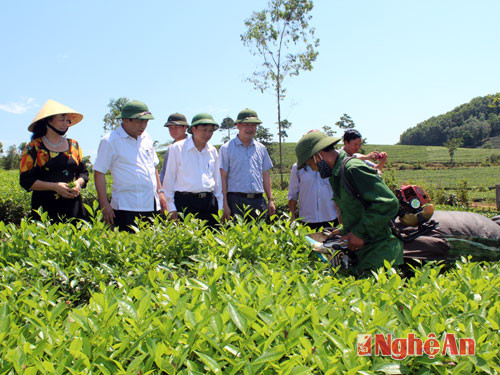 |
| Comrade Nguyen Xuan Duong and the delegation visited and harvested tea in Hung Son commune (Anh Son district). |
Along with tea, Anh Son district is now confident in sugarcane cultivation thanks to the operation of the Song Lam Sugar Mill. People in the western localities of the district are focusing on improving sugarcane yields on over 1,500 hectares, an area that could increase to 1,800 hectares by the end of 2014; the yield and quality of rice and corn on over 6,500 hectares have also improved, contributing positively to food security. Simultaneously, the district is strengthening coordination in planting over 2,000 hectares of rubber in planned areas. To enhance economic efficiency, in addition to developing crops according to planned areas, district departments and agencies are strengthening support and training to improve farming techniques for the people; promoting land conversion to facilitate planting, caring for, and harvesting. To date, 9 out of 20 communes have completed land consolidation and exchange. The district also focuses on developing livestock farming by increasing the number of buffaloes, cows, pigs, fish, and poultry in a commercial direction.
Working with the leaders of Anh Son district, Comrade Nguyen Xuan Duong acknowledged the efforts of the Party Committee, government, and people in the area in promoting economic development, laying a solid foundation for caring for cultural, social, health, and educational fields, and actively contributing to the construction of new rural areas. To date, the communes have achieved 9 to 15 criteria for building new rural areas. The Chairman of the Provincial People's Committee noted that the district needs to replicate successful economic models, mobilize comprehensive resources, and create a breakthrough in the movement to build rural roads. Currently, many road projects on the right bank of the Lam River leading to the communes of Binh Son, Thanh Son, Tho Son, Hung Son, etc., in the district are severely damaged, significantly affecting socio-economic development. The district needs to strengthen solutions to improve the efficiency of management, improve the quality of cadres and civil servants; promote mass mobilization, and mobilize comprehensive strength to focus on economic development and effectively address social issues. Closely coordinate with relevant departments, agencies, and businesses to effectively address the balance between investment in production and livestock development, linking it with processing and securing markets for agricultural and industrial products in the area.
On its path to development, Anh Son district has early on clearly identified its key crops and livestock and focused on effectively resolving the relationship between the "three stakeholders": the State, farmers, and businesses. This consensus is creating an important foundation for socio-economic development in the right direction. New opportunities and hopes opened up when, in early May, the district successfully organized an Investment Promotion Conference, resulting in investment agreements for the construction of several factories processing tea, cassava starch, medicinal herbs, forest products, vegetables, fruits, and clean charcoal for export. Comrade Le Hong Vinh - Secretary of the District Party Committee - stated: "Along with the province's orientations, we believe that with the diligence and dynamism of the local people, the district's potential and advantages will be further developed. The district leadership also determined to focus on solutions directed towards the grassroots, enhancing the sense of responsibility of Party committees and governments at all levels for the goal of socio-economic development…"
Nguyen Son


