
New factors in Russia-West relations
(Baonghean) - On Wednesday, December 23, the Russian Federal Investigative Committee announced the arrest in absentia and the international manhunt for former oligarch Mikhail Khodorkovsky - two weeks after he issued a statement calling for "a revolution against the current government".
Mikhail Khodorkovsky, 52, lives in exile in London and Switzerland after his release in 2013. The former richest man in Russia was imprisoned for over 10 years on charges of masterminding the murder of the mayor of Nefteyugansk (Siberia), the city where the Yukos oil company is headquartered and a major source of his income.
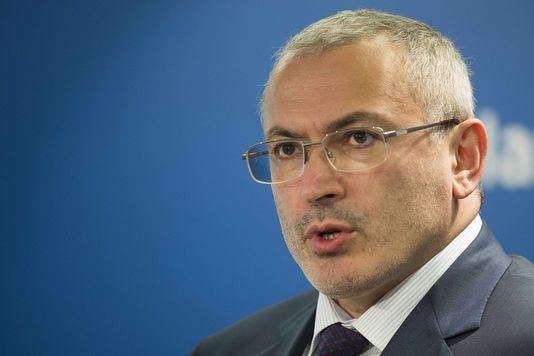 |
| Mikhail Khodorkovsky in Washington, D.C., in June 2015. Photo: AFP |
The victim was allegedly making decisions that went against Yukos' interests before being murdered by two of the company's employees under the direction of their boss, Mikhail Khodorkovsky.
On October 25, 2003, the former tycoon was arrested, facing two prior convictions for "tax evasion" and "large-scale theft by fraudulent means." At the time, some suggested that Khodorkovsky was the victim of a "political purge" orchestrated by the Kremlin. All his assets were taken over by a state-owned company, and the Kremlin eliminated a formidable political rival. Of course, this was merely a hypothesis from the anti-Kremlin school of thought.
Today, the Kremlin's pursuit of legal action against Khodorkovsky is taking place against a somewhat different backdrop. While requesting exile in London – far beyond the reach of Moscow's courts and Siberian prisons – Khodorkovsky continues to provoke the Kremlin. The former oligarch is secretly pursuing international lawsuits involving former Yukos employees and leaders.
Most recently, in July 2014, the International Court of Justice in The Hague – the world's capital of justice – ruled that Russia dissolved Yukos for political reasons and ordered Russia to pay a record fine of 37 billion euros. Although Russia rejected the penalty, seizure procedures are still underway in France, Belgium, Germany, the United Kingdom, and the United States.
But even more significant is that Mikhail Khodorkovsky has spoken out on the political stage, breaking his promise to cease criticizing the Kremlin upon his release. From a former "outcast" oligarch, Khodorkovsky founded the Open Russia movement to rally opposition forces in Russia. He also helped publicize the investigation into links between the Russian mafia and figures close to the Kremlin.
Most recently, on December 9th, he even delivered a strongly worded attack on the current Russian President Vladimir Putin at a press conference in London: “Russia has witnessed an illegal coup: illegal laws passed by an illegal parliament, enforced by an illegal government and an independent justice system. To return to a genuine rule of law, a revolution is necessary.”
Soon after, Russia intensified its legal proceedings against Khodorkovsky and his supporters. On Tuesday, December 22, Russian federal police arrested several members of the Open Russia movement in Moscow.
Perhaps this former tycoon would not have attracted so much attention from the Kremlin and the international community if it weren't for the current tense relations between Russia and the West. Evidence of this is the fact that legal proceedings against Khodorkovsky were "loosened" by Russia after his release in 2013 and only "restarted" recently.
Certainly, Khodorkovsky himself wasn't the sole cause – in fact, he had always pursued a stance against the current Russian government. So what reason could there be for such a relatively unknown figure to suddenly become the focal point of world politics? Could it be that such a factor, in the current context, has the potential to influence relations between Russia and the West, depending on the path both sides choose?
A revolution against the Kremlin – the idea sounds unrealistic in a Russia that strongly supports President Vladimir Putin, but who can be sure that Russians – or at least a segment of them – won't change their minds if the domestic economic situation continues to deteriorate? The West has been putting pressure on Russia, and if their new solution is to support an opposition force that already possesses a domestic base and power base, it will not be a scenario that pleases Kremlin officials.
Perhaps the Russian president is having a turbulent time on the international stage, but is extremely "vigorous" domestically. This does not mean the Kremlin leader is underestimating the dangers emanating from within Russia, and the tough stance against Khodorkovsky is the most concrete evidence of this. A Khodorkovsky might not necessarily cause a political upheaval in Russia, but it is clear that new possibilities and methods for the West and Russia to confront each other are gradually emerging…
Thuc Anh
| RELATED NEWS |
|---|


