
Many police officers even pawned their police identification cards to borrow money.
Trusting the police officers who used their police identification cards to borrow money, Mr. Phi gave them hundreds of millions of dong, but when the repayment deadline arrived, the creditor still hadn't been able to get the money back.
Colonel Nguyen Phan Khoi, Head of the Duyen Hai Town Police (Tra Vinh), said he is encouraging police officers who borrowed money from the public to come up with a plan to repay the debt soon. For officers and soldiers who used their police identification cards to borrow money, the unit will take disciplinary action according to regulations.
"We have informed the parents of the students who borrowed money so that the families are aware. Using police identification cards to borrow money is wrong," Colonel Khoi said.
Even using Party membership cards as collateral to borrow money.
According to Mr. Phi (names of characters in the article have been changed, residing in Ward 1, Duyen Hai town), on February 1st, Lieutenant Nguyen, working at the Traffic Police Team of Duyen Hai Town Police, came to his house to ask to borrow 330 million VND for the purpose of "refinancing a bank loan". The traffic police officer wrote a receipt, promising to repay the money to Mr. Phi within two days, but then broke his promise.
|
| The traffic police lieutenant's loan receipt and police identification card were pledged as collateral. |
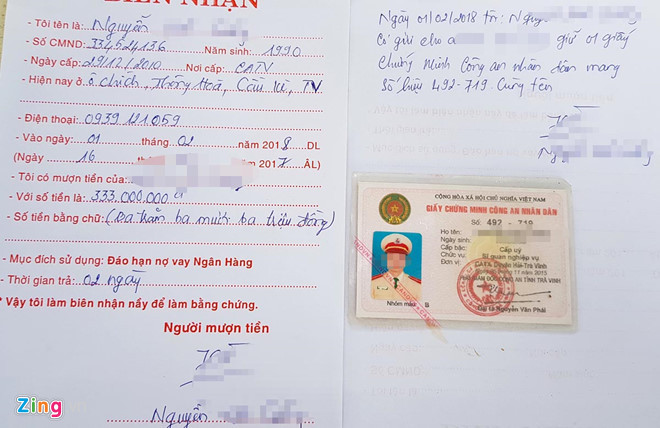
"When the deadline passed, I called to demand the money, but Mr. Nguyen said he couldn't afford to pay. Every time I asked for the money, he promised to pay within 10 days, but after many times, he still didn't keep his promise. When he borrowed the money, Mr. Nguyen gave me his police ID card to hold," Mr. Phi recounted.
Besides Lieutenant Nguyen, Mr. Phi also held many police identification cards belonging to officers and soldiers working at the Duyen Hai Town Police Department, PA72 of the Tra Vinh Police Department, and Ben Gia Prison (under the General Department VIII of the Ministry of Public Security, located in Duyen Hai). These individuals had credit relationships with Mr. Phi, and they gave their "official ID cards" to their creditors as collateral.
During the investigation of Mr. Phi's complaint, reporters discovered that in addition to police identification cards, some police officers were also using Party membership cards to borrow money. One officer, a junior officer, handed over both documents to the borrower simultaneously. When questioned by authorities, the officer requested the original documents, then photocopied them, signed a "certified copy," and gave it to the creditor.
Creditors allege "abuse of trust".
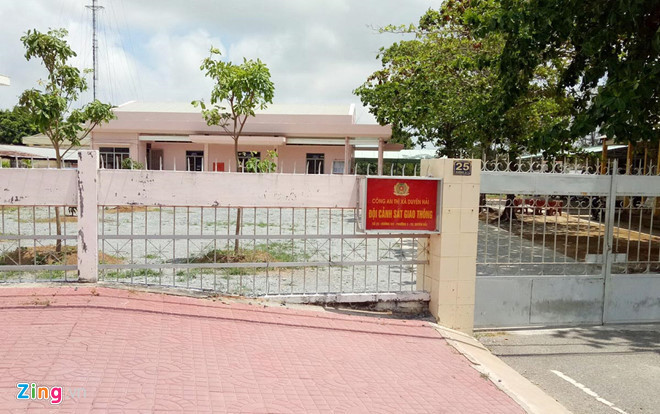
According to the lender's complaint, Lieutenant Nguyen said he used the money to "refinance a bank loan." This means that Nguyen would then be able to get another loan from the bank and would be in a position to repay Phi.
|
| The Traffic Police Team of Duyen Hai Town Police Department, where Lieutenant Nguyen works. |
"It's possible that Mr. Nguyen didn't 'refinance his bank loan' but used the money for other purposes, which is why he doesn't have the money to pay me back. If he used the money for purposes other than those stated to borrow from me, and then didn't repay the debt, he shows signs of abusing trust to misappropriate property. Mr. Huynh is similar," Mr. Phi explained.
Speaking to reporters, Lieutenant Nguyen said he was on leave to go back to his hometown to "raise" money to pay off his debt. The traffic police officer claimed the reason for breaking his promise to Mr. Phi was family financial difficulties, and promised to fulfill his obligations as borrower in 10 days to get his police identification back.
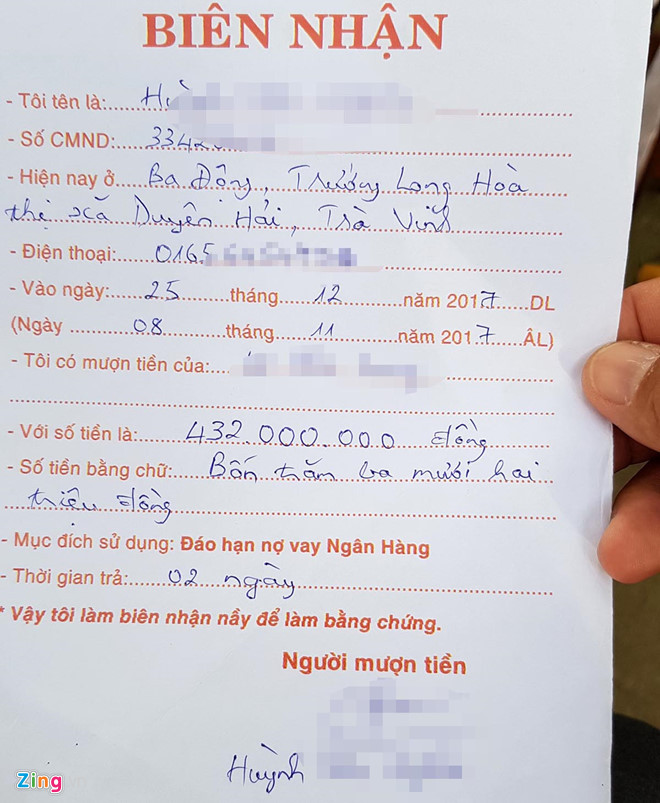
Similarly, Lieutenant Huynh also admitted to owing Phi hundreds of millions of dong and being unable to repay the debt.
"It's not just me here; many people owe Phi money. I didn't give him my police identification," the criminal investigator said.
|
| Receipt from the criminal investigator. |
According to Colonel Nguyen Phan Khoi, the unit received a complaint from Mr. Phi. However, this is a civil transaction; those who borrowed money must repay Mr. Phi. If the borrower fails to repay, the creditor can sue in court for a ruling.
Lawyer Nguyen Van Duc (Can Tho City Bar Association) argues that the transaction involving the police officer pledging his professional ID card to Mr. Phi was intended to secure a loan. This is a civil transaction, and if one party violates the agreement, the other party has the right to request the authorities to resolve the matter.
"The police identification card used as collateral in this case is more about trustworthiness than monetary value. Using the police ID card for this purpose is highly inappropriate and will negatively impact the image of the People's Police," lawyer Duc said.


