
Many parents enthusiastically show off their children's report cards.
"It happens without a prior arrangement," as soon as schools release their end-of-year grades, parents immediately flock to social media to show off their children's scores.
In recent days, report cards of children have once again been shared by many parents on social media. Although many claim they don't care about achievements or grades, and even though grades of 9 or 10 have become commonplace, these report cards still hold a strange fascination for many. The emotions of many parents still revolve around their children's grades.
Many people comment, share, praise, and evaluate... but behind those comments lie many unspoken feelings. Most notably, many parents cannot escape the mentality of comparing their children to other children, even if unintentionally.
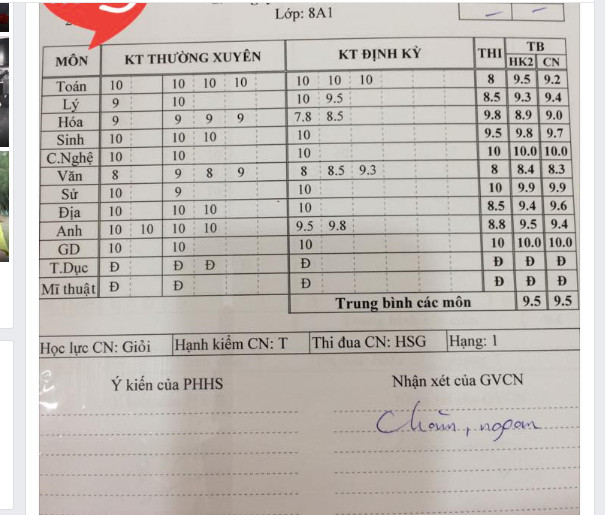 |
| At the end of the school year, parents enthusiastically share their children's report cards on social media. |
It's not just about praising their children for being good students and getting high grades. Some parents, upon seeing the report cards of "other people's children," immediately start complaining about their own children's low grades. Some lament that their children's scores are still only 9.5 like last semester and haven't improved, or that their children are still ranked 7th in the class. Others express regret that just a few more points would have put their children first...
Since June 2017, when the Children's Law came into effect, the issue of parents posting their children's report cards online has been raised. Accordingly, parents who want to post personal information, including their children's grades, online must ask for their child's permission; otherwise, they will be breaking the law. This not only protects children's personal information but also aims to ensure their safety.
Regarding children's grades, experts suggest that parents may share them out of excitement and joy, but they don't fully understand the impact this has on their children. Many children dislike their parents showing off their grades, and they dislike their problems being dissected, discussed, and debated by others.
Even praise for high grades can create unnecessary pressure on students, potentially fostering a subconscious belief that studying is solely for the sake of grades. Many students throw themselves into studying, sacrificing many things just to achieve high grades and please their parents.
A psychologist in Ho Chi Minh City shared that many parents assume their children are talented and capable based on their grades. As a result, they become overly proud and praise their children excessively. This can lead to two outcomes: the child may feel ashamed and lose confidence, or conversely, some children may develop delusions and fail to recognize their true abilities.
As someone deeply interested in education, journalist and writer Truong Anh Ngoc shared that at the end of the school year, he observed that grades were a hot topic. A child's grades can be a source of pride for some parents, but also a source of shame for others. This could be because their child has made them feel inferior, or because parents understand that their child isn't that academically gifted, but perhaps due to school performance, the child was given higher grades.
According to Mr. Ngoc, for many parents, without grades, they wouldn't know if their child is smart or not; they wouldn't know how their child compares to the neighbor's child in terms of intelligence or lack thereof... Many parents view their children as mere ornaments for themselves and their family. This inadvertently deprives their children of many opportunities for healthy learning and activities.
Then, the excessive emphasis on grades from teachers also pushes parents into a race for prestige. A close friend of Mr. Ngoc's, after attending a parent-teacher meeting, recounted that the teacher only talked about grades and nothing else. She praised this student as excellent and that one as terrible, without looking around the class to see the various emotions of the parents.
In numerous discussions with parents, Dr. Nguyen Thi Bich Hong (Ho Chi Minh City University of Education) has consistently emphasized that children who achieve high grades in school are not necessarily successful in life. This requires parents to strike a balance between academic learning and cultivating life values and skills.


