
Many gravity-fed water supply systems are deteriorating and damaged.
During a recent meeting with us to learn about the results of implementing ethnic policies in Quy Chau district, Mr. Lang Van Thanh - Head of the District's Ethnic Affairs Department - said: Unlike basic infrastructure projects such as electricity, roads, schools, and health stations, which have truly brought a new look to the rural mountainous areas of Quy Chau, the self-flowing clean water projects in the area have not been effective.
(Baonghean)During a recent meeting with us to learn about the results of implementing ethnic policies in Quy Chau district, Mr. Lang Van Thanh - Head of the District's Ethnic Affairs Department - said: Unlike basic infrastructure projects such as electricity, roads, schools, and health stations, which have truly brought a new look to the rural mountainous areas of Quy Chau, the self-flowing clean water projects in the area have not been effective.
Quỳ Châu District has 12 communes and towns, and almost every commune and town has one or two gravity-fed water supply systems. The common investment is around 1 billion VND, with the largest reaching approximately 2.4 billion VND per system, funded from various sources including Program 135, non-governmental projects, and corporate donations. It can be said that with dozens of such systems, the total investment in gravity-fed water systems in Quỳ Châu is considerable. However, for various reasons, these systems have not been effective. Aside from objective factors such as changing weather conditions and water flow, some water systems in Châu Hội and Châu Hạnh communes have lost their water supply, rendering them ineffective. Investigations reveal that the deterioration and damage to these water systems are largely due to subjective factors.
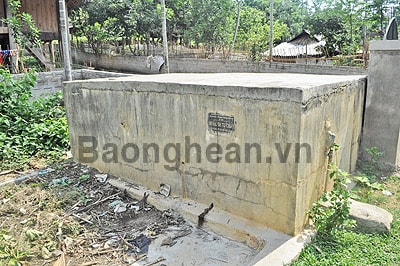
The water reservoir in Nong village, Chau Thuan commune, has been abandoned.
In most gravity-fed water supply projects, the design phase and the role of local consultants were not given sufficient importance, resulting in unsuitable installations after completion. This is most evident in the gravity-fed water supply project in Chau Thuan commune, which was first constructed in 2002. According to the design, upon completion, it would supply water to nearly 400 households. The project involved two construction phases and one subsequent repair. Initially, the pipes were made of cast iron and plastic, but they broke during use, requiring a complete replacement with flexible plastic pipes. Therefore, while the entire project cost only about 800 million VND, the repair costs amounted to 380 million VND. Put into operation in 2011, the project has only supplied water to the upstream villages, while the downstream areas are deteriorating and damaged.
Mr. Cam Ba Kinh, Vice Chairman of the Chau Thuan Commune People's Committee, explained: Due to the poor awareness of the people, when they need water, they arbitrarily break through the shared pipeline running through their houses to get water. Households at the source leave the pipelines exposed, allowing water to leak all day, while at the end of the line, the water pressure is weak, and the centralized reservoirs at some points are running dry…
This situation is not unique to Chau Thuan commune. A representative from the Quy Chau District People's Committee frankly stated: With the current authority and mechanisms, the commune-level People's Committee can completely handle this through the issuance of regulations. In reality, regardless of the funding source, completed projects are handed over to the local government for management. The people benefit from them, along with the responsibility of managing and maintaining them. However, due to a long-standing sense of dependence, both the people and the government are indifferent and lack awareness of the need to preserve and protect these projects!

The water intake valve at the source is broken.
Right here in Quy Chau, there are models worth learning from and replicating. One example is the self-funded clean water project. In Le village (Chau Hoi commune), 12 households each contributed 1 million VND to build the water reservoir, purchase pipes, and carefully maintain the system. As a result, they have had a stable and clean water supply for several years. In Chau Binh commune, with an investment of 2.4 billion VND and a plan to supply water to 600 households in 3 villages, instead of the traditional method of building pipes to draw water from the source to central reservoirs, the commune decided to change the model, laying pipes directly to each house without building reservoirs. It is known that the Chau Binh commune People's Committee is piloting a monitoring team and will eventually implement a water usage fee to fund maintenance and ensure sufficient supply capacity.
To improve the effectiveness of programs and projects for mountainous areas in general, and water projects in particular, we believe the State must establish a mechanism for evaluating and monitoring the effectiveness of investment and support projects for mountainous areas. This mechanism should assign specific responsibilities to local authorities and village-level governments in managing and protecting these projects.
Text and photos: Nguyen Hai


