
Many localities did not achieve the expected productivity.
(Baonghean)Under the scorching heat, farmers across the province are still busy harvesting the spring rice crop to prepare for the summer-autumn planting season. However, this year, due to various factors, the spring rice yield has not met expectations and is lower than in 2012.
While hurriedly loading heavy bundles of rice onto a cart under the sweltering midday sun, Ms. Nguyen Thi Ha (Hamlet 3, Nghi Van Commune - Nghi Loc District) recounted: Her family has 5 sao (approximately 0.5 hectares) of rice fields, planted with various varieties, from AC5, Q5, glutinous rice, etc., including 3 sao of terraced fields that require direct sowing. Although the weather was quite favorable at the beginning of the season, and there was no shortage of water, the yield was ultimately low. Fields planted with AC5 rice only yielded about 2 quintals/sao, while Q5 rice yielded better - 2.5 quintals/sao - but the price was low, usually only 560-570 thousand VND/quintal. According to her, the low rice yield is due to poor tillering, sparse and short panicles. Currently, her whole family is focusing on harvesting the spring rice crop so that in a few days, when water becomes available, they can prepare the land for sowing the summer-autumn rice crop. Walking along a stretch of road, beside a recently harvested rice field, Ms. Nguyen Thi Lan (Hamlet 3, Nghi Dien Commune) also expressed her disappointment: "My family cultivated over one acre of spring rice, all of it the new GS9 variety, but although the rice grains weren't empty, the panicles were small and short, with few grains. So, while in previous years the yield was over 3 quintals/acre, this year it's only over 2 quintals/acre."
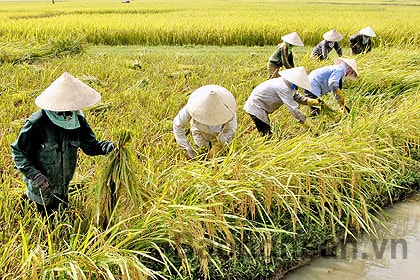
People in Lang Thanh commune (Yen Thanh district) are harvesting their 2012-2013 winter-spring rice crop.
Photo: Ho Cac
According to assessments, the yield of the 2013 spring rice crop throughout the province was not as high as in previous years. Mr. Tu Trong Kim (Head of the Crop Production Department - Department of Agriculture and Rural Development) said: At the beginning of the season, production was quite favorable in terms of both water resources and weather, so the planted area reached 89,021 hectares, exceeding the plan by over 3,000 hectares. In terms of structure, localities basically followed the province's directives, introducing many high-quality, high-yield rice varieties such as GS9, AC5, BTE1, ZZ004... However, in many places, farmers did not seriously follow the recommendations of the agricultural sector regarding planting seasons.
According to the directive, long-duration rice varieties should be sown earlier, and vice versa, to ensure all rice crops flower simultaneously from around April 25th, in accordance with the safety regulations of spring crop production. However, some localities sowed early, with rice flowering between April 10th and 15th. During the heading and flowering period, heavy rains and storms significantly affected yields. According to Mr. Kim, if not for the damage caused by natural disasters, the expected rice yield would still be around 65 quintals/hectare, approximately the same as the 2012 spring crop. However, due to the impact of adverse weather factors such as storms, heavy rain, low temperatures, and weak sunlight, about 7,000 hectares experienced a yield reduction of 30% or more, including 3,000 hectares using the BC15 rice variety.
According to the general report of the Department of Agriculture and Rural Development, this year's spring crop is expected to yield an average of only about 63.6 quintals/hectare, with a total production of 565,947.5 tons. Of this, 51,180 hectares of hybrid rice are expected to yield about 66.3 quintals/hectare, and 38,224.9 hectares of purebred rice are expected to yield about 59.4 quintals/hectare. In the key rice-growing area of Dien - Yen - Quynh, while last year's spring crop yielded over 70 quintals/hectare across more than 35,000 hectares, this year it has decreased significantly. Except for Yen Thanh, which is estimated at 71.5 quintals/hectare, Dien Chau is expected to yield only 66.3 quintals/hectare, and Quynh Luu even 60 quintals/hectare.
However, alongside the overall decline in productivity across the province and in some localities, even in key rice-growing areas, some commendable examples stand out. As a midland and mountainous district, Thanh Chuong does not have the same favorable conditions as some other localities in the province, yet this year's spring crop production has achieved encouraging results, ranking among the leading localities in the province in terms of spring rice yield. Harvesting began on May 10th and is currently nearing its end, with plans to complete it before May 25th to allow for timely preparation for the summer-autumn crop.
Mr. Phan Dinh Ha, Vice Chairman of the District People's Committee, happily stated: "The yield of this year's spring crop is expected to be approximately the same as, or even higher than, the 2012 spring crop, which was considered a bumper crop, at around 67 quintals/hectare. This achievement is primarily due to the district's introduction of many high-yield, high-quality rice varieties that have been proven to be adaptable and resistant to common pests and diseases in Thanh Chuong, such as GS9 and Nhi Uu 986…"
Anticipating the possibility of warm weather and rapid rice growth, the district closely followed the province's planting schedule, avoiding early transplanting and only transplanting half of the area before the Lunar New Year. This ensured that the rice plants did not encounter monsoon winds and low temperatures during flowering. The district also implemented appropriate technical measures such as early and strong basal and top dressing to promote strong tillering and a large number of tillers. Pest and disease control was prioritized, with timely warnings to ensure effective treatment. Notably, apart from a very small number of households still sowing rice directly, all spring rice in Thanh Chuong was transplanted using seedlings. As a result, while some localities suffered heavy damage from recent storms, Thanh Chuong experienced no damage thanks to the robust rice plants, unlike those sown directly, despite the storms occurring in the area.
Text and photos: Phu Huong


