
Large tea plantations were damaged by drought.
(Baonghean) - The intense heat has continued to cause significant damage to tea-growing areas such as Thanh Chuong and Anh Son districts. According to initial statistics, nearly 2,000 hectares of tea plantations across the province have died. Areas of tea planted since October last year, after months of care, are now practically wiped out...
Climbing over several hills under the scorching sun, we arrived at the newly planted tea plantation of Ms. Vi Thi Lan's family (Lap village, Ngoc Lam commune, Thanh Chuong district). The rows of tea plants interspersed with cassava plants had withered. Ms. Lan said dejectedly, “We have 3 sao (approximately 0.3 hectares) of tea that are already producing fruit, but for more than 10 days now, due to the drought, the leaves have turned yellow. The plants in this area are large and have strong roots; if it rains in the coming time, they can still recover. I'm just worried about the 6 sao of tea that we planted at the end of last year, which will be lost…” Ngoc Lam commune has 14 villages, and all 14 cultivate tea, making it their main crop. For the past two weeks, many tea plantations have started to turn yellow, dry out, and shed their leaves. Mr. Lo Van Ca, an agricultural officer of the commune, said: “The 15 hectares of commercial tea plantations in the commune are drying up.” Of the more than 70 hectares of tea planted last year, in low-lying areas near streams, the tea plants are still green, but in the areas on the high hills, they have begun to scorch red, and many areas are considered completely lost, with no possibility of recovery.
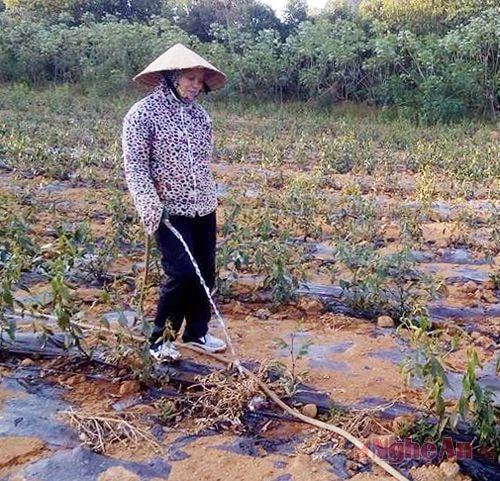 |
| Farmers in Phuc Son commune (Anh Son district) water their tea plants to save them. Photo: Dang Duong |
In Thanh An commune (Thanh Chuong district), Ms. Tran Thi Kim Ngan, Head of the Commune's Agriculture Committee, said: "The tea plants have started wilting for the past week. Over 200 hectares out of a total of 450 hectares of tea plants in the commune are gradually turning yellow. Currently, we are focusing on directing and advising farmers to make every effort to save the tea plants, but because most of the tea plants are located on high hills, water sources are scarce."
In October 2013, Mr. Tran Dinh Hong's family (Hamlet 2, Thanh My Commune, Thanh Chuong District) planted 1 hectare of tea. The 2014 drought completely destroyed the entire newly planted tea crop. Fearing a repeat of this current heatwave, saving the tea has been the family's top priority for the past two weeks. Every day, he utilizes every available water source, pumping it into tanks and transporting it by truck to irrigate the tea plants. Many days, he and his son don't return home until 2 AM the following morning. Thanks to this effort, the family's 1 hectare of tea remains healthy and green. However, the area irrigated in this way is limited due to water scarcity and the large area requiring irrigation.
Ms. Nguyen Thi Xuan, Head of the Agriculture Department of Thanh My commune, said: “The entire commune has more than 40 hectares of industrial tea plantations and more than 100 hectares of commercial tea plantations. The peak of tea wilting started about 10 days ago. In tea gardens located on higher hills, the scorched yellow color is spreading more and more. Most worrying is the tea planted last year; currently, about 30% of the area has died, and the rest is wilting. The commune is mobilizing people to find and utilize all available water sources to irrigate the tea, but it is still very difficult.”
Thanh Chuong currently has 4,400 hectares of tea plantations, distributed across 14 communes, mainly located in hilly and mountainous areas with steep slopes and many areas far from residential areas and water sources such as lakes, dams, and streams. Therefore, the tea plants rely almost entirely on rainwater. In recent years, droughts have become increasingly complex and severe, causing significant damage to the entire tea growing area of Thanh Chuong.
According to Mr. Le Dinh Thanh, Head of the District's Agriculture Department, it is projected that 3,900 hectares of commercial tea plantations will experience a decline in yield. Of the 500 hectares newly planted in 2014, some areas have already been severely damaged by fire, with virtually no possibility of recovery. Even more concerning is that most of the newly planted tea in Thanh Chuong is concentrated in resettlement areas such as Thanh Son and Ngoc Lam communes. The death of the tea plants not only causes losses for farmers in terms of investment but also delays the harvest by a year, significantly impacting the morale of the people in developing the economy of their new rural areas. Perhaps the province should consider providing timely support to the people.
 |
| Tea plants withered and died due to the intense heat in Hung Son commune (Anh Son district). Photo: Dang Duong |
In Anh Son district, the area of tea plantations destroyed by fire is spreading rapidly. The once lush green tea hills have now turned yellow, with an estimated damage of 2,000 hectares. The director of Hung Son Tea Enterprise stated that over 100 hectares of the enterprise's tea plantations have been destroyed. Although there are some water reservoirs, most of the tea hills have been burned. Areas of completely destroyed tea include: Phuc Son (40 ha), Long Son (15 ha), Hung Son (35 ha), Cam Son (30 ha), Khai Son (30 ha), Hoi Son (7 ha), Hoa Son (14 ha), and Thanh Son (55 ha)... Leaders of Anh Son district have inspected the affected tea plantations, encouraging tea growers to use all available methods to irrigate their tea plants in the morning and late afternoon. They have also instructed farmers to use electric pumps to draw water from wells and ponds, and to invest in extended hose systems for irrigation. Many households with newly planted tea are focusing on irrigating their tea plants using extended plastic hoses.
Currently, Anh Son and Thanh Chuong districts are focusing on directing communes to encourage farmers not to harvest tea using machines to reduce water loss. They are concentrating on three main measures: in areas with readily available water sources, they are utilizing water pumps or carrying water to irrigate the tea plants; using branches to shade newly planted tea plants; and applying green manure and straw under the tea plants. However, if there is no rain in the next 10 days, the area of damaged tea plants will likely increase...
Phu Huong - Dang Duong
| According to data from the Nghe An Tea Investment and Development Company, as of June 3rd, 730 hectares of the company's tea plantations had been destroyed, including 30 hectares in Con Cuong, 100 hectares in Bai Phu, 50 hectares in Anh Son Tea Factory, 100 hectares in Hung Son Tea Factory, 400 hectares in Hanh Lam Tea Factory, and 50 hectares in Ngoc Lam Tea Factory. A summary from the districts shows that nearly 2,000 hectares of tea plantations have been scorched, with nearly 1,000 hectares completely destroyed... |


