
Many theories surround the A320 plane crash in France.
French authorities announced that search teams have recovered a black box from the Germanwings Airbus 320 that crashed on the morning of March 24 in the French Alps while en route from Barcelona to Dusseldorf.
However, it is still too early to determine the exact cause of the accident.
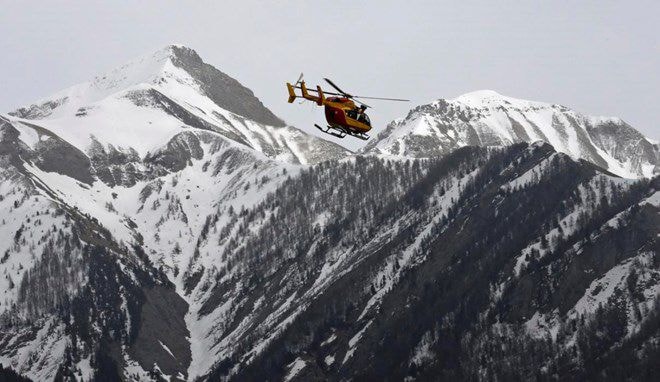 |
| Rescue aircraft at the scene of the Germanwings plane crash (Source: AFP) |
Currently, speaking to the French media, many experts are preliminarily suggesting that a technical malfunction is the most likely hypothesis leading to the catastrophic accident that killed 150 people. However, experts acknowledge that all hypotheses are possible, as many factors remain unclear.
Below are the scenarios that have been put forward by French aviation experts:
Causes of bad weather:Normally, meteorological conditions, even in mountainous areas, do not significantly affect long-haul flights, unless "terrain waves" occur—that is, sudden turbulence in certain mountainous regions. However, this scenario has a fairly low probability of occurring. The French meteorological website Meteo Consult stated that weather conditions at the time of the plane crash were "optimal."
Sudden drop in cabin pressure:In the event of a sudden drop in cabin pressure, the pilot would be forced to descend to regain proper pressure. If the internal pressure drops too drastically or an explosion occurs (for example, a hole in the passenger compartment due to a strong impact or a door being blown off 10,000 meters away), the pilot only has about 25 seconds to be conscious before passing out. This explains why the crew did not (in time) send a distress signal, as the French Civil Aviation Authority stated. The pilot also did not take any action to indicate an attempt to avoid the terrain.
Collision with a bird:This was also a hypothesis put forward on the evening of March 24th. It's possible the plane collided with a flock of geese flying very high. In that case, the impact could have been very strong.
Technical malfunction:According to some experts, the plane may have experienced a technical malfunction, and this hypothesis has a fairly high probability of being true. Flight path analysis shows that the plane made an emergency descent from a cruising altitude of approximately 9,000 meters to 2,000 meters within 8 minutes. This was not a sudden landing, like the Algerian Airlines plane crash in northern Mali in July 2014, where the plane fell vertically, or the MH17 crash caused by a missile strike in Ukraine.
On LCI television, expert Robert Galan mentioned the possibility of structural failure, loss of control, or engine explosion. Some German experts suggested a problem with the control panel's IT system or a computer malfunction. However, this hypothesis was quickly dismissed by Lufthansa.
Meanwhile, speaking to the French newspaper Le Figaro, pilot Arnaud Louvet suggested that the aircraft's tilt sensor may have malfunctioned. Normally, this system limits the angle of inclination of the aircraft's fuselage during flight to no more than 1 to 2 degrees.
If this part freezes, possibly due to water ingress from rain during takeoff in Barcelona, the aircraft will become stuck in a certain angle. A similar situation occurred in 2008 when an A320 crashed in the Mediterranean Sea while flying near Perpignan, in southern France.
Attacked by terrorists:In the current context, this possibility is always the first to be raised, but in this case, it's not really convincing. Experts believe the accident was not like an explosion in mid-air. The wreckage was scattered over an area of only 2 hectares, so it couldn't have exploded in the air. A local witness said they saw a plane flying at an altitude of only 800 meters.
Furthermore, the automatic transceiver responsible for communication between the radar and the aircraft's air traffic control tower switched to a "malfunction" signal. In the event of hijacking or terrorism, the pilot has other ways to transmit special signals.
Authorities say the Airbus A320 is a medium-range, single-aisle aircraft with a capacity of 150 passengers. When it was first introduced to the market, this aircraft attracted attention due to several groundbreaking advancements at the time, such as its electronic flight control system and modern control screens.
The aircraft also had nearly 50% lower fuel consumption than its main competitor, the Boeing 737. Later, the A320 developed into new variants from the A318 to the A321 and became widely used around the world. The aircraft involved in the accident had entered service in 1990 and had only recently undergone a thorough technical inspection.
| RELATED NEWS |
|---|
According to VNA


