
Many car models in Vietnam are cheaper than in Thailand.
Some car models, such as the Mazda CX-5 or Mercedes A-class, are priced lower in Vietnam compared to their equivalent versions in Thailand.
In Southeast Asia, car prices in Vietnam are among the highest, only lower than Singapore due to the island nation's need to restrict private vehicles because of its small size. However, a steady wave of price reductions over the past two years is resulting in different outcomes, with some car models in Vietnam now cheaper than in Thailand.
| Car model | Prices in Vietnam | Prices in Thailand |
| Mazda CX-5 2.0 | 34,892 | 40,036 |
| Mercedes-AMG A45 | 98,956 | 132,149 |
| Mercedes-AMG CLA45 | 102,476 | 142,685 |
| Mercedes-AMG GLA45 | 100,276 | 145,695 |
| Mercedes GLC250d | 82,676 (*) | 97,531 |
| Porsche Macan Turbo | 221,760 | 288,982 |
(Unit: USD, exchange rate as of August 20, 2017. (*) In Vietnam, this is the GLC250 gasoline version)
The above comparison table shows that the price of the CX-5 2.0 in Vietnam is approximately $5,000 cheaper than in Thailand. This is the first time this has happened. For some high-performance AMG models from Mercedes, the price difference between Vietnam and Thailand is significantly higher, around $40,000. The GLC250d in Thailand is also about $5,000 more expensive than the GLC250 in Vietnam.
The fact that the Mazda CX-5 is cheaper in Vietnam than in Thailand is the result of the price reduction campaign launched by Truong Hai over the past two years. Compared to 2015, the CX-5 is now about 300 million VND cheaper. Truong Hai has ambitions to export cars back to Southeast Asian countries, so reducing production costs to lower car prices is a prerequisite for Mazda cars produced in Chu Lai to be competitive in foreign markets.
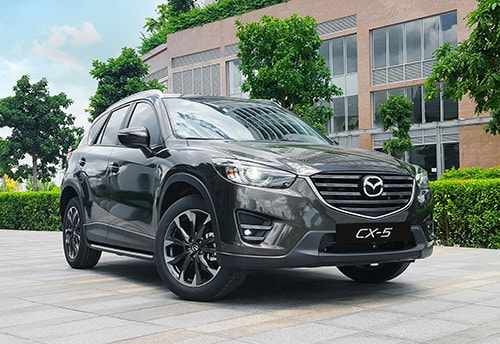 |
| The Mazda CX-5 in Vietnam is now cheaper than in Thailand. |
Meanwhile, the prices of some Mercedes AMG models in Vietnam are much cheaper than in Thailand due to different tax systems. Currently, the special consumption tax in Vietnam is based on engine displacement, while Thailand abandoned this method and switched to calculating based on CO2 emissions from the beginning of 2016; the more emissions a car produces, the higher the tax. Therefore, sports-oriented cars that consume more fuel and emit more emissions, such as Mercedes-AMG and Porsche, will have much higher prices than mainstream models.
Aside from the Mazda CX-5 and other high-performance models, car prices in Vietnam are generally slightly higher than in Thailand, but the difference isn't significant, only a few thousand USD. For example, a Mazda3 2.0 costs $33,684 in Thailand and $35,156 in Vietnam, while a Toyota Vios costs $23,750 in Thailand and around $27,300 in Vietnam.
An industry expert predicts that car prices in Vietnam will fall to regional levels, or even lower if prices can drop further in 2018. However, accessibility to cars is not uniform, as while car prices are similar, Vietnamese people have some of the lowest incomes in the region.
According to the World Bank, in 2016, the average per capita income in Vietnam was $2,185, while in Thailand it was $5,900, almost three times higher. The pressure of car prices is much less for Thais than for Vietnamese.
According to Vnexpress
| RELATED NEWS |
|---|


