
Nhiều mô hình hỗ trợ giảm nghèo chưa bền vững
(Baonghean) - With the goal of helping people in communes, villages, and hamlets find suitable crops and livestock to escape poverty, many pilot models are being implemented in Quy Chau district. However, for these models to help poor people achieve good and sustainable results, it is necessary to strengthen technical support and loan capital for production investment.
(Baonghean) - With the goal of helping people in communes, villages, and hamlets find suitable crops and livestock to escape poverty, many pilot models are being implemented in Quy Chau district. However, for these models to help poor people achieve good and sustainable results, it is necessary to strengthen technical support and loan capital for production investment.
Initial results
In the final days of the year, the atmosphere at the Quy Chau District Agricultural Extension Center was quite busy. People were rushing back and forth between the communes in the district to inspect and summarize the results of production models. Mr. Sam Van Thai, the station chief, introduced us to the initial results of the pilot models being implemented in Quy Chau district, aiming to help people in the communes, villages, and hamlets find suitable crops and livestock to escape poverty.
In Hoa Binh village, Chau Binh commune, since April 2013, the Agricultural Extension Station has implemented a high-yield gac fruit cultivation model, piloting it in 9 households. The villagers were provided with 400 high-yield gac seedlings along with fertilizer and pesticides. Under the close guidance and supervision of agricultural extension officers and engineers, by the end of 2013, the villagers' gac orchards began to yield impressive results: all 400 trees produced fruit, with some trees yielding up to 30 fruits, an average yield of 1.4 kg of fruit, and a total of 8.4 tons of finished gac fruit. With the current purchase price of 7,000 VND/kg from Nghe An Food Joint Stock Company, 1 hectare of high-yield gac fruit yielded nearly 59 million VND in its first year.
According to projections, by the second year, after the gac fruit trees have adapted to the climate and soil conditions, yields will double, and total income will exceed 117 million VND. This is truly a dream figure for the poor people in Quy Chau. After more than half a year of testing the high-yield gac fruit cultivation model, the Agricultural Extension Center found that gac fruit trees are perfectly suited to the climate, hilly soil conditions, and farming methods of the Thai ethnic people in Quy Chau district. Gac fruit is a plant with few pests and diseases, with a lifespan of 15-20 years, providing stable income for the people. On the same unit of land, gac fruit trees are currently yielding the highest income. Importantly, this model has also attracted businesses to participate alongside the government, farmers, and scientists, as Quy Chau district has signed a contract with Nghe An Food Joint Stock Company to purchase all of the farmers' gac fruit at market price.
Besides the high-yield gac fruit cultivation model, a high-yield model of growing fragrant root (Rhizoma Aquilariae) is emerging in Quy Chau district. In December 2012, Mr. Ho Viet Thang's household in Tan Huong 2 Hamlet, Tan Lac Town, Quy Chau District, was selected by the District Agricultural Extension Center as a pilot site for developing fragrant root propagation models. After more than a year of implementation, by the end of 2013, the model began to show effectiveness as the fragrant root plants developed very well, and propagation by cuttings yielded a high survival rate. Previously, models of growing fragrant root under acacia and rubber plantations had been successfully implemented in Hoa Hai village (Chau Hanh commune), yielding very positive results, with an average yield of 4.5 - 5 tons of fresh roots per hectare, generating hundreds of millions of dong per hectare. Currently, this model is being replicated in Chau Phong, Chau Binh, Chau Tien communes, Tan Lac town, etc.
While the cultivation of fragrant root and gac fruit is becoming a highly effective and productive economic model, breeding sows and Quy Chau Muscovy ducks are also truly helping many households in Quy Chau escape poverty. Leading us on a tour of sow breeding models in Chau Tien commune, Mr. Lo Thanh Son, Head of the Agriculture Department of Quy Chau district, said that more than a year ago, some poor households in Chau Tien commune received breeding sows. After a year of proper care and techniques, these households now have herds of up to 12 piglets. “This Tet holiday, our family will sell these 12 piglets to get money for the holiday and buy another piglet to raise,” confided Ms. Lo Thi Thu from Hong Tien village. Mr. Son added that many families in the remote communes of the district are also very successful with the model of raising Quy Muscovy ducks in streams. The ducks sell at high prices, so people are not afraid of being exploited and are very enthusiastic about restocking their flocks. This confirms that many models supporting the economic development of ethnic minorities in Quy Chau district are proving effective, making a significant contribution to helping ethnic minority people change their business mindset and gradually escape poverty.
Many models fail prematurely.
Khác với không khí ồn ào, náo nhiệt của những ngày cận Tết ở thị trấn Tân Lạc, bản Chiềng, xã Châu Thuận khá tĩnh lặng và vắng vẻ. Bản có 71 hộ, trong đó có 16 hộ nghèo, trong những năm qua, bản Chiềng nhận được sự hỗ trợ của nhiều chương trình, dự án để giúp bà con thoát nghèo. Năm 2010, có 10 hộ dân trong bản được nhận bê từ Chương trình dự án 135. Ai cũng vui mừng, phấn khởi bởi đối với những hộ nghèo người dân tộc Thái thì con bê trị giá từ 7 - 8 triệu đồng đối với họ là tài sản lớn. Cũng như nhiều hộ nghèo khác, sau khi nhận bê, anh Cầm Bá Hợp cố gắng chăm bẵm nhưng vì nhiều nguyên nhân khác nhau, trong đợt rét đầu năm 2013, con bê của gia đình anh Hợp đã bị chết rét. Cùng chung hoàn cảnh như anh Hợp, nhiều con bê khác của các gia đình trong bản cũng bị chết. Theo kết quả khảo sát của chúng tôi, trong số 10 con bê của bản Chiềng được hỗ trợ từ dự án 135 thì hiện nay chỉ còn lại 1 con, 9 con khác đã chết.
Là bản nghèo của xã Châu Thuận, năm 2012, có 13 hộ dân ở bản Thăm 1 được nhận 13 con bê của dự án 135. Sau gần 1 năm chăm sóc, đến nay, số đó chỉ còn lại 3 con. Ở bản Thăm 2, tình hình cũng không khá hơn bao nhiêu, trong số 12 con bê dự án của người dân được nhận thì có 5 con đã bị chết rét. Chị Hà Thị Phòng - cán bộ nông nghiệp xã Châu Thuận cho biết, năm 2010, xã Châu Thuận được hỗ trợ 41 con bê, sau một thời gian chăm sóc, có tới 34 con đã bị chết trong đó có bản Nong được hỗ trợ 8 con thì cả 8 đều bị chết, bản Chiềng 9/10 con bị chết,… Năm 2012, xã Châu Thuận được hỗ trợ 25 con bê với kinh phí 200 triệu đồng thì hiện nay chỉ còn lại 10 con còn sống. Số lượng bê dự án phát triển tốt và sinh sản hiện chỉ đếm trên đầu ngón tay.
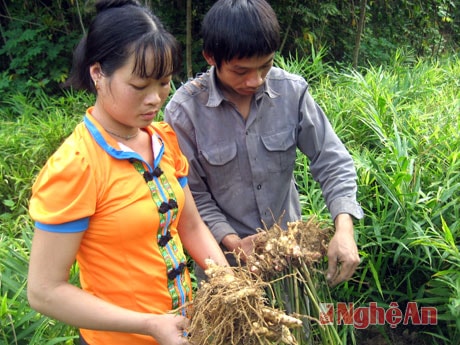 |
| Mô hình trồng gừng ở xã Châu Thuận. |
Ngoài chính sách hỗ trợ bê giống, chương trình dự án 135 còn hỗ trợ lợn, giống vịt bầu Quỳ, lợn... Tuy nhiên kết quả không được như mong muốn. Trong số 1.600 con vịt và 32 con lợn nái hỗ trợ cho người dân nghèo của huyện Quỳ Châu thuộc đối tượng thụ hưởng của chương trình dự án 135, đến nay, nhiều gia đình đã bán lợn, bán vịt nhưng không có khả năng tái đàn. Tại xã Châu Thuận, 8 trong tổng số 16 con lợn nái đã bị chết; năm 2011 xã Châu Bính được hỗ trợ 26 con lợn giống thuộc Chương trình 135 nhưng đến nay, số tồn tại và phát triển, tái đàn được rất ít.
Năm 2012, xã Châu Thuận thí điểm thực hiện mô hình trồng gừng trên diện tích 2 ha ở bản Chàng. Gừng được trồng dưới tán rừng và trên diện tích đất đồi, phát triển rất nhanh, không sâu bệnh. Đến thời kỳ thu hoạch, một khóm gừng bình quân thu trên 1 kg gừng củ, sản lượng thu được 15 tấn/ha, chất lượng gừng rất tốt, củ đều và đẹp khiến bà con rất vui mừng. Tuy nhiên, niềm vui ngắn chẳng tày gang, mô hình trồng gừng nhanh chóng chết yểu vì không có đầu ra ổn định. Anh Lương Văn Dũng, cán bộ nông nghiệp xã Châu Thuận cho biết, đến nay, người dân chỉ trồng gừng để ăn, không ai trồng gừng để làm hàng hóa nữa vì không biết bán cho ai…
Nói về một số mô hình hỗ trợ người dân không đạt kết quả như mong muốn, đặc biệt số lượng bê dự án bị chết quá nhiều, cán bộ nông nghiệp xã Châu Thuận cho biết, nguyên nhân chính là do các đợt rét đậm, rét hại kéo dài. Bên cạnh đó, bê giống quá nhỏ, trong khi đối tượng thụ hưởng là những người nghèo, rất nghèo, họ không có các kỹ năng chăm sóc, không đầu tư thức ăn, không có kiến thức để đối phó trước các loại dịch bệnh. Trong khi đó, bê giống được cấp thường đưa từ nơi khác đến, không hợp khí hậu, thổ nhưỡng của địa phương, trong khi phong tục tập quán của người dân là chăn nuôi theo hình thức thả rông, không có chuồng trại kiên cố nên bê không thể phát triển. Thậm chí, còn có hộ dân thiếu ý thức tìm cách bán hoặc làm thịt bê dự án hoặc bán để lấy tiền tiêu và báo cáo với thôn bản là bê bị chết vì rét…
Thực tế, lâu nay, các chính sách hỗ trợ đồng bào sản xuất vẫn thực hiện theo tiêu chí “cho cần câu thay vì cho con cá”, tuy nhiên, qua thực tế các mô hình, dự án hỗ trợ đồng bào nghèo ở huyện Quỳ Châu không đạt được hiệu quả trong thời gian qua, có thể nhận thấy rằng, đã có “cần câu” nhưng “người đi câu” làm được như thế nào là một vấn đề khác. Theo ông Lô Thanh Sơn - Trưởng phòng nông nghiệp huyện cho rằng các chương trình dự án cần phải được phân bổ thêm cho những người có điều kiện kinh tế, có kiến thức về khoa học kỹ thuật, sản xuất để họ làm gương cho những hộ gia đình khác làm theo. Các dự án phải làm có trọng tâm, trọng điểm, nếu có hiệu quả thì mới tiếp tục triển khai, không hiệu quả thì phải chuyển các loại cây, con giống khác để tránh lãng phí.
Việc triển khai các chương trình hỗ trợ cho đồng bào nghèo là chính sách đúng đắn của Đảng và Nhà nước với mục tiêu giúp đồng bào thoát nghèo. Nhưng, cũng cần phải trang bị kiến thức về khoa học kỹ thuật, cho người dân vay vốn để đầu tư, sản xuất song song với hình thức cầm tay chỉ việc của cán bộ cơ sở, để các mô hình giúp đỡ đồng bào nghèo đạt kết quả tốt và bền vững.
Nguyên Khoa


