
Many "bottlenecks" need to be resolved.
(Baonghean) - One issue of concern to the Provincial People's Council and voters is that agricultural and forestry farms and youth volunteer brigades for economic development are entrusted with managing and using large areas of land, but have not been able to utilize them effectively; meanwhile, local people lack land for production, leading to disputes in some localities.
The Bai Phu Tea Enterprise (Anh Son district) is entrusted with managing and utilizing 524.46 hectares of natural land. This includes over 419 hectares of agricultural land; 32 hectares of forest land; and the remainder being wasteland, streams, ponds, dams, roads, and non-agricultural land. Currently, the entire agricultural land area is utilized by the enterprise through contracts with over 1,000 households for growing tea, sugarcane, corn, beans, and peanuts; nearly 7 hectares of non-agricultural land are used for offices, tea processing plants, etc.
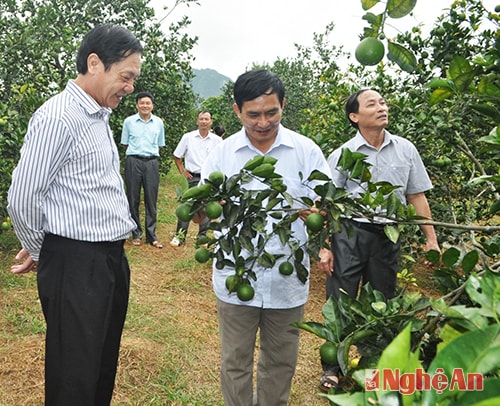 |
| The Economic and Budget Committee of the Provincial People's Council is supervising the management and use of land at the Bai Phu Tea Enterprise. |
According to regulations, the Bai Phu Tea Enterprise, as the entity entrusted by the State with the management and use of land, is responsible for developing land use plans, selecting and introducing crops and livestock for production in accordance with the plan; transferring scientific and technical advancements; and guaranteeing the purchase of products from households. However, in practice, the enterprise has mainly "outsourced" the land to the households. The relationship between the contracted households and the enterprise is limited to the fact that the contracted households are responsible for paying the contracting party an annual financial obligation of 3% of the total value of 60% of the products that the enterprise delivers to the households under the contract. Mr. Nguyen Van Dong, Director of the Bai Phu Tea Enterprise, also acknowledged this: The management of the land under the enterprise's management has not been truly strict. Some households have arbitrarily built houses on the leased land, and land encroachment still occurs. Land planning, crop arrangement, and the transfer of scientific and technological advancements have not received sufficient attention, leading some members to arbitrarily plant crops outside the enterprise's planned areas, such as orange trees. Based on these limitations and shortcomings, it can be affirmed that the Bai Phu Tea Enterprise has not fulfilled its role as the entity managing and utilizing the land entrusted to it by the State.
At Con Cuong Forestry One-Member Limited Company, a field survey revealed that the land under its management is free from vacant land, abandoned land, and land disputes or encroachments; only some areas have overlapping or duplicate land titles. In addition to managing and protecting natural and protective forests, the company has also guided, advised, and directed the selection of tree species, and transferred forestry science and technology to local people cultivating over 698 hectares of managed production forest, including bamboo, bodhi, and acacia. The average yield per hectare of bamboo and bodhi trees over a 6-year cycle is 40 million VND (after deducting initial investment, management, and protection costs, people earn a profit of 31 million VND/hectare/6 years); for bamboo, after deducting expenses, people earn 10-12 million VND/hectare/year. Mr. Nguyen Duc Son, Director of the company, affirmed: Up to this point, in Con Cuong, no type of tree planted on forest land has yielded higher economic returns than the crops the company has already planted. The problem is that, despite being entrusted with managing over 5,000 hectares of natural forest, the company lacks the necessary funding for protection, while the government has advocated for "forest closure" for many years. The inability to exploit the forest for management and protection purposes, coupled with the lack of financial support, makes forest management and protection difficult for the company. In addition to the issues Mr. Son raised, our survey revealed that there are also 67 hectares of land currently occupied and cultivated by 36 households that have yet to have their land ownership procedures resolved according to regulations.
Along with the aforementioned issues, during our survey of land management and use in collaboration with the Economic and Budget Committee of the Provincial People's Council, we found that the management and use of land by state-owned tea plantations and tea farms in the province are revealing shortcomings. Joint ventures, partnerships, and transfers in land exploitation and use are still arbitrary. Previously, state-owned tea plantations and tea farms were allocated land by the province on paper and maps, not on the ground. As a result, the management units have lacked boundary markers, leading to overlaps, duplications, and land disputes. For example, at the Bai Phu Tea Plantation, a review as of December 31, 2013, showed that only 453.33 hectares out of 524.46 hectares on paper were allocated. On the other hand, implementing Resolution No. 28-NQ/TƯ, dated June 16, 2003, of the Politburo "on continuing the restructuring, reform, and development of state-owned agricultural and forestry farms" and Government Decrees No. 170/2004/ND-CP and 200/2004/ND-CP stipulating policies and solutions for reforming state-owned agricultural and forestry farms, these farms have transformed their organizational models into single-member limited liability agricultural and forestry companies, joint-stock companies, and Protective Forest Management Boards. Upon transformation into enterprises, these units are required to pay land tax on the areas under their management, including areas that are not being used effectively, as well as roads, streams, lakes, dams, and rocky mountains. Therefore, in recent times, these units have proactively reviewed the actual land area and are proposing plans to return areas that are not being used for production in accordance with the unit's assigned tasks to local authorities. These include areas of rivers, streams, ravines, lakes, and roads; and areas where people have built stable houses for three generations. The organization of transforming these groups into a new form of management and production, as seen in the Youth Volunteer Brigade 6 – Economic Development, is also posing difficulties in compensation and land clearance for new projects...
Mr. Vi Luu Binh, Deputy Director of the Department of Agriculture and Rural Development, stated: The establishment of agricultural cooperatives and cooperatives was appropriate for a certain historical period, but at this stage, their role, functions, and responsibilities are becoming increasingly unclear. For example, their pivotal role in transferring science and technology to form large-scale agricultural product zones in each locality is no longer prominent. Currently, the transfer of science and technology is not solely through "hands-on" methods or model demonstrations; in reality, it is conveyed through numerous channels such as newspapers, television, visits, and model learning... Furthermore, in terms of effectively managing land and organizing production and business on the allocated land, agricultural cooperatives and cooperatives have not yet achieved this goal. Given these existing shortcomings, the restructuring and reorganization of agricultural cooperatives and cooperatives is necessary. And Resolution No. 30/NQ-TƯ, dated March 12, 2014, of the Politburo "On continuing to restructure, innovate, develop, and improve the operational efficiency of agricultural and forestry companies"; and Decision No. 686/QĐ-TTg, dated May 11, 2014, of the Prime Minister on the program and plan for implementing Resolution 30 of the Politburo, have clearly demonstrated the efforts to overcome the shortcomings and limitations currently facing agricultural and forestry enterprises. The most difficult challenge now is clarifying land ownership, due to the ongoing changes. The second difficulty is addressing existing issues such as housing on the land, or the implementation of contracting mechanisms under Decrees 01, 200, and 135, which implicitly lead people to understand that the land belongs to their family, as it is passed down from grandfather to father, and then to son...
Based on the survey findings, the Economic and Budget Committee of the Provincial People's Council proposed that state-owned agricultural and forestry enterprises (SOEs) review and inventory the land area under their management, and on that basis propose to the authorities at all levels a plan for managing each type of land; at the same time, implement effective management and use of the land under their direct management; and coordinate with the government and relevant departments to address the issues at hand. The Department of Agriculture and Rural Development needs to research and propose a plan to implement Resolution 30 of the Politburo on continuing to reorganize, innovate, and improve the efficiency of agricultural and forestry companies, focusing on the interests of farm workers and households, and ensuring effective management, use, and leasing of land. Simultaneously, it should research and propose to the province the conversion of SOEs into different management models, whether public service or commercial units...
Text and photos:Mai Hoa


