
Many unused SIM cards will be locked.
The decision by the Vietnam Post and Telecommunications Group (VNPT), issued on July 6, 2011, regarding the validity period of prepaid SIM cards/kits for MobiFone and VinaPhone, continues to face opposition from SIM card dealers…
The network provider's decision aims to better manage its subscribers, but it significantly impacts customer rights.
The network provider's reasoning
According to Decision 978/QD-VNPT-KD of the Vietnam Post and Telecommunications Group, MobiFone and VinaPhone SIM cards/kits issued before 0:00 on August 1, 2011, are only valid until December 31, 2013.
SIM cards/kits issued after 00:00 on August 1, 2011, have a validity period of 24:00 on December 31 of the second year following the year of issuance. After this time, all VinaPhone and MobiFone SIM cards/kits that have been released to the market but have not been activated, or have been activated but have not generated any charges, will be recalled for re-issuance according to current regulations.
VNPT explained that the decision regarding the validity period for prepaid subscriptions is solely aimed at better managing subscribers. Through this policy, telecommunications companies hope to reduce the number of inactive or non-performing subscribers sitting at retail outlets, thus wasting resources. Additionally, tightening the validity period will curb the practice of dealers "speculating" on premium phone numbers for resale and profit.
Representatives from both VinaPhone and MobiFone acknowledge that millions of mobile SIM cards are currently sitting in retail stores nationwide. Limiting the validity period will inevitably impact the market and the sellers.
However, both telecommunications companies acknowledge that tightening the validity period will help them manage their number inventory more effectively. At the same time, authorized dealers will be responsible for selling SIM cards faster instead of importing thousands of SIMs and then hoarding them to sell off the desirable numbers gradually for profit. Another reason given by the network operators is to prevent SIM cards issued too long ago from becoming damaged and to avoid hackers exploiting desirable numbers without the knowledge of either the customer or the network operator…
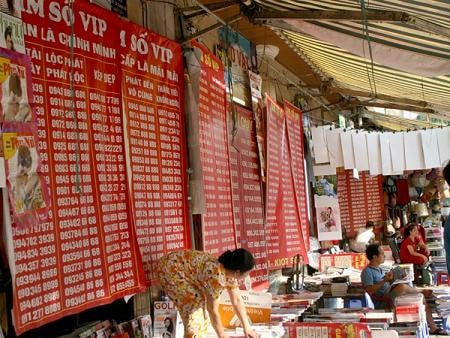
Many unused SIM cards may be blocked. Photo: Minh Duc
The struggles of a dealer
According to Mr. Hung, the owner of a SIM card dealership in Thai Ha, before August 1, 2011, his store had purchased 10,000 SIM cards at a price of 50,000 VND per SIM, totaling 500 million VND paid to the network provider. Of those 10,000 SIM cards, about 200 were considered "premium" and were kept by the dealership for later sale. The remaining 9,800 SIM cards were distributed to retail stores, and some were even supplied in advance. Thus, the network provider received the money, but the dealerships had not yet recovered their capital. For dealerships that purchased large quantities (40,000-50,000 SIM cards), if they hadn't sold them by the December 31, 2013 deadline, they would have to cancel or have them recalled, resulting in significant losses.
On the other hand, mobile network operators, especially Vinaphone, have long implemented a policy of selling SIM cards bundled with scratch cards. Any dealer wanting to purchase 1,000 SIM cards had to buy 2 billion VND worth of scratch cards. The discount rate that the main distributors received from the network was 6.7%, while to purchase the SIM cards, all dealers had to absorb the losses and sell them on the market at a rate of 8-10%. To obtain their current SIM card inventory, dealers have had to bear the cost of subsidizing scratch cards for many years.
Therefore, dealers are forced to factor in the value of premium phone numbers to recoup their investment and ensure profitability. Mobile network operators are aware of this, so in their year-end sales campaigns, they often reward dealers with premium numbers if they purchase large orders of prepaid phone cards worth hundreds or thousands of billions of dong.
Mr. Tung, the owner of a SIM card agency on Bach Mai Street, believes that a general deadline of December 31, 2013, should not be set, as each agency has a different amount of SIM cards in stock. Agencies with more SIM cards will need more time to sell them, as the number sold depends on market demand.
Furthermore, the concept of "lucky" phone numbers needs to be acknowledged, as even mobile network operators auction off lucky numbers and offer them to users as part of a commitment-based scheme.
The decision to regulate the prepaid SIM card market by mobile network operators puts distributors and dealers at risk of losing billions of dong. The question is how to ensure the legitimate rights of both dealers and consumers. From the dealers' perspective, based on the contract signed between the network operator and the main distributor, after the dealer has made full payment, the goods belong to the dealer.
If the network operator unilaterally cancels the numbers in the dealer's inventory and issues new SIM cards and sells those SIM cards on the market (collecting money again), then it is clear that the network operator has taken away the legally recognized property of the dealer.
If the network provider (Party A) wants to change the terms of the contract, they must invite the agent (Party B) to a meeting to negotiate. Only with Party B's agreement can the two parties agree to add the new terms.
The dealers argue that, regarding the SIM cards already sold to them under the old contract, the network provider should withdraw its decision. After the old contract expires, the network provider should add a clause about the SIM activation deadline to the new contract, so that the activation deadline for newly issued SIM cards will be agreed upon by all parties.
According to Tien Phong


