
Remembering Rộ Market... the days leading up to Tet
A light spring rain falls. The rural landscape seems stirred by the bustling footsteps of villagers shopping for Tet (Lunar New Year). Following them, we arrive at a rural market nestled beside the Lam River, which is always full of water – this is the Ro Market.
The market is located on land that formerly belonged to the Vo Liet district, a place with significant historical importance, now part of Vo Liet commune, Thanh Chuong district. It's no coincidence that this land was chosen as a place for trading traditional goods since ancient times; it offers convenient transportation by both river and road, has a flat terrain, is close to the riverbank, and is also a central hub for surrounding areas.
Usually, each commune has a market, but they are smaller in scale and only meet a few times a month on specific days. However, Rộ Market meets 30 days a month, with a main market every 5 days – specifically on the 5th, 10th, and 15th of each month. Around the 25th or 26th of the twelfth lunar month, the market is almost always crowded, from dawn until well past noon. People from all directions leading to the market are bustling with activity, carrying their goods like a festival. People from the surrounding areas, from the lower regions, and even those from the right bank of the Lam River struggle to cross the crowded ferries to Rộ Market to shop for Tet (Lunar New Year). They come here to buy, to sell, and many others simply to visit and learn about the market.
|
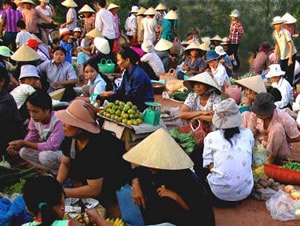
Although the market isn't large, it has nearly 40 stalls built from bamboo and thatch, selling a full range of products from the local villages. There are still clothes, meat, fish, sweets, conical hats, and more... but in the days leading up to Tet (Lunar New Year), goods from all over pour in in abundance. Right from the main gate, the vibrant green of two rows of banana leaves, neatly arranged on heavily laden carrying poles, fills the air. Further inside are the rice and sticky rice stalls. The women, both cheerfully inviting customers and skillfully sifting and winnowing each bundle of rice and sticky rice according to customer requests, create a unique and lively atmosphere. Next to the rice stalls are the fruit stalls, with baskets overflowing with bananas, oranges, tangerines, guavas, and sapodillas – produce from each household and garden, left on the trees until today before being brought to market by the women. The green of leafy vegetables, the red and yellow of fruits... blend together with the fragrant aroma wafting from the nearby incense stalls, making the hearts of market-goers even more joyful as the Lunar New Year approaches.
If you go into the stalls selling paintings... you'll be surprised to see images of carp gazing at the moon, colorful peacocks, and all kinds of couplets filled with auspicious wishes swaying under the eaves, brightening up a corner of the market. The paintings here are mainly made from paper and various types of woven mats... simple and rustic, yet perfectly suited to the tastes of many locals. Going to the Tet market is probably more carefree and relaxed than for us children, holding colorful balloons in our hands, eating all sorts of things like sticky rice candy, ginger jam, honey cakes... sneaking around to admire the delicious and beautiful goods, tiptoeing near the firecrackers, hiding behind adults to watch and hear the crackling and booming sounds of the colorful firecrackers. At times, they would run back and forth, playing with the vibrant paper flowers interspersed with balloons fluttering on tightly bound bundles of reed brooms, and the gnarled, weathered branches of plum and peach trees, proudly displaying their colorful, lush green buds and shoots under the radiant gaze of the vendors.
A unique feature of the Tet market here is that in one corner, there are also heavy loads of fresh grass. Once, out of curiosity, I asked my mother, "What do people sell grass for during Tet, Mom?" My mother playfully tapped my head and said, "We shouldn't forget our pets during Tet because for humans, Tet is about eating sticky rice cakes and sweets, but for buffaloes and cows, grass is always the best food."
By the morning of the 30th, the market was still open, but there were significantly fewer shoppers. By then, only those shopping for Tet late due to other commitments remained, or those returning from afar trying to stop by the market to buy some gifts for their families. Everyone else was busy preparing offerings for their ancestors at home before entering the important moment of a new year filled with joy and new hopes.
The Rộ Market still maintains its old-fashioned layout and size, but the goods are now more abundant and diverse. The new bridge across the river has made it easier and more convenient for people on the right bank to shop. Perhaps in the near future, the market will be moved to a larger location, but the authorities, especially those who have lived there, been connected to it, and understand Rộ Market, are concerned about whether this will alter its traditional value. Right now, Rộ Market remains a focal point attracting many people, the "center" of trade for the entire left bank region, especially during the days leading up to Tet (Lunar New Year). Perhaps this is a unique feature, a charm that Rộ Market has contributed to the cultural identity of the homeland, much like a once-famous dish:
Our homeland, Nam Dan, has sweet sugarcane.
Sweet potatoes from Cho Ro market, fragrant oranges from Xa Doai.
Nguyen Ngoc -Nghe An Publishing House


