
Remember Huoi Poc
The echoes of Huoi Poc Mountain evoke memories of the long road from National Highway 7, the arduous trek along precarious, secluded trails, crossing many fields and wading through numerous streams. Remembering Huoi Poc also evokes memories of the steep slopes with their jagged, sharp rocks that seem ready to tear apart the feet of those unfamiliar with the mountainous terrain. Yet, the Hmong women still nimbly climb the slopes, carrying heavy loads of firewood on their backs. Behind those slopes lies the largest village in Nam Can commune, Ky Son district. Huoi Poc has 173 households and approximately 1000 inhabitants. All are Hmong people, belonging to various clans: Lau, Ho, Ly, Gia, Cu...
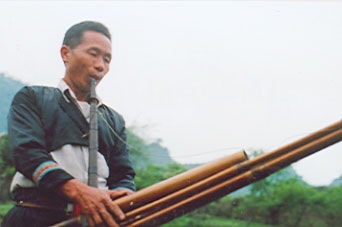 |
| Echoes of the Mountains |
It was 2004, and we reporters had the opportunity to visit Huoi Poc. We left early in the morning from the highway and didn't reach the village until late afternoon. I still vividly remember the wild sunlight of the vast forest lingering over the misty valleys. Our guide that day was Kien, an accountant at Nam Can 2 Primary and Secondary School. Kien was born in 1978. After graduating from accounting school, he came to Ky Son, determined to settle in this remote borderland. In Huoi Poc, he married a teacher from the school, and together they pursued the career of educating children. When we arrived in the village, we heard a clear, melodious Hmong song emanating from a loudspeaker in one of the villagers' houses. We didn't quite understand, but we could still feel the cheerful melody of the Hmong flute, as if it contained the dance steps of Hmong boys and girls, the babbling of a stream, and the pride of Hmong feet on the highest, most remote mountain peaks... Greeting us from the slope, the village elder, Lầu Xái Hờ, patted the camera: "This is the first time television has come to our village. The people have been eagerly waiting!" The elderly and children in the village rushed out to look at the reporters, curious about the various pieces of equipment.
We had to climb another steep slope to reach Nam Can 2 Primary and Secondary School. The school sits atop a large hill, right in the middle of the village. Therefore, Huoi Poc seems to be divided in two, and this school acts as a connecting link between the two sides. At the foot of the mountain, several teachers and village women were busily collecting small amounts of water in plastic containers for daily use. Elder Xai Ho said that water here is more precious than gold. The entire village only has a few underground springs, and at most, they can only collect a few hundred liters of water each day. To bathe, they have to travel far across several hills, where the border guard patrol is stationed. Therefore, the lives of the teachers here are very difficult. Every morning, they often recite two lines of poetry by Uncle Ho: "If you use it to make tea, don't use it to wash your face. If you use it to wash your face, don't use it to make tea," to lighten the mood of their water scarcity.
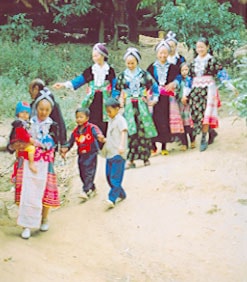 |
| Go to the market |
Nam Can 2 Primary and Secondary School was established in 2002 with the aim of providing primary and secondary education for school-aged children in Huoi Poc village. In its first year, the District Education Department changed principals three times without achieving stability, partly due to the extremely difficult circumstances in the area and partly due to ineffective efforts to encourage students to attend school. In 2003, Mr. Nguyen Van Khoa (from Nam Dan district) was transferred to become the principal, along with the addition of many experienced, young, and enthusiastic teachers. By enlisting the help of village elders and leaders to raise awareness among the people, coupled with the unwavering dedication of the teaching staff who went door-to-door to encourage children to attend school, the school initially had only one class, then gradually expanded to two, three... classes. Today, Nam Can 2 School has 350 students, including 250 primary school students. Half of the 31 teachers and staff members are volunteers from the lowlands who came to Huồi Pốc to dedicate themselves to the community. The image of these teachers has become beautiful and deeply cherished by the people of this border village. The nights we stayed were sleepless nights for Huồi Pốc; the whole village was bustling with celebrations for Teachers' Day. The villagers stopped working in the fields and expressed their gratitude to the teachers with songs, dances, and gifts of cucumbers harvested from the mountains and plump sugarcane from their gardens...
Remembering Huồi Pốc, I occasionally call Mr. Nguyễn Xuân Khoa. With that same hoarse, raspy voice, he tells me, "Why haven't you returned to Huồi Pốc in years? Now you don't have to climb the slope anymore; you can take a motorbike taxi along the border ring road, stop at the top of the hill, and then walk for 30 minutes to reach the village." I recall the firm handshake of the village head, Cử Xái Xo (now the Party Secretary): "Huồi Pốc longs for the day we can welcome a district leader to visit; the highest-ranking official to come here is the Chairman of the District Fatherland Front, journalist." I suddenly think, now that the road is open, many leaders can travel here...
Binh Minh (Provincial Police)


