
Remembering the sunshine of the Mekong Delta
The city, a blend of concrete buildings and asphalt roads, where scorching midday sun easily brings outdoor temperatures up to thirty-eight or thirty-nine degrees Celsius. We struggle to buy an air conditioner, gritting our teeth as we pay the electricity bill so that my wife, children, and I can huddle in our tiny bedroom, enjoying the artificial coolness without knowing whether we're happy or sad. Turning on the news, we're startled by reports of scorching heat exceeding forty degrees Celsius in this or that mountainous region. We remember those hot days "in the forest"...
The city, a blend of concrete buildings and asphalt roads, where scorching midday sun easily brings outdoor temperatures up to thirty-eight or thirty-nine degrees Celsius. We struggle to buy an air conditioner, gritting our teeth as we pay the electricity bill so that my wife, children, and I can huddle in our tiny bedroom, enjoying the artificial coolness without knowing whether we're happy or sad. Turning on the news, we're startled by reports of scorching heat exceeding forty degrees Celsius in this or that mountainous region. We remember those hot days "in the forest"...
I remember that dusty, red-hot midday in the far northwestern part of my province, Muong Piet and Muong Phu in Thong Thu commune, Que Phong district. The deputy chairman of the district in charge of agriculture enthusiastically said that the people there are now passionate about growing fresh, clean vegetables. They have enough to eat, and they even sell the rest along the newly opened road, part of the future National Highway 48 extension project leading to the Thong Thu border gate.
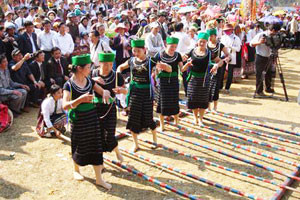 |
Children from the Quỳ Châu highlands perform the bamboo pole dance. |
And the vegetables were truly green. It's strange! Kohlrabi, cabbage, gourds, and pumpkins, naturally growing green in the fields and meadows along the stream banks for several seasons, still haven't become accustomed to the people in the newly relocated villages along the main road; not to mention the young women from Laos who crossed border marker I3 to the Vietnamese market, passing through Muong Piet and Muong Phu, their eyes wide with admiration, eagerly waiting to buy bunches of green vegetables to carry back home. That's a story I overheard at the border guard station of Post 515 three years ago. Now, back in Que Phong, when I ask about the green vegetables of Muong Phu and Muong Piet, no one enthusiastically tells the story anymore.
Further back, one late summer day in 2001, I visited Tay Son commune, a remote area in Ky Son district. The lively conversation revolved around the village elder, Vu Pa De, planting cypress trees. That day, the heat of Ky Son was nothing compared to the story of the Hmong people in our country abandoning their villages and migrating to Laos. Elder Vu Pa De ignited the Tay Son heat with his exemplary leadership, persuading countless Hmong men and women to stay and remain connected to the forest and their village.
I still have a photograph of old man Vu Pa De striding through the vast, sun-drenched forest like a border general, leading provincial leaders on a tour of the boundless, neatly arranged pine forest, standing together like a disciplined army. Nearly ten years have passed, and when asked about the story of old man Pa De in Tay Son who was so skilled at planting pine trees, some remember, others forget.
Speaking of forests and trees, I want to mention the Tam Hoa plum tree of Muong Long. The Tam Hoa plum blossoms have been dreamily compared by many to a celestial flower descended to replace the bewitching poppy that has long reigned supreme in this alluring yet mysterious "Muong Lac" land.
The day the Tam Hoa plum tree "stood" in Muong Long, a skilled Hmong man emerged who produced seedlings of all kinds of plums, pears, and peaches... That was Lau Va Giong. Now, Va Giong's fruit tree seedlings have spread throughout the Mekong Delta and even to Laos. For over a decade, the Tam Hoa plum has had no market, and neither have the peaches and pears... but Va Giong continues to diligently research and produce seedlings, and many people from various localities come to buy them. When I met Va Giong again, he still remembered me, saying that his son is now studying at a boarding school in the province. I went to visit him but was worried about the plants at home and hurried back.
It turns out that Muong Long has added elephant grass to its livestock farming, particularly cattle farming. Va Giong is enthusiastically embracing this new crop, treating it as just a service. Lau Va Giong is truly a remarkable Hmong man; his mind thinks only of, and his hands do only work with, fruit tree cultivation, as if it were his past life and will continue to be in this one. He's not a model or a model to be flashy about. He loves his village and his forest, and he works quietly. But he's achieving lasting prosperity! Just set a short-term goal: the government should secure a market for the fruit trees that have been recommended, promoted, and supported for planting in the highlands for many years. Va Giong will be one of the people contributing to the transformation of the Mekong Delta!
One sunny day, after attending the ceremony in Nam Can to award the title of Hero to the self-defense soldier and martyr Va Tong Khu, I climbed the steep slope of Set Dat to visit a remote Mong village near the border. It was so peaceful, it was hard to imagine the recent tragedy of gunfire and the loss of a Mong man. That Mong village was unique, nestled in the heart of the forest, still preserving many pure yet friendly and open customs. The villagers actively developed cattle and buffalo farming and cultivated elephant grass. There were no starving households in the village.
I don't wish for much, just a convenient road to get in, making it easier to sell my buffalo and cows. The locals say that free migration is only for bad people and lazy people; good, hardworking people wouldn't do that. Forget the sad things, let's talk about livestock farming, growing elephant grass, and wishing for a road to the commune and the district! I understand that the Hmong people have chosen a path that will keep them connected to their homeland...
I wonder if the peak temperatures in Con Cuong and Quy Chau districts can reach 41 or 42 degrees Celsius like last year? People in the city are terrified and reluctant to travel to the mountainous areas for work. But those who come down from the mountains talk endlessly about village and community matters, never mentioning the deadly heat.
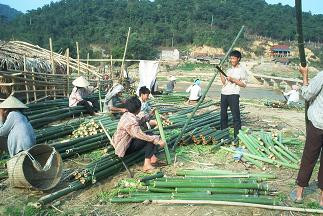 |
People in Chau Thang commune (Quy Chau district) are harvesting bamboo. |
That's something we're used to. It's hot, but the stream water remains cool, and even though the old-growth forest has been severely damaged, new trees are still being planted to salvage the ecosystem. The worry is the vast white stone quarry area in Quy Hop. With that kind of mining, exposing the rock face and core to the sun, it's unbearably hot.
But no one has died from the heat or sunstroke yet. Many have died from work accidents at the white stone and tin mines in Quy Hop. So, the heat from the sun is nothing compared to the heat caused by the indiscriminate exploitation of mineral resources, stemming primarily from lax state management, leading to significant economic losses and a loss of social security and public trust.
Whether the "behind-the-scenes" issues surrounding the quarrying activities in Quy Hop are serious or not is hard to say. But the notoriety has reached the capital. A colleague from the Young Literature and Arts Newspaper, who had just eagerly investigated and exposed some kind of resource exploitation scandal, even bringing down the leaders of a Northwestern province, called me frantically, saying, "I'm about to come and investigate the Quy Hop mineral exploitation case in your area!" I nodded indifferently. Then, suddenly, his family called to inform me that he had suffered a stroke and passed away. Now, rambling on about the sunny days of the Mekong Delta, I remember him, and feel regret...
During the dry season in the Mekong Delta, the biggest worry is forest fires. Local authorities, forest management units, and those with forests all report being well-prepared and ready to prevent forest fires. But I bet that whichever forest fire strikes, that person will be "dead."
I think that if local officials in the area where a forest fire occurs were to resign, then forest fire prevention and control would see a significant improvement. Recently, I read in the newspaper about deforestation along the Nam Non - Tuong Duong border and in some other localities.
Again, we see that in many places there are hardly any forests left to worry about fires or damage. Owners of wood processing factories, both licensed and unlicensed, are now unanimously complaining that the authorities and forest rangers are cracking down too hard. Many are automatically selling their sawmills and abandoning the business. It's gratifying to think that just ten or fifteen years ago, if illegal loggers were as intimidated by the authorities and forest rangers as they are now, then the development potential of our Mekong Delta could be truly confirmed. This is because, as a foreign expert once asserted, when talking about Mekong Delta, one must first mention the forest resources. It just goes to show that we've been too slow in taking strict action...
Our Mekong Delta region is rich in hydropower potential, notably Tuong Duong and Que Phong. With this scorching heat, running air conditioners all day costs an extra million dong per month in electricity bills. Thinking about Ban Ve, Hua Na, Khe Bo, and dozens of other large and small hydropower projects in the Mekong Delta once they're fully operational, I wonder if electricity prices will actually decrease? It's just a nagging feeling of anxiety when paying the electricity bill, and then it all comes to mind.
But there's this: at a recent meeting on the investment situation, leaders said that if we fully exploit our potential, our total hydropower capacity could reach thousands of megawatts, generating thousands of billions of dong in annual revenue.
Soon after, the tourism committee met, and there was a heated debate about the strategy of developing ecotourism in the Mekong Delta, which could generate significant revenue, but the risk of hydroelectric projects ruining it all... Who knows what to think. But there are things that really need reconsideration, such as Sao Va in Que Phong, where a small hydroelectric power plant is being built not far from the waterfall. Well, maybe I won't swim in the waterfall on sunny days anymore; I'll just stay home, turn on the fan, and dream about it!
Speaking of tourism, I recall that in the summer of 2004, I accompanied a group of tourism experts, both Western and Vietnamese, upstream along the Khang stream in Con Cuong to survey the Giua village of the Dan Lai people. They weren't relocating but intended to preserve the area for international tourism, exploiting the ecological potential of Pu Mat National Park. The scenery there was undeniably beautiful. After a relaxing midday bath, we enjoyed a meal of sticky rice cooked in bamboo tubes and boiled wild meat with a dipping sauce made from mắc khẻn (a local spice) – it was absolutely fantastic.
Visiting the village chief's house, he offered me another drink and then rambled on, saying that this beautiful stilt house was the seventh one he'd built. He said that as soon as someone asked to buy it, he'd sell it, and this one was about to sell too, and they were preparing wood for a new one. Oh my! So, preserving the people means losing the forest, and what will there be left to visit? I don't know if this is the reason, but the tourism development steering committee hasn't mentioned anything about building a dedicated tour to this supposedly preserved area. Pù Mát has Khe Kèm, but few people want to visit a second time because the service is so poor. I went to the sacred fish stream in Thanh Hóa; it was certainly unusual, but it's just fish, nothing sacred. Their service is excellent. Well-organized, large-scale, bustling, with a wide variety of products and goods... tourists flock there, and everyone spends money generously.
I'm hesitant about the sun and wind, but if I can break away from my city job to take a trip to the Mekong Delta, it's always a new and exciting experience for someone who loves to travel. Every river originates in the mountains. I've always wanted to go towards the mountains, the source of the rivers. Looking forward to a trip to the Mekong Delta in this sunny weather...
Dinh Sam


