
Remembering the Autumn Days in Thailand
(Baonghean) - The historic autumn days on the S-shaped land of Vietnam are always vibrant with heroic songs, and the red flag with a yellow star flutters everywhere. It has been more than 50 years since Vietnamese people living abroad like us returned to live in the embrace of our motherland, fully experiencing the bustling atmosphere of the country's autumn days, filled with overwhelming joy and happiness…
My parents told me that in 1946, when I was only three years old, the French colonialists, under the guise of the Allied forces and with the help of the British army, returned to invade Indochina. They launched attacks on major Lao cities such as Savannakhet, Thakhek, and Vientiane. Considering the balance of power between us and the enemy at that time, the Central Committee instructed the armed forces to temporarily withdraw to Vietnam and arrange for Vietnamese expatriates to seek refuge in Thailand. My family was living and working in Laos at the time. After hearing President Ho Chi Minh's call to "rather sacrifice everything than be enslaved," my parents and 11 children, along with over 60,000 Vietnamese expatriates in Laos, evacuated to Thailand with nothing but the clothes on our backs. My family wasn't alone; countless Vietnamese families left behind all their possessions—houses, gardens, and everything they had worked so hard to build over nearly half a century—in Laos. On the day of departure, the unwavering hatred for the invaders and the hope for a brighter future were the immense strengths, the source of encouragement, and the unifying force that bound the Vietnamese diaspora community into a united front.
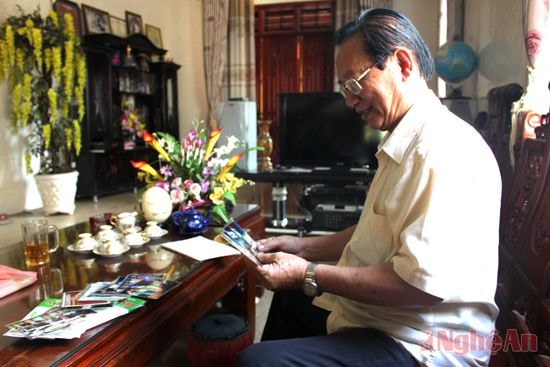 |
| Mr. Ho Ba Loc with souvenir photos from his days in Thailand. |
My parents will never forget the memories of that evacuation. Men, women, the elderly, children... they fled together, escaping the pursuit of the French colonialists. Behind them, the sound of planes circling and machine gun fire tore through the peaceful sky. In front of them was the vast, turbulent Mekong River. Groups of people boarded the lifeboats, heading towards the land of Buddha, towards a strange land, filled with anxiety and confusion, but never losing hope. This perilous and dangerous river crossing was the beginning of a new journey, full of difficulties and challenges. But thanks to the hard work and diligence of our Vietnamese expatriates and the help of the Thai government and people, life gradually stabilized. Vietnamese people in Thailand not only worked hard to sustain their lives but also saved money and resources to send back to Vietnam, contributing to the resistance.
During the autumn days, while compatriots in Vietnam joyfully celebrated the anniversary of the August Revolution and National Day on September 2nd, Vietnamese expatriates in Thailand were equally delighted. That day, everyone took time off work, organized meals and gatherings, children wore new clothes, and the atmosphere was as festive as a holiday. The altars in their homes were meticulously decorated, with a respectful portrait of President Ho Chi Minh and the red flag with a yellow star displayed. At that time, although revolutionary activities were not openly practiced, this did not diminish the joy of the Vietnamese expatriates as they looked forward to the nation's National Day. Nearly 20 years living in Thailand, I still vividly remember that joyful and celebratory atmosphere. Vietnamese people are deeply patriotic; no matter how far they travel or how long they stay, they always cherish the memory of their homeland. Geographical distance can never sever the blood ties that connect expatriates to their country, whether the nation's life is in danger or peace has been restored. We share the pain and joy of our nation.
The more joy and sorrow the Vietnamese people shared with their nation, the more determined each Vietnamese expatriate in Thailand became to work hard to support the resistance. The wealth and material goods sent from Thailand were a heartfelt expression of the Vietnamese community there. In my memory, I can never forget the moment I heard the news of our army and people's glorious victory at Dien Bien Phu on May 7, 1954. Emotions overwhelmed us; everyone hugged each other, crying and laughing at the same time, tears mixed with joy and pride. However, at that time, fearing the growing strength of our fighting forces, the Vietnamese expatriates in Thailand were increasingly oppressed by the colonialists. They could only watch the nation's joy from afar, deep in their hearts. But what does it matter? All of this only intensifies the love and longing for their homeland, urging them to live and work well, believing in a bright future that will unfold for the nation's destiny. On that day, they will return, burying their faces in the protective embrace of their motherland…
But, having escaped French colonial rule, the country once again braced itself against the invasion of American imperialism. The longing of those living abroad was once again delayed in returning to their homeland. A parting with a promise to return soon, yet after decades of separation, love and longing only grow stronger with each passing autumn. While compatriots in Vietnam celebrate the August Revolution and National Day on September 2nd, Vietnamese expatriates in Thailand share in the joyous atmosphere with their nation.
In 1960, when President Ho Chi Minh called on overseas Vietnamese to return home to rebuild the country, no one hesitated or wavered; they readily registered to return. From the beginning of 1960 to 1964, 75 ships carried more than 40,000 overseas Vietnamese from Thailand back to Vietnam. The first ship, named Anh Phuc, carrying 922 overseas Vietnamese, was organized by the Thai side and docked at Hai Phong Port on January 9, 1960, bringing back these children to their homeland after many years of separation. What no one returning home dared to imagine was that President Ho Chi Minh himself was present at this solemn and warm welcome. Upon seeing the leader's figure, the overseas Vietnamese were somewhat surprised, feeling as if they were strangers, yet it turned out they were familiar and deeply connected. President Ho Chi Minh was none other than Thau Chin from years past – the man who had shared hardships with them when they were exiles abroad, who had helped them carry bricks to build schools for their children, traded goods with their neighbors, and even fished together with them. Overseas Vietnamese were overwhelmed with joy, pride, and emotion. This was because people in Vietnam had the opportunity to meet President Ho Chi Minh when he presented the Declaration of Independence on September 2, 1945, while Vietnamese expatriates in Thailand had lived alongside him and received his guidance and education since 1928. This was the greatest comfort and encouragement for those who, though far away, never stopped longing for their homeland.
It has been over 50 years since I and other overseas Vietnamese left Thailand to return to our homeland. Our country has changed a lot, and major holidays are celebrated with greater pomp and ceremony. But one thing never changes: the love for our homeland that we Vietnamese people share. Whether in times of war and bombs or in times of peace, and although each person expresses it differently, we all share a fervent love for our country. Like our generation of overseas Vietnamese before, living in distant Thailand, we couldn't freely celebrate victory, but our love for our country and our hatred for the enemy always burned brightly. I often tell my grandchildren about the hardships of being far from home, about the history of our nation growing up amidst suffering and hardship. Having lived almost a lifetime, to return to my homeland, to see my children and grandchildren prosperous and successful, that is what my country has given me.
Phuong Thao
(Recorded based on the account of Mr. Ho Ba Loc, Vice Chairman of the Vietnam-Thailand Friendship Association of Nghe An province)


