
Remembering the screenwriter of "Sharing the Same River"
(Baonghean) On March 15, 1953, President Ho Chi Minh signed the decision to establish the film industry, but it wasn't until six years later that we had our first feature film, "Sharing the Same River." Writer Dao Xuan Tung, a native of Nghe An province, was one of the pioneering artists who contributed to writing the script for this important, landmark film in the history of Vietnamese cinema.
(Baonghean) On March 15, 1953, President Ho Chi Minh signed the decision to establish the film industry, but it wasn't until six years later that we had our first feature film, "Sharing the Same River." Writer Dao Xuan Tung, a native of Nghe An province, was one of the pioneering artists who contributed to writing the script for this important, landmark film in the history of Vietnamese cinema.
In fact, before the production of "Sharing the Same River," another feature film had been developed. However, that work was unsuccessful and was not released. The historical context at the time was that the US had invaded South Vietnam, the country was divided in two, and the Ben Hai River became the dividing line.
Following instructions from higher authorities, the Vietnam Feature Film Enterprise
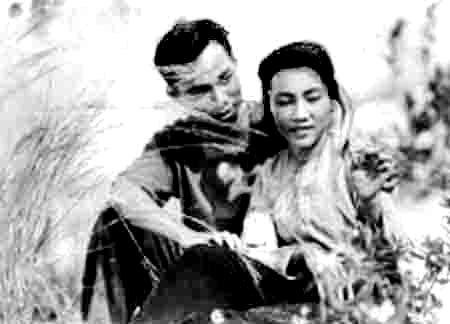
Scene from the movie "Sharing the Same River".
Thus, right from their first feature film, the filmmakers delved into a burning theme: the profound emotions of the nation. The work possessed both deep metaphors and a compelling plot, along with quite vivid characters. Of course, the film also had limitations due to the rudimentary filmmaking conditions and the lack of experience among most of our filmmakers at that time. Nevertheless, upon completion and widespread release, the film was warmly received by the people. It truly became a milestone in the history of Vietnamese feature films.
Sharing his thoughts on the question: "What led writer Dao Xuan Tung to be assigned to co-write the script 'Sharing the Same River' with Cao Dinh Bau?", Mr. Dao Xuan Lam said: Dao Xuan Tung came from a revolutionary family. His father was the founder of the Communist Party branch in Dien Chau, Nghe An in 1930. Dao Xuan Tung participated in the seizure of power in his hometown of Dien Hong, Dien Chau in 1945, and later served as the head of the information and propaganda department of Dien Chau district from 1945 to 1948.
From 1949, he served as Deputy Head of the Information Department of Nghe An province; from 1950 to 1953, he was Head of the Information and Propaganda Department of Thua Thien province. During the period 1956-1957, he studied film scriptwriting at the Truong Xuan Film Studio in China. In 1959, Dao Xuan Tung was Deputy Secretary and Head of the Feature Film Editing Department at the Vietnam Film Studio.
For nearly 30 years afterward, from 1960 to 1987, Dao Xuan Tung was in charge of scriptwriting at the Vietnam Feature Film Studio.
Outside of his work at the film studio, he always found time to write. In 1960, his novel "Early Season Longan" (co-written with Tran Thanh) was published. The book attracted the attention of many readers and became a literary phenomenon of that era. In the late 1970s, his knowledge and understanding of the early revolutionary period in Nghe An helped him, along with his close friend and fellow countryman, the poet Tran Huu Thung, to create the screenplay for the film "That Day on the Banks of the Lam River." This work was adapted into a famous film about the tenacious struggle and noble sacrifice of the revolutionary soldiers and people of Nghe An – the cradle of the Vietnamese revolution in the 20th century – against the French colonial invaders.
Dao Xuan Tung also wrote the novel "The Bell" about a Catholic region in his hometown, along with many other themes about the revolutionary war. He also harbored the aspiration to write about President Ho Chi Minh... But the circumstances of the country at that time made publishing and filmmaking very difficult. Many of his works never had the opportunity to appear before the public. And unfortunately, in 1984, during a flood, all of his unpublished works were destroyed. Dao Xuan Duong, his son, tried to dry the wet manuscripts, but because the paper was old and damaged by the rain, the ink had smudged, and there was no way to restore them.
After retiring in 1987, he returned to his hometown to live with his devoted wife. She accepted living apart from him for decades, diligently raising their six children to be successful adults. Sadly, a few years later, in the early 1990s, he suffered from a severe spinal condition that rendered him unable to walk. Thus, he had to put aside his literary and artistic dreams. So many creative plans could no longer be realized.
Once, when I returned to my hometown, I visited him. Knowing that I worked in the film industry, he inquired about my friends and former students. He also shared many thoughts about the state of Vietnamese cinema. On November 24, 2005, he quietly passed away at the age of 80. His name, however quiet it may have been, still shines brightly. And in the future, people will surely still remember him along with the creation of the immortal film "Sharing the Same River," which marked the early days of the country's feature film industry.
Tian Shan


