
Remembering Uncle Ho's Mid-Autumn Festival in prison
(Baonghean.vn) -The Mid-Autumn Festival of 1945 was the first Mid-Autumn Festival that Vietnamese children could enjoy freely in a country that had just gained independence, after more than 80 years of French colonial rule. On this occasion, President Ho Chi Minh affectionately sent a letter to the children along with many loving kisses.
Uncle Ho knows very well that this Mid-Autumn Festival, you children are all laughing and joyful, and so is your Uncle Ho. Everyone is happy for two reasons, in Uncle Ho's opinion: Firstly, he loves you children very much, and secondly, because in previous Mid-Autumn Festivals, our country was still oppressed, and you children were still a group of child slaves, but this Mid-Autumn Festival, our country has gained freedom, and you children have become the little masters of an independent nation.
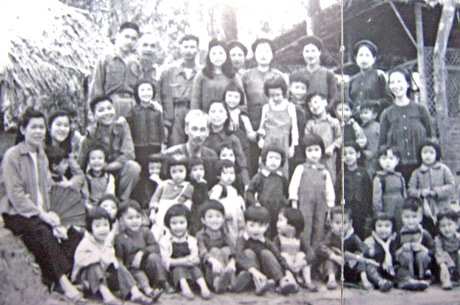
Uncle Ho visits kindergarten children on the occasion of the Mid-Autumn Festival in the Viet Bac War Zone.
The Vietnamese have a proverb, "Eat new rice, talk about old things." Celebrating the Mid-Autumn Festival of 1945 with so many significant events, many people will surely remember the arduous journey of President Ho Chi Minh during the early days of the revolution. Specifically, they will remember the period from August 27, 1942, to September 10, 1943, when he was imprisoned in 30 different prisons across 13 districts of Shaanxi Province (China), during which he wrote his book.Prison DiaryIn this work, there is also an instance where the author celebrates the Mid-Autumn Festival with a special mindset:
Mid-Autumn Festival
(Transliteration of Chinese characters)
Mid-Autumn Festival, the moon is round like a mirror.
Shining brightly upon humanity, the white light casts a silver glow.
Family reunion during the autumn festival.
The person imprisoned in prison never forgets the sorrowful man.
Prisoners also celebrate the Mid-Autumn Festival.
The autumn moon and autumn wind carry a touch of sadness.
Unable to freely enjoy the autumn moon,
My heart wanders with the autumn moon...
Mid-Autumn Festival
(Poem translated by Nam Trân)
Mid-Autumn Festival, a perfect mirror of autumn.
The whole world is bathed in a silvery light.
Everyone gathers at their own home to celebrate Tet (Lunar New Year).
Never forget the one who grieved in prison.
We celebrate the Mid-Autumn Festival in prison.
The moon and wind of the autumn night evoke a sense of melancholy.
I am not free to enjoy the moon.
My heart yearns for the distant autumn moon...
In prison, he had endured hunger, thirst, lice, and complete physical deprivation for over a month ("Mid-Autumn Festival" is considered one of two poems, numbered 22 and 23 out of 133). The Mid-Autumn Festival arrived again, the moon shone brightly across the world, outside the prison families reunited, children cheered... This scene contrasted sharply with the prison, where the prisoner was swallowing his sorrow and humiliation.
Everyone gathers at their own home to celebrate Tet (Lunar New Year).
Never forget the one who grieved in prison.
Is it a question or a reminder? In any case, that association alleviates the poet's sorrow. Here, the author doesn't create a contrast to justify his frustration or self-reproach. The first two lines of the first poem depict a space with a beautiful moon. That is a timeless beauty that can soothe the heart on wandering journeys. Therefore, the first line of the second poem makes perfect sense: "Even those in prison enjoy the Mid-Autumn Festival."
However, while in prison, and as a patriotic prisoner unjustly arrested, Uncle Ho could not help but feel sad: "The autumn moon and autumn wind carry a touch of sorrow." If an ordinary person were to be moved by the scene, they would easily become negative, leading to feelings of sadness, loneliness, or complaining, lamenting, and resentment... But prisoner Ho Chi Minh was not like that:
I am not free to enjoy the moon.
My heart yearns for the distant autumn moon.
The poem's ending highlights a great personality, which the author had already revealed at the beginning of the collection.Prison Diary"The body is in prison – the spirit is outside." The body may be imprisoned, but no one can imprison the spirit, the heart and the will of a person. It can be said that "The heart follows the distant autumn moon," as translated by Nam Tran, is a wonderful poetic idea, timeless and unparalleled.
Please note: In that concluding sentence, Uncle Ho borrowed a line from an ancient poem by Zhang Yue from China. The foreign author wrote:The heart follows the lake's waters, drifting along."Through Uncle Ho's poem, he simply replaced the two words "lake water" with "autumn moon":My heart wanders with the autumn moon."Truong Duyet's poetry depicts the sadness of being separated from a friend, a melancholy feeling like the lake's surface, while the poetry of Vietnamese revolutionary prisoners is different."
Having experienced such Mid-Autumn Festivals in prison, and then becoming a free man, especially after the country gained independence, how natural and immense was the joy Uncle Ho felt in being with the children to celebrate the Mid-Autumn Festival!
Kim Hung


