
The arduous job of "vegetable harvesting"
(Baonghean) At three or four in the morning, groups of people could be seen hunched over on the rocky outcrops and reefs along the beach, scraping seaweed (seaweed). They held a sickle in one hand, pressing it against the rock surface to scrape, while using the other hand to catch the seaweed.
"Gathering little by little makes a lot of money."
From around the end of December of the previous year to the first half of April (lunar calendar) of the following year is the season for harvesting seaweed (seaweed sprouts). People in Quynh Tien (Quynh Luu district) flock to the sea, immersing themselves in the salty water. Some harvest the seaweed to cook soup or make cakes, as it's refreshing and nutritious; others harvest it to earn extra income, as selling the seaweed brings in cash. In years of poor harvests, when fishing yields little, the whole village rushes to the beach; women and girls harvest the seaweed, and even the men and boys take up their sickles to search for it.
"To scrape the vegetables properly, you have to be brave," said Vu Thi Lien, 40, from Minh Son hamlet (Quynh Tien), clinging to a slippery rock, leaning to one side, and scraping vegetables while speaking.
Near the shore, the water spinach grows sparsely, and there are many people harvesting it. Choosing a spot with calmer waves, a few people cling to each other and wade out to a nearby beach, where the water reaches their necks, leaving everyone soaking wet. "The waves are calm like this this season, and although it's cold, it's nothing compared to what it was in December," Lien confided.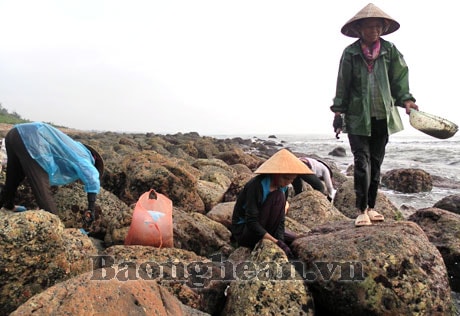
People in Quynh Tien commune are harvesting vegetables.
This job is very arduous: those with minor injuries suffer blisters on their hands from pressing the sickle against the rocks, or bleeding from oyster cuts; those with more serious injuries break their legs or arms from being tossed around by the waves... and some even lose their lives. And yet, even after harvesting the seaweed and bringing it home, the process isn't over! Getting the seaweed to the consumer is another arduous task. The harvested seaweed is rinsed briefly at sea, then brought back to be sun-dried, pounded, pounded, and sifted three or four times to remove rocks and debris. The seaweed is then soaked in fresh water, washed, scrubbed, and rubbed by hand until the water returns to its original color, and the seaweed is clean of weeds, dirt, and sand—this process takes dozens of water changes.
Currently, 1 kg of fresh harvested seaweed costs between 60,000 and 70,000 VND, while dried seaweed costs 300,000 VND. Professional seaweed harvesters only get 2-3 kg of fresh seaweed per trip. Therefore, during their free time, the women in Quynh Tien fishing village take advantage of the opportunity to make seaweed cakes to sell. Each time they steam and pack the cakes, it takes several hours. 150,000 to 200,000 VND is the income from at least one harvest, one cleaning session, and one arduous day cycling dozens of kilometers to sell at the markets.
The work is hard done, yet even that is precarious, because vegetables don't always grow on schedule. For example, this year the drought has caused the vegetables to grow late, be scarce, and stunted, making the vegetable harvesting business even more difficult.
Fate...
The people of Quynh Tien coastal village still recount the tragic accidents their villagers suffered while harvesting seaweed. But because of the need to earn a living, every seaweed harvesting season they brave the mud, wading through the water and clinging to the rocks to harvest.
Having toiled in this profession for over 40 years, Mrs. To Thi Ly in Minh Son hamlet (Quynh Tien) can't remember which generation in her family has pursued this trade. At just 10 years old, she had to walk hundreds of kilometers with her parents to harvest vegetables. After getting married and having children, her small family relied solely on the vegetables they harvested.
Having traveled to various beaches along the Quỳnh Lưu coastline to harvest seaweed, such as Quỳnh Lập, Quỳnh Bảng, Quỳnh Lương, Quỳnh Nghĩa, Quỳnh Long..., she understands the nature of each tide and the characteristics of each beach better than anyone else. While nimbly harvesting seaweed and glancing at the waves, Mrs. Lý confided: "There are two low tides a month, and regardless of the time, whenever the tide is low, we go out to sea."
According to Ms. Ly, when harvesting seaweed, one should never turn their back on the sea, because fierce waves can crash at any time. A moment of carelessness on the part of the harvester can cost them blood, tears, or even their lives. Even now, she is still shaken when recounting the story of the woman who was harvesting seaweed with her and was unexpectedly swept away by the waves two years ago.
For example, Mrs. Ly's husband, Mr. Mai The Vinh (54 years old), was harvesting vegetables in the Trap field (Quynh Lap) when a piece of sand flew into his eye. After nearly a year of treatment at hospitals in both the North and South, and two surgeries at the Central Eye Hospital without success, in September 2012, he had to have one eye surgically removed, costing him nearly 80 million VND.
Mrs. Ly and her ailing husband still work tirelessly to pay off their debts, as their two daughters are now married. In her fifties, with gray hair and wrinkled skin, this arduous and difficult profession continues to cling to her life.
Since Tet (Lunar New Year), she and her sister-in-law, To Thi Can, have cycled three times along the breakwater to Cua Lo to harvest vegetables. Her tools for making a living are very simple: a small plastic basket, a homemade sickle, and a few bags; her belongings consist only of the clothes she wears, a spare set, a work shirt, worn-out sandals, and a faded hat; plus a few kilograms of rice and a pot of braised fish.
Each trip usually lasted five to seven days. The two women would eat a bowl of leftover rice before setting off at dawn. When they were hungry, they would eat the rice and potatoes they brought along, only returning to their lodging late in the afternoon. Despite the hardship, sometimes they returned empty-handed, and other times they only had enough money for medicine. Because of the long-distance cycling and the falls from the slippery surfaces while harvesting vegetables, in addition to the numerous fresh and old wounds on her legs, Mrs. Ly also suffered from persistent, chronic joint pain.
I visited the seaside village one late spring afternoon and learned that Mr. Minh, Mrs. Ly's husband, had been ill since returning from the hospital and could no longer go harvesting vegetables. A friend from somewhere in Yen Thanh had hired him to herd ducks in the fields. Mrs. Ly, having just finished making a batch of cakes to sell at the market, quickly prepared betel leaves and mugwort soaked in alcohol to apply to her leg. She said, "I hope my leg heals quickly so I can go harvesting vegetables again." And this time, her rickety, rusty bicycle became her companion, traveling dozens of kilometers all the way to Thanh Hoa province…
Seaweed is a highly nutritious food. Besides protein, seaweed contains many minerals, vitamins, and valuable trace elements. In particular, seaweed has a very high iodine content. Porphyra is one of the three most popular types of seaweed. Porphyra is a coffee-brown plant with a soft, cartilaginous stem, growing in clusters at the top. It grows on rocky reefs and seabeds, and is often harvested by locals for use in soups. |
Nguyen Thi Hoe (Quynh Luu)


