
The elderly women who 'carry the trumpet' in the border commune.
(Baonghean)In Mon Son commune (Con Cuong district), out of 13 villages, 8 have female Party branch secretaries and 3 have female village heads. In two villages, both the Party branch secretary and the village head are women. This is a rare occurrence in mountainous areas where the role of women is not yet fully recognized.
The old woman has been "carrying the trumpet" for 20 years.
For the past 10 years, Ms. Ha Thi Thin has been elected as the Party Secretary of Lang Xieng village, Mon Son commune (Con Cuong district). Prior to that, she served two consecutive terms as the head of the village women's association, each term lasting 5 years. Therefore, Ms. Thin has been a village official for 20 consecutive years, a feat not many Thai women in highland villages can achieve.
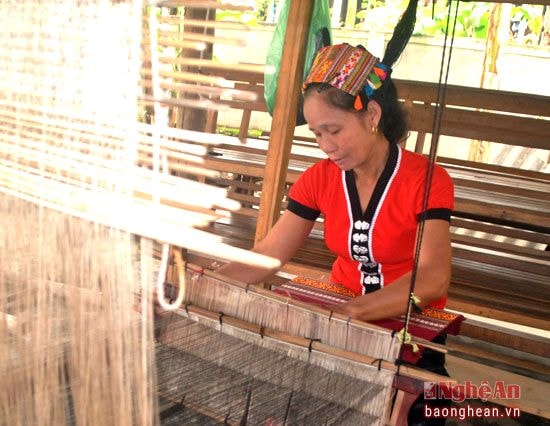 |
| Party branch secretary Ha Thi Thin is also a skilled brocade weaver in Lang Xieng village. Photo: Huu Vi. |
Recently, Xieng Village became the first village in the district to be recognized as a traditional craft village: the Xieng Village Brocade Weaving Village. Nearly a decade ago, she and the members of the management board mobilized the women in the village to revive the brocade weaving craft, which was on the verge of disappearing.
Initially, there were only a few supporters, then a handicraft production facility was established. Now, the facility has been recognized as a traditional craft village. This is a great joy for someone like Ms. Thin, who played a leading role in the movement in its early days.
This is just one of the many joyful events throughout the 20 years of hard work undertaken by this woman living in a multi-generational household. Now a grandmother, Mrs. Thin still wakes up at 2 a.m. every day. Her first job is weaving to contribute products to the village's craft. The clicking sound of the shuttle is a familiar sound in this small Thai village along the picturesque Giang River. Around 5 a.m., the 53-year-old woman lights the fire to prepare breakfast for the whole family.
As the sun rose and breakfast was finished, Mrs. Thin went to the river to feed the fish. For over a year now, her family has participated in a cage fish farming model on the Giang River. Her family also manages a 10-hectare forest and 6000 square meters of rice paddies, cultivating two crops per year.
The management team is predominantly female.
About ten kilometers from Xieng Village is Bac Son village. In this Thai ethnic village, positions such as Party branch secretary, village head, head of the Elderly Association, head of the Farmers' Association, and statistician are all held by women. They occupy a plot of land approximately 3000 square meters.2 On the outskirts of the village, Party branch secretary Nguyen Thi Nhuan and her husband are putting up a fence around their garden to prevent chickens from destroying their newly planted corn. This woman, who looks more weathered than her 32 years, leads a Party branch of 12 members in Tan Son village. Having started as a women's association leader, Ms. Nhuan was elected Party branch secretary in September 2016.
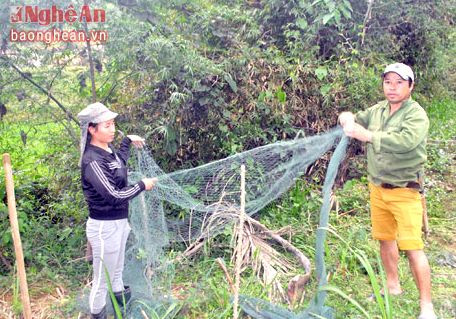 |
| Nguyen Thi Nhuan, Party branch secretary of Bac Son village, and her husband are engaged in agricultural production. Photo: Huu Vi. |
Ms. Nhuần said: "Even though I'm a village official, my family is still classified as near-poor. In this small border village, the percentage of poor and near-poor households remains high, so the role of the community leader is even more important."
During her nearly six months as Party branch secretary, Ms. Nhuần successfully implemented a model for corn cultivation among the local people. The model was funded by TH Milk Factory, which provided everything from seeds and fertilizers to guaranteed product purchase. From the tasseling stage to the young ear stage, the factory would buy the corn from the farmers. Thanks to this initiative, many rice fields that previously only yielded one crop due to water shortages have found a new direction to increase income for the villagers.
A short distance from Ms. Nhuần's house is the small house of village head Vi Thị Đại. She is highly regarded by the community as a proactive and enthusiastic person, always taking charge of village affairs. Because of her straightforward nature and consistent actions, this woman, who has three sons-in-law, has been trusted and elected to lead various village organizations for over three years now.
Like Ms. Nhuần and most other female village heads in the commune, Ms. Vi Thị Đại, who had served as the head of the women's association for 14 years, was already familiar with the work of a village official. However, when she was assigned the new task, she initially felt pressured because the work of the village took up more of her time than her family. Thanks to the understanding of her children, she overcame the challenges and successfully fulfilled her role as the village leader.
For Ms. Nhuần and Ms. Đại, the task of developing their village remains fraught with difficulties. Many roads in Bắc Sơn village are still unpaved, making travel extremely challenging. Most of the villagers' agricultural land is located on the other side of the Giăng River. Crossing the river to reach their fields and farms requires using motorboats or rowboats. The villagers are striving to overcome these hardships. As village leaders, the two women understand better than anyone their role in helping their fellow villagers overcome these challenges.
I want to escape poverty to set an example for my people.
On our way back, we visited Khe Lo village. This is also a village where both the Party branch secretary and the village head are women. Despite facing many difficulties as a Party member, since the end of 2016, Ms. Luong Thi Tam has been elected as the village Party branch secretary. This young woman, born in 1984, discussed with her husband the possibility of withdrawing from the list of impoverished households.
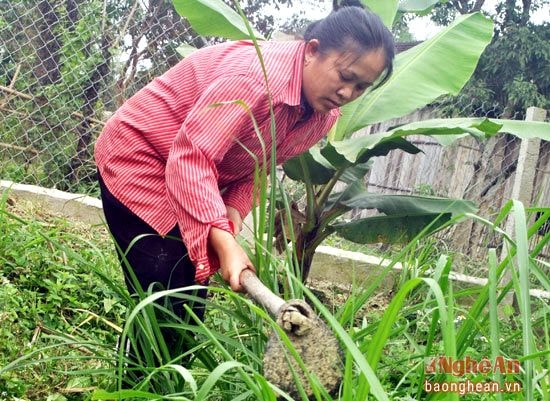 |
| Ms. Luong Thi Tam, a young "auntie," was elected Secretary by the Party members in the branch in September 2016. Afterward, she persuaded her family to submit a request to be removed from the list of impoverished households. (Photo: Huu Vi) |
In the hazy midday sun, with a hoe in one hand tending to her banana plantation, Ms. Tam recounted her family's story. She got married in 2004. Their finances weren't particularly good, but she and her husband worked hard together. Their small plot of land barely provided enough rice for their family. Determined to stay in her village rather than seek work elsewhere like her peers, Ms. Tam accepted the position of head of the women's association in her village in 2009.
Thanks to this, she had more exposure to the government's economic development policies for particularly disadvantaged areas and participated in agricultural training courses. By applying production techniques, her family's economic situation improved, but according to the criteria, they are still not out of poverty. "Even so, I'm determined not to be on the list of poor households anymore," Ms. Tâm said with unwavering resolve.
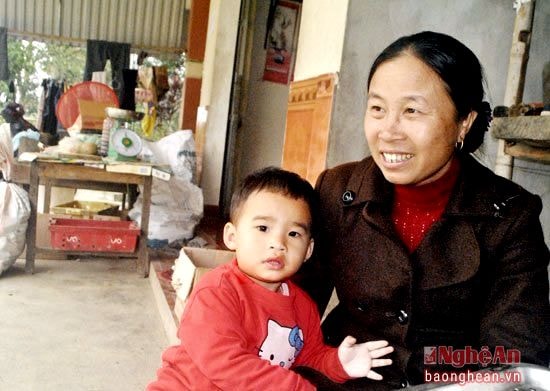 |
| Village head Vi Thi Dai with her granddaughter. Despite being 45 years old, she remains highly respected by the villagers for her energy and enthusiasm in carrying out her duties as the village chief. Photo: Huu Vi |
Speaking about the story of Ms. Tam's family applying to be removed from the poverty list, Ms. Vi Thi Viet, head of Khe Lo village, shared: "Although they are still facing difficulties, considering that both husband and wife are in their prime working age, Ms. Tam submitted the application to be removed from the poverty list to set an example for others to follow. Because in the community, there are still many people who want to rely on the government's poverty alleviation policies."
Bidding farewell to the female village officials in Mon Son border commune, we felt a strange sense of joy. For them, fulfilling their leadership roles at the village level was by no means easy. But everyone shared a common goal: to strive for the community, aiming to contribute to the development of this particularly disadvantaged commune in all aspects.
Huu Vi
| RELATED NEWS |
|---|


