
Surprises in the grading of the national high school graduation exam.
The grading committee for the 2017 National High School Graduation Examination in Literature began its work. A teacher considered a "killer" was assigned to grade the first round. He worked seriously and diligently, but after the first few papers, the grading committee decided... to replace him!
That story made a strong impression on Mr. NT, a literature teacher in Ho Chi Minh City, during his participation in grading the national high school graduation exam over the years.
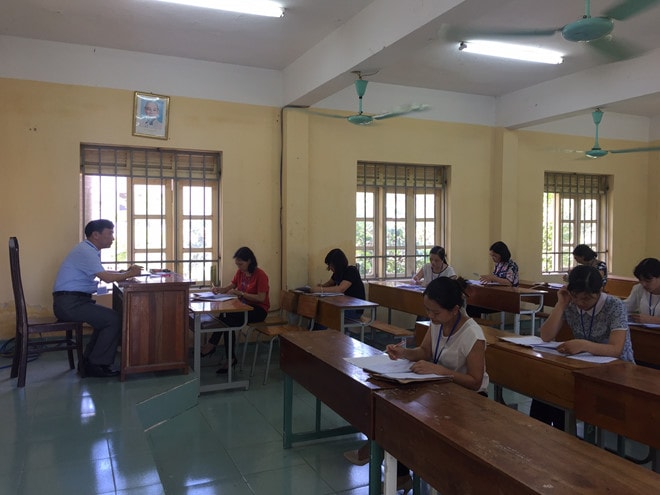 |
| Teachers grading the 2018 National High School Graduation Examination in Hung Yen province. Photo: Tue Nguyen |
The examiner is too strict, we need to change them!
According to the essay grading procedure, each exam paper is usually graded in two independent rounds in two different examination rooms. The first grader grades on an individual grading sheet, while the second grader grades directly on the exam paper and records the score on a score sheet.
The story of the teacher mentioned above lies in the fact that he graded... too strictly! The scores he gave in the first round of grading consistently differed significantly from those given by his colleagues in the second round. When such discrepancies arose, the grading committee had to reconvene. Ultimately, the committee chose to... replace the teacher who graded the papers.
According to many teachers, grading Literature, the only essay-based subject in the national high school graduation exam, is quite stressful, so many avoid the task when assigned it. In recent years, teachers' enthusiasm has decreased significantly as the work is stressful but the remuneration is not commensurate.
In previous years, when all subjects were tested using essay questions, with a large number of exam papers, many incidents occurred. In 2008, when inspectors from the Ministry of Education and Training checked the grading process at Ton Duc Thang University and Ha Tay Television College, they found that the two schools were not grading according to regulations. Specifically, teachers graded too many exam papers too quickly in a short time, failing to follow all the steps stipulated by the Ministry. The Ministry's inspectors ordered both schools to re-grade their exams.
The exam paper is too dirty, the machine can't grade it!
The grading of multiple-choice tests relies heavily on automated grading machines. Because the machines grade the tests, errors in the test papers can sometimes prevent the machine from recognizing them. This will result in the student losing points.
In the 2012 high school graduation exam, a student in Ho Chi Minh City scored 2.5 points in English. After a review and re-marking by machine, the score remained unchanged. However, when re-marked manually, the student received a perfect 10. The explanation given was that the student's answer sheet was shorter than others, preventing the machine from recognizing it!
Most errors can be corrected and rescanned on a computer after comparison with the candidate's original work. However, some exam papers cannot be rescanned because the machine cannot recognize them. For example, an exam paper with an error... that's too dirty! This error occurs when the candidate's hands are dirty, and they press too hard on the paper while writing.
The deputy head of the training department at a university in Ho Chi Minh City said this is why candidates taking the exam are carefully instructed to use a 2B pencil because this type of pencil has the best smoothness and gloss. Experience shows that the better the pencil shading and the cleaner the paper, the fewer errors there will be when scanning.
However, sometimes the fault lies with the machine! Dr. Nguyen Duc Nghia, former Deputy Director of the Vietnam National University Ho Chi Minh City, recounted a year when all the multiple-choice tests entered into the machine malfunctioned and could not be recognized. Later, the reason was determined to be that the answer sheets given to the candidates were too thin. The technical department had to adjust the sensitivity of the "electronic eye" to grade them.
Collaborating in exam grading fraud.
There have been numerous cases of cheating related to exam grading. The most egregious was the exam cheating scandal that occurred in three provinces – Ha Giang, Son La, and Hoa Binh – in 2018. This was one of the worst irregularities in the history of national education, with over 200 candidates having their scores altered. As a result, nearly 20 education administrators, teachers, and police officers were prosecuted and detained for investigation, including three deputy directors of provincial Departments of Education and Training. Unimaginably, the buying and selling of exam scores also occurred.
In 2011, a "collusion" to loosen grading regulations occurred in the Mekong Delta provinces. At that time, leaders of the Departments of Education and Training in 11 provinces and cities in the Mekong Delta region met, discussed, and agreed to issue separate grading guidelines for the region, leaning towards a more lenient approach. All essay-based exams in both the high school and continuing education systems had "special" grading guidelines.
The reason for such a large-scale meeting involving multiple departments is that at this time, provinces are not grading the candidates' exam papers themselves but are instead cross-grading them among themselves. After the meeting, one teacher felt frustrated and sent information to the press to voice their concerns.
A former leader of the Ministry of Education and Training who directly handled the matter recounted that the situation was extremely tense at that time. Public outrage was at its peak. The Ministry of Education and Training was even more stressed when information emerged suggesting that this "collaboration" had been approved by the Ministry.
Immediately after receiving the information, the then Deputy Minister of Education and Training, Professor Bui Van Ga, flew to the Mekong Delta and requested a meeting of the Directors of the Departments of Education and Training and the Vice Chairmen of the People's Committees in charge of culture and social affairs of the relevant provinces. The provinces reported on the entire situation. The results showed that in these provinces, some did not follow the "agreement" but still graded according to the Ministry's guidelines.
Deputy Minister Bui Van Ga requested that provinces conduct a review of the grading process. If the exam papers are graded more leniently than the Ministry's answer key, they must be re-graded.
Hand over the examination grading facilities and equipment before June 24th.
Mr. Mai Van Trinh, Director of the Quality Management Department, Ministry of Education and Training, inspected the preparations for the 2019 National High School Graduation Examination in several provinces and cities. Mr. Trinh made several important remarks regarding this year's exam, including the grading process.
Mr. Trinh noted that for the exam grading area, especially for multiple-choice exams, the Departments of Education and Training need to equip the universities with all necessary facilities in accordance with regulations. Attention must be paid to equipping the computer systems for grading multiple-choice exams to ensure compliance with regulations. The handover of facilities and equipment for grading multiple-choice exams to the universities responsible for grading must be completed before June 24th.
For essay-based exams, it is necessary to completely isolate the process of assigning codes to answer sheets, and to randomly draw lots to divide the grading bags, with two independent rounds of grading. Note that at least 5% of the Vietnamese language exam papers must be checked, with high-scoring papers being selected for verification.
For the marking of multiple-choice tests, it is recommended that the necessary facilities be prepared, and all test marking data be encrypted as it is completed, with universities taking the lead. The marking area and the area for storing and preserving test papers must be strictly managed.
Mr. Trinh also noted that handling unusual situations during exam supervision and grading requires adherence to three basic principles: absolutely no concealment of information from the examination room, information must be relayed to the head of the examination center/chairman of the examination board by the supervising officer, and the regulations must not be exceeded; the interests of the candidates must be prioritized over the interests of the invigilators.
If the score is lower than the inspector's mark, the examiner will have to provide an explanation.
Ms. Duong Minh Phuong, Head of the Literature Department at Truong Dinh High School in Tien Giang, with 11 years of experience in grading exams, shared: “Before grading, the Literature grading committee holds a meeting to review the answer key and grading guidelines to minimize discrepancies among examiners. While other subjects usually have quick meetings, Literature always takes the longest due to its unique characteristics. We have to come up with various approaches to ensure we can grade while remaining flexible and adhering closely to the answer key. Typically, each examiner will spend about 5-7 minutes grading each exam, depending on the length and speed of the essay.”
According to Ms. Phuong, there are some exams where two examiners give different scores. If the difference is less than one point, the two examiners will discuss and agree on a suitable score. If the difference is more than one point, the team leader and deputy team leader must give their opinion. "Occasionally, situations arise where an examiner is summoned by inspectors to...""Explanation is required. For example, typically 25-30% of exam papers are graded by the inspectors. If the examiner's score is lower than the inspector's score, to avoid disadvantaging the candidate, the examiner will have to explain why they graded so strictly. In unusual cases, such as when the score difference is too large, the matter must be brought before a council for a vote (120-130 examiners)," Ms. Minh Phuong shared.
Regarding multiple-choice exams, Dr. Tran Thien Luu, Head of the Training Department at Ho Chi Minh City University of Transport, stated that equipment is the most important factor. Therefore, preparation involving technical elements is crucial. Dr. Luu observed: “We must check the resolution beforehand, because if it doesn't meet the standards, color recognition will not be complete. The grading process will go through four parts: scanning, image reading, error correction, and grading after submission of answers. If the scanning process is not up to standard in terms of resolution and color accuracy, then image reading will be affected.”


