
Deceptive tactics of Chinese brands
(Baonghean)Goods originating from China are increasingly being boycotted by consumers in many countries due to their poor quality and safety. In response, Chinese businesses have devised sophisticated schemes to deceive customers about the origin of their products.
Mr. Trung's family in Quy Hop town bought a LUCKY brand car and motorcycle washer with all the labels in English. The product's origin, as stated by the distributor in Vietnam, was "Made in PRC." Mr. Trung was convinced it was from a Western country, but upon reflection, seeing the low price (2.2 million VND), he consulted a foreign language student and learned that "PRC" stands for "People's Republic of China," the English abbreviation for the People's Republic of China; and the "Italy Style" label meant "Italian design." In other words, Mr. Trung had bought a genuine Chinese product!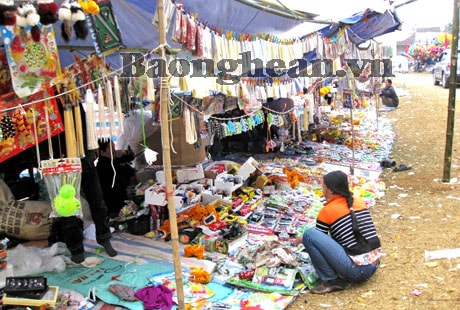
Chinese goods of unknown origin were widely sold at the Hang Bua Festival in 2012.
In another case, Ms. Thanh Truc in Cua Nam ward (Vinh City) intentionally looked for a mosquito racket labeled "High-Quality Vietnamese Product" when buying one, even though it was about 10,000 dong more expensive than a Chinese product. However, upon checking at home, she found it was from VINACO Company, a small import-export business. The design and features of the mosquito racket were identical to the Chinese product. Ms. Truc believes she bought a Chinese product disguised as a Vietnamese product. Previously, when cheap Chinese motorcycles flooded Vietnam, exploiting the Vietnamese preference for branded goods, a Chinese company produced motorcycles under the HONGDA brand, which at first glance looked like HONDA motorcycles (Japan). Similarly, Mr. Quang Dung in Vinh City, when buying a notebook from a bookstore, found no indication of the country of manufacture. Upon returning home, he noticed the notebook was of very poor quality (the paper was illegible, falling apart), and then he noticed a small piece of paper with the product code according to international standards. When he peeled off this piece of paper, he saw the words "Made in China".
Faced with consumer caution and boycotts of "Made in China" products, Chinese manufacturers have devised a new method: labeling products with the origin as "Made for + brand name + country name." For example, "Made for Wall-Mart, USA," meaning made for Wall-Mart in the United States. Another method is printing "Packaged in + USA," meaning packaged in the USA. These boxes may still bear the "Made in China" label (according to international law), but it's printed in very small font, in an inconspicuous location. Consumers, seeing the large "USA" text, mistakenly believe the product was made in the USA. Alternatively, a large package might be labeled "Made in China," but when the individual products are unpacked and displayed in supermarkets, the label disappears, thus deceiving consumers.
Another trick is importing Chinese goods into Vietnam, removing the "Made in China" labels, and replacing them with "Made in Vietnam" labels. For example, on December 1, 2011, anti-smuggling forces of Dong Nai Customs caught Tianhua Company (located in Dong Nai), a wholly Chinese-owned company, affixing Vietnamese labels to 100 packages of goods originating from China for export to evade taxes. Customs also discovered a business in Da Nang and another in Tay Ninh exporting hundreds of tons of honey of Chinese origin to the US but declaring it as Vietnamese. This fraudulent practice seriously damages the reputation of Vietnamese goods in the international market, especially specialized products like honey, and more fundamentally, undermines national prestige. The phenomenon of Chinese goods disguised as Vietnamese goods rampant in the domestic market has also been reported by many newspapers.
Vietnamese consumers often don't thoroughly research products before buying them and tend to choose cheap products, making them easy targets for Chinese manufacturers. According to the Law on Consumer Protection, effective from July 1, 2012, manufacturers and distributors are obligated to provide complete and accurate information about the origin, quality, and features of their products, as well as warning consumers about potential dangers. The law also strictly prohibits deceptive or misleading practices through advertising that conceals, provides incomplete, false, or inaccurate information about goods.
I believe that, in addition to strengthening the legal framework to protect consumers, every citizen should be a "wise consumer," knowing how to protect themselves from deceptive information from some manufacturers, especially those from China, and actively supporting Vietnamese goods. By 2015, the ASEAN-China Free Trade Agreement, with its 0% import tariff on many goods, will create conditions for goods from other countries, especially China, to flood the domestic market. Vietnamese manufacturing businesses will face significant difficulties. Therefore, it is necessary to provide information about goods, products, and services from China so that people understand them clearly, while actively promoting Vietnamese goods and brands to consumers.
Tran Quang Dai


