
Female teachers in their 20s go to the fields to find students.
(Baonghean.vn) – They are young people who travel hundreds of kilometers through the forest to the most remote villages in the highlands of Nghe An province to teach.
Life in a place with "three no's" (no food, no shelter, no water, no air ...
From Hoa Binh town, it takes about 50 km of mountainous road to reach Minh Thanh and Cham Puong villages, which are part of Xa Luong Primary School (Tuong Duong). Floods have caused many landslides along that route; if it rains heavily, no one would dare pass through because of the mud and slippery conditions.
Minh Thanh school has 4 classes with 36 students but only 4 female teachers. They are all very young, the oldest born in 1990 and the youngest in 1995. Life in this "three no's" village (no roads, no electricity, no phone signal) is incredibly difficult.
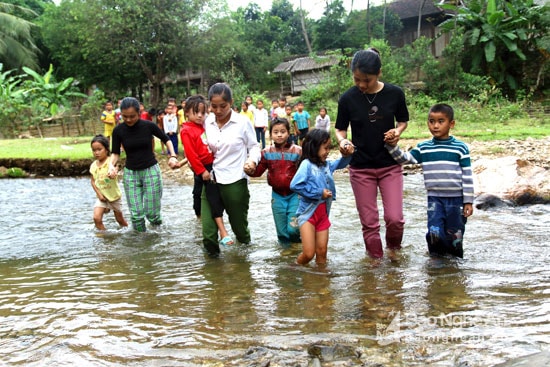 |
| Teachers in Minh Thanh village help students cross the stream to get to school. Photo: Dao Tho. |
Every day, the teachers here have to wake up early in the morning to go to the stream to welcome the students. The Mat stream separates the 34 students on the other side, making it impossible for them to get to school whenever the water level rises.
On normal days, the younger students have to be carried across the stream by their teachers to get to school. Ms. Vi Thi Thuy Mo, a contract teacher here, said that for the safety of the children, the teachers have to be on duty every day to ensure the children arrive at class safely.
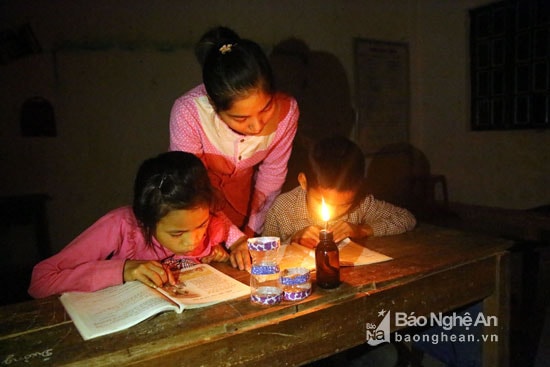 |
| The teachers help students study at night. Photo: Dao Tho |
The simple meal consisted only of wild vegetables and a few salted fish that the women had stockpiled since the beginning of the week, but it tasted delicious, because, according to them, the lives of the local families were much harder.
After quickly finishing their evening meal, the teachers prepared to light their lamps and head to the stream to welcome the students to class. In the classroom, each teacher was in charge of a class, meticulously guiding them from spelling to writing and arithmetic.
Despite the pungent smell of burning oil emanating from the oil lamps, the teachers continued to work diligently on their textbooks. Ms. Kha Thi Thu, a teacher born in 1990 who traveled 50 km from Tam Thai commune to this remote village, shared: “At night, without electricity, we sometimes buy candles, and when the candles run out, we ask parents to contribute oil so the children can come to school. If the children stay at home, their parents can't teach them… as a result, the quality of their learning is improved.”
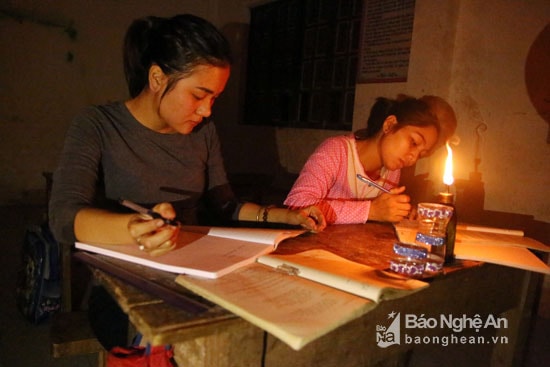 |
| Every night, teachers stationed in remote villages work diligently by the light of oil lamps. Photo: Dao Tho |
After the school bell rang, the girls gathered in the small room. Four of them huddled together, working on paperwork by the light of an oil lamp. Tran Thi Quynh Trang, a recent graduate assigned to this school, said that when she first received the assignment to trek through the forest alone to get to school, she was trembling. There was no electricity, the phone signal was intermittent, and the four of them were crammed into a small room...
Going into the forest to find the student.
At the Cham Puong school, life is somewhat better, but it is the most remote school. Electricity remains a distant dream for the people and teachers here. This village has the largest number of students in Xa Luong commune with 98 children, but the classrooms are still makeshift. The school has to use a teacher's room as a classroom for the children.
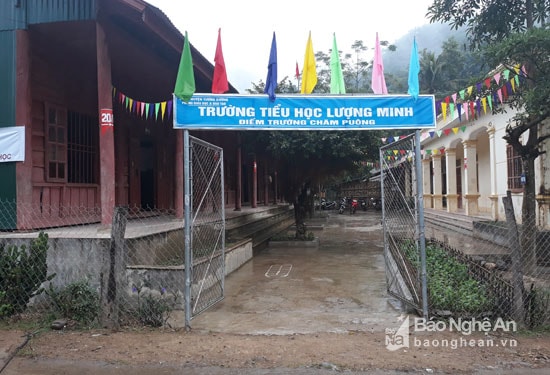 |
| Xa Luong primary school in Cham Puong village. Photo: Dao Tho |
By the light of an oil lamp, young teacher Vi Thi Mien, born in 1991, recounted that although she graduated a long time ago, she is still under contract with the school. She clings to her profession and continues her mission of teaching, but many times she and her teachers have to go searching for students.
Especially during the rice harvest season, students would go with their parents to the fields and stay for weeks at a time. During those times, the teacher would have to trek through the forest and cross streams to find them and bring them back to school.
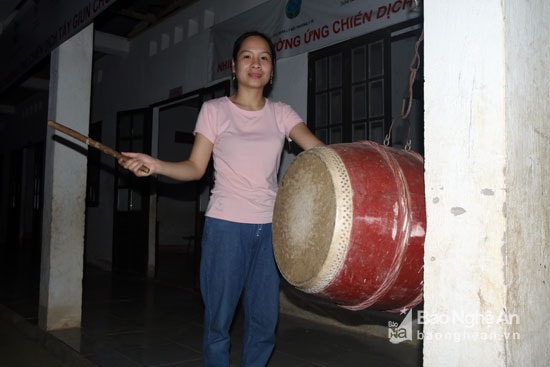 |
| These girls are also the ones who play the school drums. Photo: Dao Tho |
According to teacher Miền, just yesterday, after finishing her lesson, she hurriedly packed some rice wrapped in banana leaves and went into the forest to encourage her students to come to school. Lữ Thị Như had been absent for four days, which worried her greatly because if she didn't come to school, Như wouldn't be able to keep up with her classmates.
She had planned to leave at lunchtime so she could get back in time for her afternoon work, but the mountain road grew longer and longer, and she became increasingly tired. After more than two hours of trekking through the forest and crossing streams, drenched in sweat, Ms. Mien finally reached the small hut where the student's family was harvesting rice.
After much persuasion and negotiation, Nhu's parents finally agreed to let the teacher take their daughter back to school. It took another two hours for the teacher and student to reach the village, just as dusk was falling. "When we got back to school, all I wanted to do was lie down; I didn't even want to eat, but thinking about bringing the students back to school made me happy," Ms. Mien said with a smile.
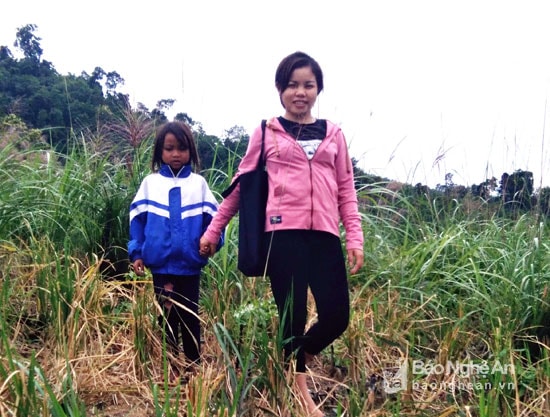 |
| Teacher Vi Thi Mien goes to the fields to bring her students back to school. Photo: Dao Tho. |
Ms. Dinh Thi Hoa, Deputy Principal of Xa Luong Primary School, also shared: “Not only teachers stationed in remote villages, but many teachers from the main campuses of the school also frequently go into the forest to encourage students to return to class. Sometimes it takes a whole day to bring the children back to school so they can continue their studies...”
Despite facing numerous such difficult circumstances, the teachers in remote villages in western Nghe An province, driven by their love for their profession and their students, continue to work tirelessly day and night, dedicated to their students and literacy. Overcoming all obstacles, they always find happiness in standing on the giảng platform.
"The precarious life of a teacher who has spent 15 years 'stationed in a remote village'"
Dao Tho


